
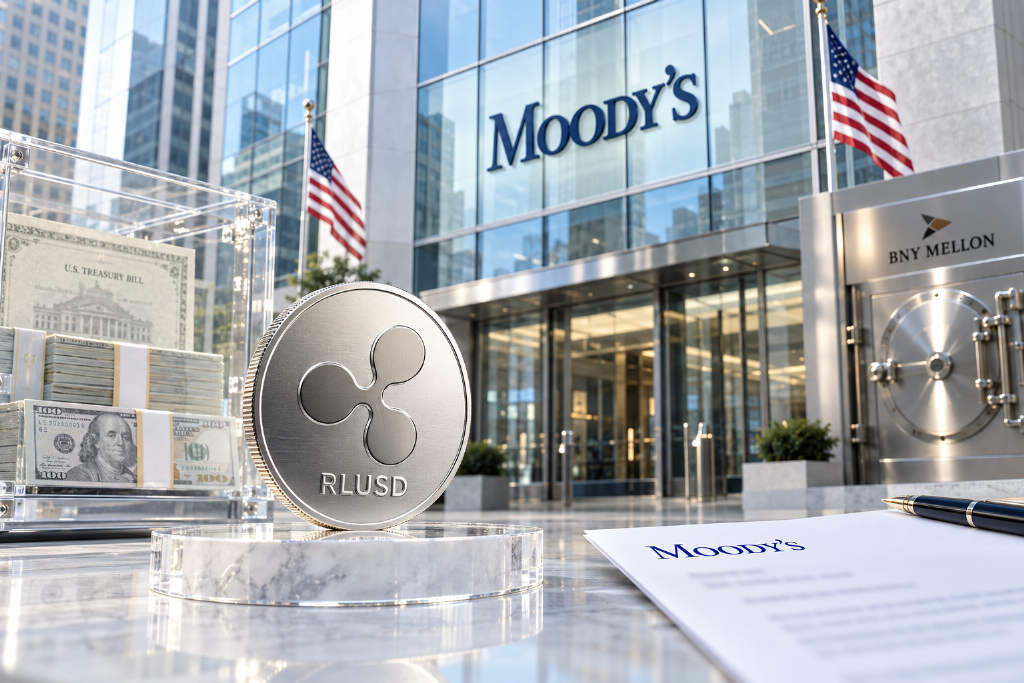
Moody’s Ratings has assigned A2 long-term and P-1 short-term deposit ratings to RLUSD, the U.S. dollar stablecoin issued by Ripple. Both ratings fall within investment-grade territory, making RLUSD the first stablecoin to receive an investment-grade rating from Moody’s, according to the provided report.
Moody’s applied its stablecoin rating methodology
Moody’s said the rating decision was made under its stablecoin rating methodology published in March 2026. The review focused on the credit quality and market value of reserve assets, reserve coverage, liquidity, and redemption arrangements.
The agency also evaluated reserve segregation and third-party custody, while reviewing structural conditions across operations, technology, legal setup, and regulation. Moody’s said the short-term P-1 rating is aligned with the long-term rating, reflecting its view that RLUSD’s short-term payment capacity is consistent with its medium- to long-term credit profile.
Reserves are concentrated in short-duration U.S. government assets and cash
According to Moody’s, RLUSD’s reserves are invested mainly in highly liquid, short-duration U.S. government assets and cash. Standard Custody & Trust Company, identified in the report as the issuing side, targets a 103% reserve coverage ratio, above the minimum level associated with the rating.
Moody’s said the largest share of RLUSD reserves is held in U.S. Treasury bills, other short-duration U.S. government assets, and cash. The reserves are custodied by Bank of New York Mellon (BNY), which carries an Aa1 rating.
GENIUS Act and downgrade triggers were part of the review
Moody’s also took into account the GENIUS Act, which is set to take effect in January 2027. The agency said the law would strengthen protections for reserve assets and stablecoin holders, including separating statutory reserves from an issuer’s bankruptcy estate.
At the same time, Moody’s said the rating could be lowered if the credit quality or market value of reserve assets deteriorates, if reserve coverage declines, or if liquidity and redemption capacity weaken.
Ripple executive calls the rating a major validation
Jack McDonald, senior vice president of stablecoins at Ripple, said on X that RLUSD is the first stablecoin to obtain an investment-grade rating from Moody’s, calling it a 「major validation」 for the project.
The timing is notable. The rating arrived shortly after the Office of the Comptroller of the Currency, or OCC, gave final approval earlier in the week for Ripple’s national trust bank. Based on the provided text, that federal charter can manage the segregated reserves backing RLUSD, act as collateral trustee for those reserves, and provide digital asset custody services.
Why the rating matters
Stablecoin issuers have talked about reserve sufficiency for years, but the market has largely relied on third-party reports published by issuers themselves, with differing formats, reporting frequency, and accounting bases. The report argues that the involvement of a rating agency turns those disclosures into a comparable credit judgment.
RLUSD launched in December 2024 and currently has a market capitalization of about $2.5 billion. Ripple said the token is used mainly inside its own payments infrastructure and as collateral for Ripple Prime. The provided report says that, even at roughly the same $2.5 billion scale, conservative institutional capital has historically struggled to place such products on internal approved lists because many institutions require external ratings under treasury and risk rules. That hurdle had effectively blocked stablecoins as a category.
Moody’s A2 rating sits in the middle of the investment-grade range, but remains below the rating level of deposits at many large banks. The report says that reflects the fact that stablecoins are not bank liabilities backed by deposit insurance.
Asia comparison and what comes next
The report also places the development in a broader Asian regulatory context. It says Japan and Singapore have already written reserve requirements and bankruptcy remoteness for stablecoins into dedicated laws, while Taiwan’s legal framework for virtual assets and stablecoins is still in the legislative stage. If external ratings become a prerequisite for institutional allocation, reserve custody, coverage ratios, and bankruptcy segregation may shift from optional strengths to baseline requirements. The article says this helps explain why Ripple secured the OCC trust bank approval a week before receiving the rating, bringing reserve management and trustee functions into a federal supervisory framework.
Two follow-up points stand out in the source text. First is whether the rating has spillover effects. RLUSD’s market cap is about $2.5 billion, still small compared with the two largest U.S. dollar stablecoins, and the next few quarters of issuance growth may test whether a rating can open the door to institutional capital. Second is whether peers follow. If a second or third stablecoin rating appears, that may determine whether this remains a one-off event or becomes an industry dividing line.



