
Moore Threads, a domestic GPU maker in China, fell to the 20% daily limit down in early trading on the STAR Market on Sept. 7. It was the first 20% limit-down move for the company since its December 2025 listing.
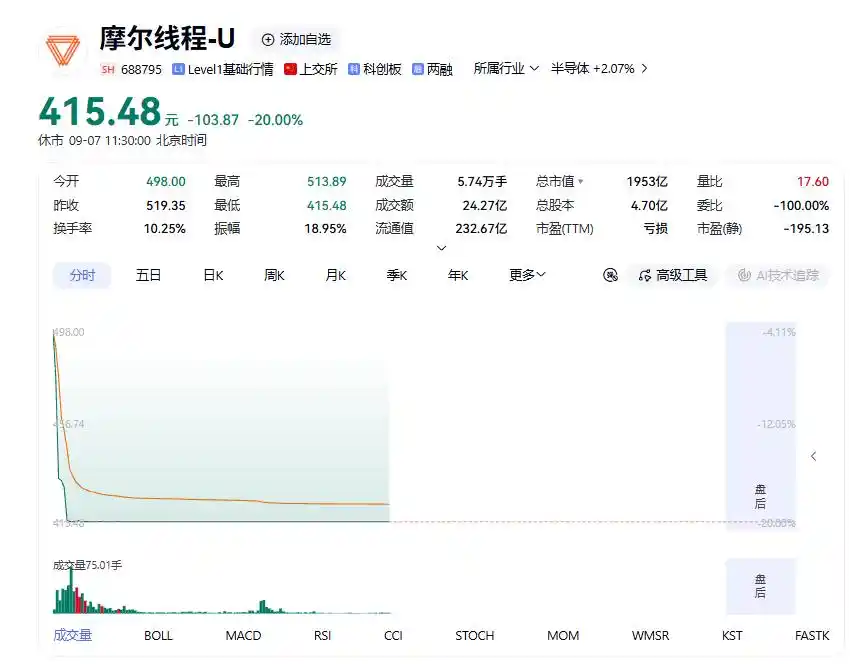
By the midday close, the stock was at CNY 415.48, down CNY 103.87 from the previous trading day, for a loss of 20.00%. Its market capitalization dropped below CNY 200 billion, to about CNY 195.3 billion.
25.7745 million locked-up shares became tradable
The direct catalyst for the sharp move was a large lock-up expiry.
According to the company’s earlier filing, 25.7745 million shares from the IPO offline placement lock-up were released for trading on Sept. 7. Those shares accounted for 5.48% of total share capital and had been subject to a nine-month lock-up period from the listing date. Based on the Sept. 4 closing price of CNY 519.35 per share, the unlocked block was worth about CNY 13.386 billion.
Before the unlock, Moore Threads had only 30.2255 million shares in free float. After the release, the tradable share count rose to 56 million, nearly doubling the float. For a relatively newly listed STAR Market stock with a small float, that kind of concentrated increase in tradable shares created clear selling pressure in the secondary market and became the core driver behind the rapid drop to the daily limit.
Unlock value ranked near the top of the day’s market-wide total
Wind data showed that 16 listed companies had lock-up expiries on Sept. 7, involving a combined 521 million shares and an aggregate unlock value of about CNY 27.785 billion. Moore Threads ranked among the top names by unlock value that day.
Company response: operations are normal and fundamentals are unchanged
Moore Threads moved quickly to respond after the stock hit limit down.
A company securities affairs representative told media that the date marked a large unlock of offline placement shares and was a normal capital-market milestone after listing. The newly tradable shares mainly came from public funds and offline investors that took part in the IPO subscription process.
The representative also said the company’s production and operations are normal and that its fundamentals have not undergone any material change, adding that investors should view the stock-price swings tied to the unlock rationally and make investment decisions carefully.
Company business staff also told media that the unlock was a normal circulation event for IPO lock-up shares upon expiry and that the market did not need to over-interpret it.
Interim report showed first-half revenue up 147.42%
On the operating side, Moore Threads’ latest half-year report supported the view that business conditions remain stable.
In the first half of 2026, the company posted revenue of CNY 1.736 billion, up 147.42% year over year, with revenue already exceeding the full-year level recorded in 2025. Gross profit reached CNY 989 million, up 103.78% from a year earlier.
On the earnings side, net loss attributable to shareholders and net loss after non-recurring items both narrowed from the same period last year, by 95.73% and 52.37%, respectively. The reduction in losses was significant, pointing to continued improvement in profitability.
As a core player in China’s domestic GPU segment, Moore Threads has continued to advance product lines including desktop graphics cards and data-center GPUs. The domestic substitution theme remains a long-running focus for the market.
A larger unlock is scheduled for Dec. 7, 2026
This was not the company’s biggest lock-up expiry since listing.
According to its prospectus schedule, Moore Threads is set for a larger wave of unlocks on Dec. 7, 2026, when 185.9064 million locked-up shares will be released, accounting for 39.55% of total share capital. That event will expand the free float much more sharply.
The market view cited in the source said short-term stock-price swings caused by lock-up expiries are a normal market phenomenon, while the company’s medium- to long-term share performance will still depend on fundamentals and the growth logic of the industry. Progress in domestic GPU technology iteration and commercialization was described as a key variable for valuation.