
Why Morgan Stanley sharply raised SIMO’s price target
Morgan Stanley’s latest report makes a clear sector call: the NAND market is no longer being driven primarily by the traditional consumer electronics cycle. Instead, the firm argues that AI data centers are creating a new layer of structural demand centered on enterprise SSDs, AI boot drives, cloud procurement, and server-side storage expansion. Within that framework, Silicon Motion, listed as SIMO.O, received the most dramatic upward revision.
The bank raised SIMO’s price target from $155 to $400, valuing the company at 23x projected 2027 EPS and expecting 2026 revenue to reach a record high. Longsys also saw its target lifted from RMB 300 to RMB 673, while Phison’s target moved from NT$2,248 to NT$2,588. Yet the ratings divergence matters. Morgan Stanley maintained Equal Weight on both Longsys and Phison, signaling that while pricing and memory tightness may help the sector broadly, not every memory-related company is positioned to capture the same level of operating leverage or valuation re-rating.
That distinction is central to the report. The thesis is not simply that SSD prices may rise. Rather, the bank believes the composition of NAND demand is changing in a way that favors companies linked directly to enterprise and AI storage infrastructure. Historically, NAND pricing and inventory cycles were closely tied to smartphones, PCs, and consumer SSDs. In the new setup, demand from AI servers, hyperscale cloud operators, and enterprise storage buyers may become the dominant variable.
How AI demand could push NAND into shortage through 2027
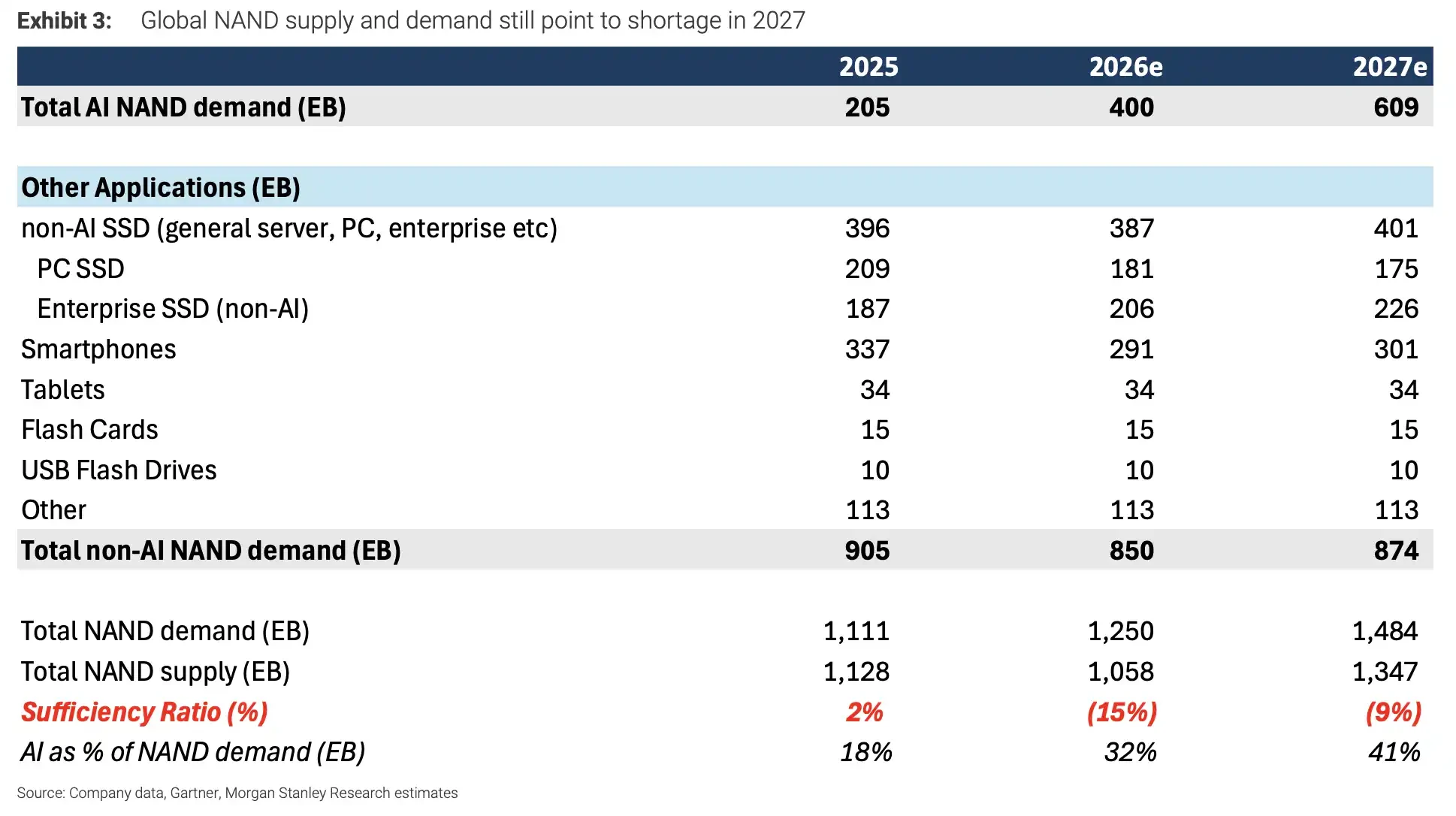
Morgan Stanley’s core forecast is that AI-related demand will support NAND tightness through 2027. The report estimates that the global NAND market will still show about 2% oversupply in 2025, reflecting the lingering effects of the previous inventory glut. But by 2026, the market is expected to swing into a 15% shortage, and even in 2027, after additional supply comes online, the shortage could remain near 9%.
In absolute terms, total NAND demand for 2025-2027 is projected at 1111 EB, 1250 EB, and 1484 EB, while supply is estimated at 1128 EB, 1058 EB, and 1347 EB. That means the supply-demand balance shifts from a 2% surplus in 2025 to deficits of 15% and 9% in the following two years. Importantly, this tightening is not built on an aggressive recovery scenario for consumer electronics. Smartphone and PC assumptions remain relatively conservative in the report, with roughly flat per-device NAND content and declining unit shipments based on the bank’s hardware team model.
Instead, the engine is AI infrastructure. Morgan Stanley expects AI-related NAND demand to rise 60% year over year in 2027, reaching 609 EB, or about 41% of total global NAND demand. This is a major shift in market structure. AI servers do not only require GPUs and HBM; they also need local storage, enterprise SSDs, and boot drives for system startup, management, and ongoing operation. Once cloud service providers move into long-term procurement cycles for these components, the volatility pattern of NAND pricing may also change.
That is why the report frames the current cycle as different from prior memory recoveries. If AI becomes the largest marginal demand contributor, NAND pricing will become more sensitive to hyperscaler capex, server configuration trends, and enterprise SSD supply, rather than simply handset restocking or PC inventory normalization.

Pricing is already diverging between enterprise and consumer NAND
Channel checks cited in the report suggest that this demand split is already showing up in pricing. In the third quarter of 2026, Morgan Stanley found that TLC enterprise SSD pricing was up roughly 30% quarter over quarter. Server-grade DRAM rose about 20%, while legacy DRAM such as DDR3 and DDR4 climbed 30% to 40%. These figures point to clear upward pressure in data center-linked products and support the bank’s view that AI and cloud demand are not theoretical drivers but active pricing forces.
Consumer NAND, however, has not moved nearly as aggressively. Smartphone and PC customers are facing tighter margin constraints and are less able to absorb comparable price increases. As a result, NAND inflation is not broad-based in the traditional sense. It is much stronger in enterprise-grade products, server-related components, and AI-linked storage configurations than in mainstream consumer categories.
This divergence is important for investors. It suggests that the right way to read the cycle is not “all NAND goes up together,” but “the strongest price and volume leverage sits where AI infrastructure demand is most concentrated.” That changes how companies across the value chain should be evaluated. A supplier exposed primarily to enterprise SSD controllers or AI boot storage may deserve a very different multiple from one still tied heavily to consumer storage modules.

SIMO’s re-rating thesis: enterprise SSD controllers and AI boot drives
Morgan Stanley’s bullish stance on SIMO comes down to positioning. The firm believes Silicon Motion is directly exposed to two of the most important storage growth vectors inside the AI buildout: enterprise SSD controllers and boot drive modules. Those categories may not attract the same headlines as GPUs or HBM, but they are essential components in modern AI server deployments.
The report identifies the MonTitan enterprise SSD business as one of SIMO’s most important growth engines over the next several years. It is expected to contribute 5% of revenue in 2026, 13% in 2027, and 19% in 2028. At the same time, boot drive modules are expected to scale materially, contributing around 15% of revenue in 2026 and 21% in 2027. Together, these businesses would reshape SIMO’s revenue mix and reduce the market’s tendency to view the company primarily as a consumer controller supplier.
That shift in perception matters because valuation multiples follow business quality and strategic positioning. If a growing share of SIMO’s revenue is tied to enterprise and AI infrastructure, the company may be viewed less as a cyclical consumer semiconductor vendor and more as a beneficiary of structural AI capex. This helps explain why Morgan Stanley is willing to anchor its target at $400 using 23x estimated 2027 EPS.
Still, the report does not present this as guaranteed upside. The valuation depends on execution across several linked assumptions: enterprise SSD adoption must scale as expected, boot drive module volumes need to ramp successfully, customer qualification and design-ins must continue, and AI server demand cannot slow materially. If any of those variables disappoint, the re-rating could prove difficult to sustain.
Why Longsys and Phison benefit, but with less upside leverage
Longsys and Phison are also positioned to gain from firmer memory pricing and stronger AI server demand, but Morgan Stanley remains more cautious on both. The key issue is that module makers face a real supply-allocation constraint during periods of tight NAND availability. When supply tightens, original manufacturers are more likely to prioritize large cloud buyers and core CSP customers, leaving module companies with less access to incremental capacity than the market may initially assume.
That is why price targets can move higher while ratings remain at Equal Weight. Rising prices help inventory valuation and average selling prices, and a better enterprise product mix can support margins. But if supply is effectively locked by upstream manufacturers and hyperscale buyers, revenue elasticity for module players may be capped. In other words, they participate in the upcycle, but not necessarily with the same magnitude of upside as companies better aligned with mission-critical AI storage components.

The report also points to long-term agreements, or LTAs, as an important structural factor. Suppliers can use LTAs to protect against sharp price declines, and Morgan Stanley expects Kioxia’s LTA coverage to exceed 50% by 2027. But LTAs are not one-way positives. Micron has also indicated that such agreements typically include both price floors and ceilings. That means LTAs can reduce downside volatility while simultaneously limiting how much suppliers can benefit from extreme shortages.
Module makers are trying to improve resilience through frameworks such as TCM, shifting more inventory pressure to customers and targeting long-term gross margins in the 25% to 35% range. Even so, the success of that strategy depends on customer willingness, the degree of market tightness, and whether the products involved are differentiated enough to command premium positioning.
2028 is the real boundary for the bullish NAND thesis
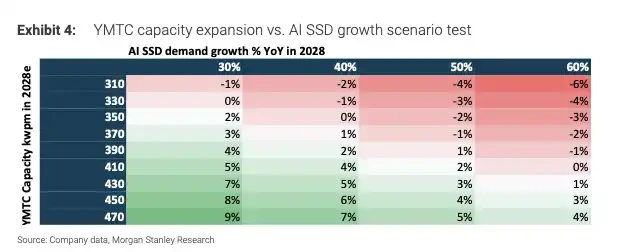
For all the optimism in the report, Morgan Stanley places a clear boundary around the thesis: 2028 may be the year that determines whether this shortage regime can last. In the bank’s base case, if AI NAND demand is still growing at 60% year over year and YMTC capacity remains around 310kwpm, the market could still face about a 5% shortage. But if YMTC expands to 470kwpm and AI growth moderates, the NAND market could move from shortage toward balance or even oversupply.

The report frames this through a scenario matrix combining YMTC capacity of 310-470kwpm with AI growth assumptions of 30%-60%. Depending on which combination plays out, the supply-demand picture could range from ongoing shortage to near equilibrium or renewed surplus. That range captures the hardest part of calling the memory cycle: short-term price strength and low inventories often amplify bullish sentiment, but once supply discipline weakens, oversupply can return very quickly.
There are already signs of this tension. Some consumer-side orders have reportedly been cut, and smartphone and PC customers remain constrained in how much additional pricing they can absorb. That suggests the ceiling for consumer NAND pricing may arrive earlier than for enterprise products. As a result, the most important market question is not simply whether SSD prices go up, but whether AI demand will be strong enough to absorb the industry’s incremental supply over the next two years.
For SIMO and other companies tied to AI storage controllers and enterprise SSD infrastructure, 2026 could mark the start of a meaningful revenue mix transition. For the broader NAND cycle, however, the decisive variables remain YMTC’s expansion pace in 2028, the strength of CSP capital spending, and whether suppliers maintain enough discipline to prevent the market from slipping back into another oversupply phase.