

Morgan Stanley’s Aug. 25 internet valuation update laid out a widening gap in how the market values Google, Meta, and Amazon. The bank kept its rating on the internet sector at “attractive,” while arguing that AI capability has become the main variable behind the split.
Over the past week, internet companies under Morgan Stanley’s coverage fell 2% on average, matching moves in the S&P 500 and the Nasdaq. Individual names moved very differently. Meta fell about 7%, Amazon dropped about 2%, and Google was roughly unchanged.
Google trades above historical norms while Meta remains discounted
Using 2026 forward price-to-earnings estimates, Amazon is trading at 19x, a 36% discount to its historical average. Google is at 17x, a 36% premium. Meta is also at 17x, but stands at a 24% discount. That leaves Google as the only one of the three trading above its historical average on this measure.
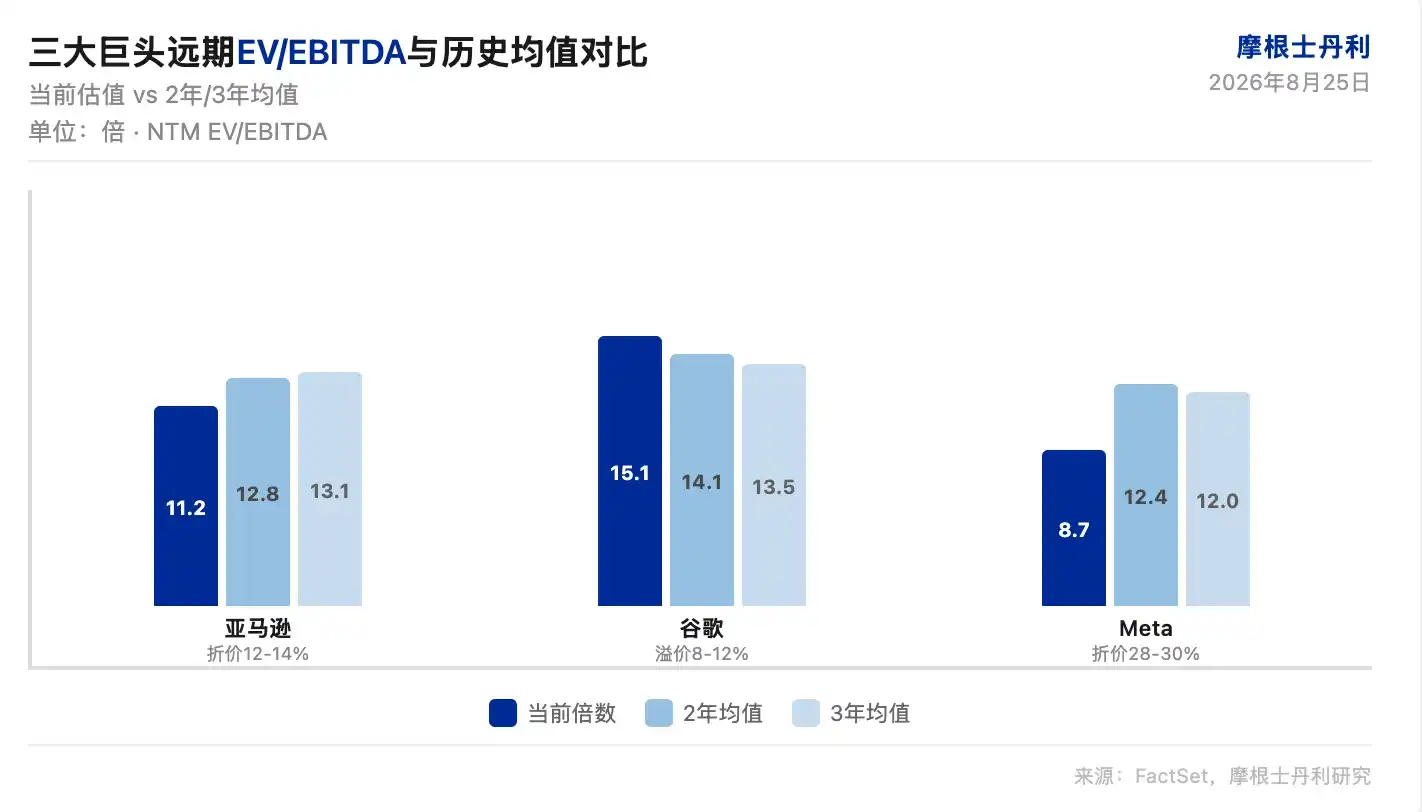
On a forward EV/EBITDA basis, Google is at 15.1x, which is 8% above its two-year average and 12% above its three-year average. Morgan Stanley said that premium reflects a market reassessment of the company’s AI position. The report pointed to higher assumptions for external TPU sales, Gemini model iteration, and margin expansion in cloud. Morgan Stanley had previously raised its revenue assumption per gigawatt to $27 billion from $20 billion.
Meta is moving in the opposite direction. The company trades at 8.7x forward EV/EBITDA, a 30% discount to its two-year average and a 28% discount to its three-year average. The report said Meta has made solid progress monetizing AI advertising tools, but worries about competition in social media advertising are still weighing on the stock’s valuation.
Amazon sits between the two. Its forward EV/EBITDA multiple is 11.2x, a 12% discount to its two-year average and a 14% discount to its three-year average.
Revenue multiples are expanding while profit multiples are shrinking
For the broader internet sector, Morgan Stanley said forward EV/EBITDA is 9% below its five-year average and 16% below its 10-year average. At the same time, EV/Sales is 16% above its five-year average and 17% above its 10-year average.
That split shows a change in how the market is pricing the group. Revenue multiples are expanding. Profit multiples are contracting. In Morgan Stanley’s reading, that means the market is placing more weight on earnings quality.
E-commerce and digital media are where valuation discounts are most concentrated. In digital media, the median forward EV/EBITDA multiple is about 9.6x, and companies such as SNAP are still loss-making. E-commerce valuations are also under pressure, with Morgan Stanley pointing to slower consumer spending and tougher competition.
SBC adjustments point to higher underlying valuation pressure
The report also said headline valuation multiples understate pressure when stock-based compensation, or SBC, is treated as a cash expense.
After that adjustment, average EV/EBITDA rises by about 36% in digital media, about 30% in e-commerce, and about 44% in travel and the shared economy. Morgan Stanley said SBC continues to take up a larger share at technology companies, widening the gap between valuation multiples based on cash profit and those based on reported profit. Looking only at reported EV/EBITDA may understate the real valuation burden carried by shareholders.
Valuation recovery depends on earnings upgrades, not mean reversion alone
Looking ahead, Morgan Stanley said investors should watch the release timing and market reception of Google’s Gemini 4, whether Amazon Web Services, or AWS, can stabilize its growth rate, Meta’s progress monetizing AI ad tools, and how changes in the rate environment continue to affect high-valuation growth stocks.
In the near term, the bank said sector valuations remain in a reasonable range overall. Discounts in e-commerce and digital media, by themselves, are not enough to justify buying. Any repair in valuations will need to come from higher earnings expectations rather than a simple return to historical averages.
The source article said it was a整理与解读 of a third-party broker research report from Morgan Stanley dated Aug. 25, 2026, combined with public market information. It added that cited ratings, target prices, earnings forecasts, and related judgments were the views of the broker’s analysts and represented only the position of that institution, not the view of the article’s publisher, and did not constitute investment advice.
The piece also said market decisions should be made independently and that the article should not be used as a basis for buying or selling any security.