
Why Morgan Stanley turned more bullish on the storage supply chain
Morgan Stanley’s latest note made a decisive shift in how it values parts of the memory and storage ecosystem. The most aggressive move was on Silicon Motion (SIMO.O), whose target price was raised from $155 to $400. The bank said that valuation implies 23x expected 2027 EPS and is supported by the view that SIMO’s 2026 revenue could reach a record high. It also raised Longsys’ target from RMB 300 to RMB 673 and Phison’s target from TWD 2,248 to TWD 2,588.
But the important point is not just the size of the target revisions. Morgan Stanley is effectively arguing that the NAND cycle is changing its core demand driver. In prior years, NAND pricing and utilization were heavily tied to smartphones, PCs, and consumer SSD inventory swings. In the new framework, AI data centers are pulling demand toward enterprise SSDs, AI boot drives, local server storage, and long-term cloud procurement agreements. That is a fundamentally different setup for pricing power and supply allocation.
The bank did not apply the same level of optimism across the board. Even after lifting target prices, it kept Equal Weight ratings on Longsys and Phison. That distinction matters. It suggests the opportunity is not evenly distributed across all module makers and storage names. Instead, upside depends on which part of the chain has direct exposure to AI-related storage demand and, just as importantly, who can actually secure supply when the market tightens.
How AI servers could push NAND from surplus into shortage
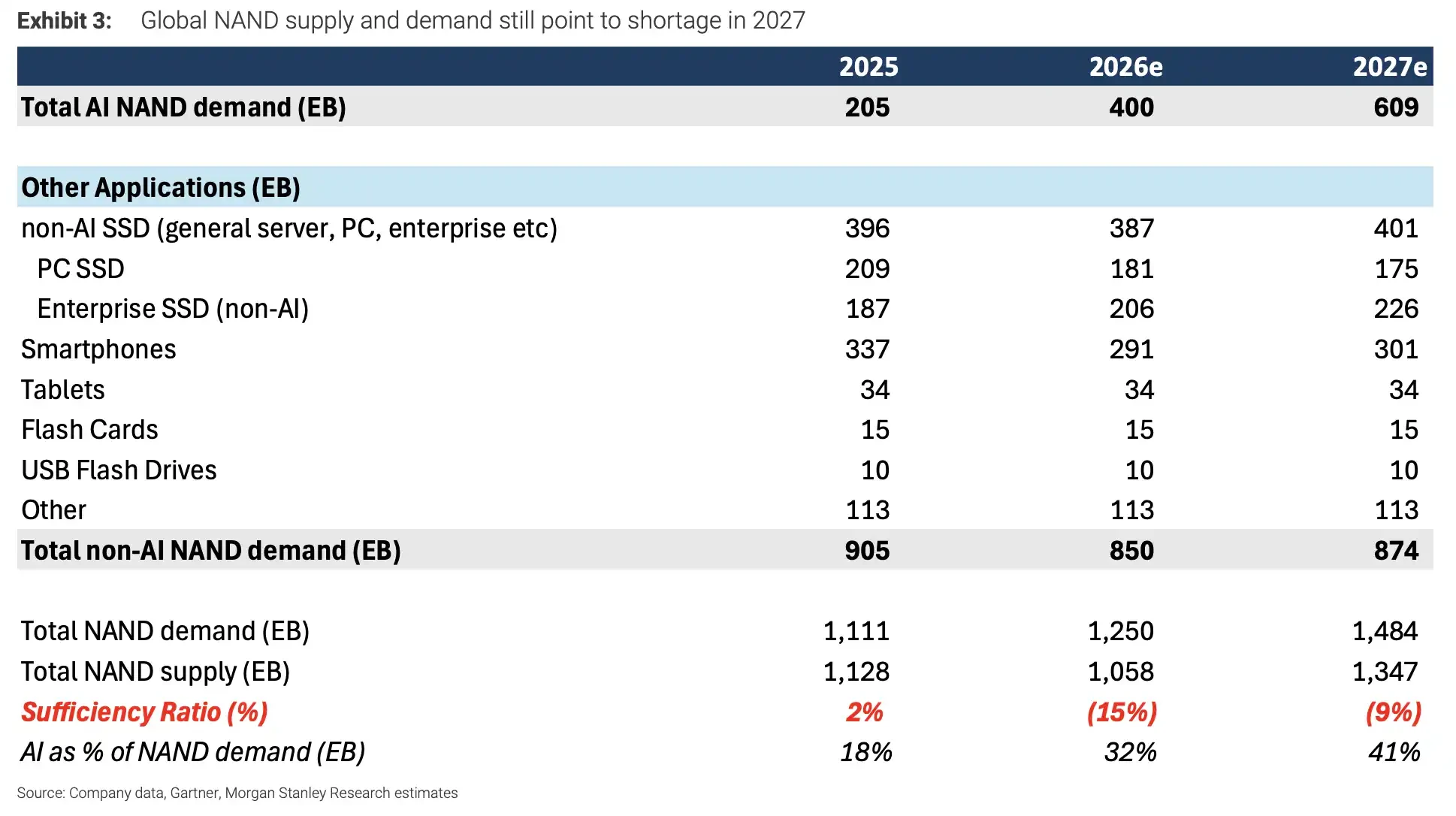
The central call in the report is that AI-related demand will support NAND through 2027. Morgan Stanley expects global NAND supply and demand to remain slightly oversupplied by around 2% in 2025 because of lingering effects from the previous inventory glut. But by 2026, the market is projected to swing into a 15% shortage, and in 2027 it could still remain short by about 9% even as supply continues to expand.
The numbers behind that view are explicit. Morgan Stanley estimates total global NAND demand at 1,111 EB in 2025, 1,250 EB in 2026, and 1,484 EB in 2027. Supply is forecast at 1,128 EB, 1,058 EB, and 1,347 EB over the same period. That takes the market from a 2% surplus in 2025 to deficits of 15% and 9% in 2026 and 2027. The bank emphasizes that this transition is not being driven primarily by phones or PCs, but by AI servers, cloud SSD purchasing, enterprise storage deployment, and boot-drive requirements.
Its 2027 demand assumptions are especially notable. AI-related NAND demand is projected to rise 60% year over year to 609EB, which would account for 41% of total NAND demand. By contrast, Morgan Stanley’s assumptions for smartphones and PCs are not aggressive. NAND capacity per device is modeled as largely flat, while end-device shipments are still expected to decline in line with the hardware team’s forecasts. In other words, the shortage thesis is not built on a broad consumer electronics rebound. It is built on continued AI server deployment and sustained cloud capex.
That distinction matters for investors. If AI becomes the dominant demand engine, then NAND pricing and inventory behavior become more sensitive to enterprise SSD supply, server configurations, and hyperscaler procurement patterns than to handset replacement cycles. The market is no longer just asking whether end-user gadgets recover. It is asking whether AI infrastructure spending remains strong enough to absorb future capacity additions.

Pricing is already diverging between enterprise and consumer storage
Morgan Stanley argues that the pricing move is already visible in the channel, but it is concentrated in data-center-related products rather than spread evenly across all NAND categories. Based on its 3Q26 channel checks, TLC enterprise SSD pricing is up about 30% quarter over quarter. Server DRAM is up about 20%, while legacy DRAM such as DDR3 and DDR4 is up roughly 30% to 40%.
Consumer NAND, however, has not moved as sharply. The report says smartphone and PC customers are under greater margin pressure and therefore have less ability to absorb the same degree of price inflation. This creates a clear split inside the broader memory market. The strongest pricing power is showing up where AI and cloud infrastructure are most directly exposed: enterprise SSD, server storage, and other data-center components. Consumer products are rising more slowly and may hit resistance earlier.
This is an important nuance because it changes how investors should interpret the phrase “SSD prices are going up.” Yes, prices are rising, but the strongest part of the move is in the data center. It is not a uniform uplift across all NAND products. That means earnings leverage will be much greater for companies tied to enterprise controllers, AI storage modules, and cloud deployment pipelines than for businesses still dominated by consumer channels.

Why SIMO received the most aggressive target increase
The reason SIMO stands out in this report is that its business mix lines up closely with two of the most attractive AI storage categories: enterprise SSD controllers and AI boot drive modules. Morgan Stanley sees both as material growth engines over the next several years and as the foundation for a meaningful rerating in the stock.
Within that thesis, MonTitan enterprise SSD products are treated as the company’s most important new growth vector. Morgan Stanley expects this business to contribute 5%, 13%, and 19% of SIMO revenue in 2026, 2027, and 2028, respectively. At the same time, boot drive modules are also expected to ramp. The report estimates they could account for about 15% of company revenue in 2026 and 21% in 2027.
For AI servers, boot drives are not the most visible component, but they are essential. They handle critical startup, management, and operational storage functions for the system. As AI server shipments rise, demand for the associated controllers and modules should rise as well. Historically, investors often viewed SIMO mainly as a consumer controller company. The valuation reset now comes from the idea that enterprise and AI-linked revenue could become a much larger share of the business in a relatively short period.
Still, Morgan Stanley’s case is conditional rather than guaranteed. The $400 target assumes that enterprise SSD and boot drive products ramp smoothly, customer qualifications continue, and AI server demand does not slow materially. If any of those assumptions fail to hold, the implied 23x 2027 EPS multiple may prove difficult to sustain. So while the upside case is clear, it is still based on execution that has yet to be fully realized in reported profits.
Why Longsys and Phison may benefit less than the headline suggests
Longsys and Phison are also positioned to benefit from stronger memory pricing and AI-server-related storage demand. However, Morgan Stanley stopped short of assigning a more aggressive rating to either name. The reason is structural: module makers face a practical limit during periods of NAND tightness because upstream suppliers often prioritize large cloud customers and core CSP accounts when allocating scarce capacity.
That supply-allocation issue directly limits volume upside for module companies. Price increases can help inventory valuation and improve ASPs. A better enterprise mix can support gross margins as well. But if the incremental bits are reserved for hyperscalers and large strategic buyers, module makers may not receive enough supply to fully translate favorable pricing into outsized revenue growth. That explains why target prices can go up while ratings remain Equal Weight.
The report also points to long-term agreements, or LTAs, as another key variable. Suppliers can use LTAs to gain some protection against downside pricing, and Kioxia’s LTA coverage in 2027 is expected to exceed 50%. But LTAs are not an unlimited positive. Micron has noted that such agreements often include both floor and ceiling mechanisms. They reduce the risk of severe price collapses, yet they can also cap upside in periods of extreme shortage.
Module makers are trying to improve their own position through models such as TCM, with the aim of shifting more inventory pressure to customers and stabilizing long-term gross margin in the 25% to 35% range. Even so, whether that works in practice depends on customer acceptance, the level of supply tightness, and how high-end the product portfolio is. The message from Morgan Stanley is clear: exposure to the cycle is not enough. Bargaining power within the cycle matters just as much.
2028 is the real boundary of the bullish NAND narrative
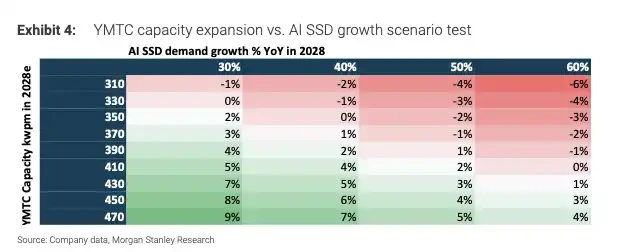
The report’s biggest caveat sits in 2028. Under Morgan Stanley’s base case, the NAND market could still be in shortage by then if AI NAND demand continues to grow 60% year over year and YMTC capacity stays around 310kwpm. In that scenario, the market could remain undersupplied by roughly 5%. But the alternative path looks very different. If YMTC expands to 470kwpm and AI demand growth slows at the same time, the market could shift from shortage toward balance or even back into oversupply.

The scenario matrix in the report shows exactly why the issue is so difficult. Different combinations of YMTC capacity at 310-470kwpm and AI SSD demand growth at 30%-60% produce outcomes that range from meaningful shortage to near balance and potential oversupply. That is the core challenge of the memory cycle: low inventory and rising prices can quickly reinforce a bullish narrative, but once supply discipline weakens, excess capacity can return faster than the market expects.
There are already signs that the consumer side may not support an aggressive bullish extension. The report notes that some orders have been cut, and phone and PC customers have limited capacity to absorb further price increases. That suggests consumer NAND may hit a ceiling sooner than enterprise products do. So the key market question is not simply whether SSD prices can keep rising. It is whether AI demand will be strong enough to absorb the next two years of incremental supply.
For companies like SIMO and others tied to controllers and AI storage infrastructure, 2026 may mark the beginning of a meaningful enterprise and AI revenue ramp. But for the NAND cycle as a whole, the more decisive variables sit further out: YMTC’s expansion pace in 2028, the strength of CSP capital spending, and whether suppliers maintain enough discipline to prevent another fast return to oversupply.