
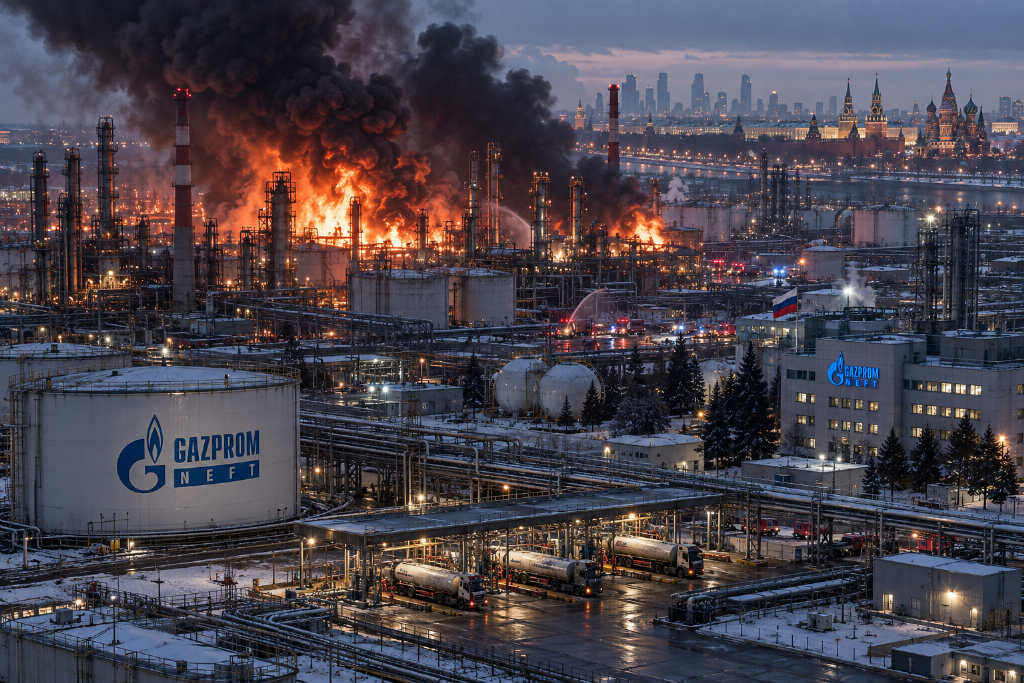
A Ukrainian strike on the Moscow refinery has sharpened concerns over global diesel supply at a time when refined fuel markets were already under heavy strain. Reports cited in the source said the attack took place early on Sept. 20 and hit one of Russia’s major refining assets, adding fresh pressure to a market already dealing with disrupted exports from key producing regions.
Ukraine says key units at the Moscow refinery were hit
According to China Central Television News, Ukraine’s General Staff said on Sept. 20 local time that Ukrainian forces struck the Moscow refinery in the Moscow region earlier that morning. Ukraine said a large fire broke out in the refinery area and that the AVT-6 primary refining unit and an integrated crude processing unit were among the facilities hit.
The Ukrainian military described the Moscow refinery as one of Russia’s largest refining enterprises, with annual crude processing capacity of about 12 million tons. It produces gasoline, diesel, jet fuel and fuel oil, according to the report. Ukraine also said the refinery helps support the needs of Russia’s armed forces.
China Central Television News and other outlets described the Sept. 20 attack as the “largest-scale attack” faced by the Russian capital. Moscow Mayor Sergei Sobyanin said more than 1,600 drones had been shot down since Sept. 19, including 450 intercepted while approaching Moscow. In that attack, the Moscow refinery suffered serious damage, according to the report.
Separately, Huanqiu cited other media reports saying Ukrainian President Volodymyr Zelensky posted on X later on Sept. 20 about the operation. Zelensky said Ukraine’s long-range strike on the Moscow region the previous night had produced “a very significant impact.” He added that an important Russian oil industry facility and logistics facility had been hit.
The refinery is owned by Gazprom Neft, according to the report, and is located about 16 miles from the Kremlin. It can process about 245,000 barrels of crude a day, or roughly 12 million tons a year. Ukraine’s General Staff said the AVT-6 primary refining unit and an integrated crude processing unit were struck. The facility mainly produces gasoline, diesel and jet fuel, supplying the greater Moscow metropolitan area while also serving Russian military demand.
Russia also launched a new round of strikes on Ukraine
Russia carried out a new wave of air attacks on multiple locations in Ukraine in response, according to the source. Ukraine’s State Emergency Service and Air Force said Russian forces launched 138 drones targeting industrial and railway facilities in Kyiv region, Vinnytsia region and Odesa region. The strike in Kyiv region had caused four deaths at the time of reporting.
With both sides continuing to target infrastructure, the market focus has widened from a single refinery incident to the resilience of fuel and transport supply chains. Diesel remains central to industry, freight and agriculture, which is why the refinery attack drew immediate attention beyond the region.
Diesel prices and refining margins were already at extreme levels
The Moscow refinery strike came as global diesel supply was already described as highly fragile. Bloomberg data cited in the report showed that diesel futures and refining margins worldwide climbed to record highs last week as supplies from the Gulf region and Russia were severely disrupted. The U.S. heating oil crack spread, a measure of the gap between fuel and crude prices, rose to $117 a barrel, the highest level in Bloomberg data since 2009.
The report also cited earlier coverage from Wallstreetcn saying U.S. retail diesel prices rose above $6 a gallon for the first time last week and climbed further to $6.45 on Friday, setting a new record. Fuel shortages have already appeared at gas stations in rural Brazil, Libya and parts of Africa, according to the article, putting pressure on a fuel that underpins industrial activity, transport and farming.
Bloomberg senior commodity strategist Mike McGlone warned that the current diesel price shock resembles the surge in gasoline prices seen during the 2008 energy crisis. At the same time, reports that Russia is considering extending its diesel export ban have added to supply concerns.
A decade-long refining buildout has been disrupted by war
The report said the current stress in the global refining system reflects a collision between the capacity expansion pattern of the past decade and current geopolitical conflict. Over the last 10 years, the Middle East and Russia invested heavily in refining capacity. Kuwait, the United Arab Emirates, Iraq and Saudi Arabia built or expanded large refineries, helping Middle East diesel exports double between 2017 and 2025 and overtake North America as the world’s largest diesel export hub.
That supply structure has now been disrupted, according to analysis from the International Energy Agency. Since February this year, restricted passage through the Strait of Hormuz has forced Kuwait, the UAE and Iraq to cut exports sharply. Houthi attacks have also reduced Saudi Arabia’s ability to export through the Red Sea. David Martin, a senior oil market analyst at the IEA, said: “We are witnessing what may be the tightest diesel market structure in history.”
Western countries have struggled to fill the gap. Alan Gelder, senior vice president for refining at Wood Mackenzie, said large-scale investment by Middle Eastern producers had compressed margins for Western refiners for years. As a result, major Western oil companies have not built a new refinery in nearly 30 years, and more than 10 refineries in Europe and the United States have closed since 2015. Western refineries are now running at full rates and tilting output toward diesel, but the report said that still has not been enough to close the supply gap.
Washington debate over a diesel export ban adds another layer of risk
As domestic fuel prices rise, debate inside the United States over whether to restrict diesel exports has intensified. Representative Tim Burchett introduced a bill this week to ban diesel exports, and Senate Majority Leader John Thune said he was open to the idea. Donald Trump blamed higher oil prices on the Russia-Ukraine war rather than the Middle East situation.
Still, IEA data cited in the report showed that diesel volumes disrupted in the Persian Gulf are about three times the size of the Russian shortfall. Analysts and several think tanks warned that a U.S. export ban would not solve the domestic problem and could instead damage global supply chains. The American Petroleum Institute said in a 2022 letter to then-Energy Secretary Jennifer Granholm that export restrictions would raise domestic fuel prices.
Research from the Center for Strategic and International Studies, the Dallas Fed and Columbia University said U.S. refining capacity is heavily concentrated on the Gulf Coast, where infrastructure is built around export markets. Domestic pipelines are already close to full utilization, and global tanker capacity is tight. CSIS said that if a ban were imposed, Gulf Coast refiners would likely cut refining activity sharply because exports would no longer be profitable. That, in turn, would reduce U.S. gasoline and diesel supply rather than increase it, partly or even fully offset any initial inventory build and putting upward pressure on the same domestic prices the policy is meant to contain, while also driving prices higher in other regions.