
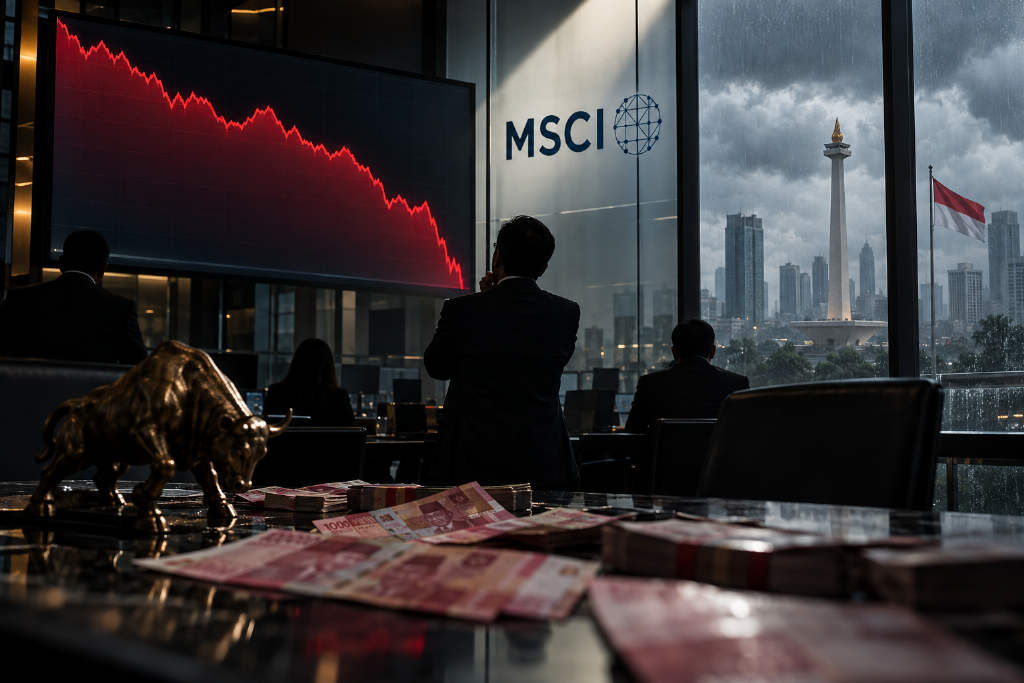
MSCI said on Oct. 15 U.S. Eastern Time that it has launched a consultation to reclassify Indonesia from an emerging market to a Standalone Market, a step that could remove the country from major global equity indexes.
Indonesia's stock market sold off for a second straight session after the announcement. The Jakarta Composite Index fell more than 5% again on Oct. 19, hitting its lowest level since early October 2020, according to CNBC.
MSCI says Indonesia no longer fits the emerging market category
In its annual market classification review in June, MSCI had already said market participants had raised major concerns about the investability of Indonesian equities. Those concerns included opaque ownership structures and suspected coordinated trading behavior. At the time, MSCI said it would consider launching a downgrade consultation if there was not enough progress before the November index review.
Indonesia's regulators later announced a series of reforms, including disclosure of shareholders holding more than 1%, more granular investor classification disclosure, reporting for high shareholding concentration, or HSC, and a roadmap for a minimum 15% free float.
In its latest statement, MSCI said institutional investors reported that those reforms had not been implemented consistently across the broader market. It also said concerns over coordinated trading remained and that there was still no evidence of effective enforcement.
MSCI added that market participants viewed a move to Frontier Markets as insufficient to reflect the severity of the issues, so it proposed moving Indonesia directly to Standalone Market status. Unless the consultation period produces evidence of clear improvement in market governance, MSCI expects to proceed with the proposal.
The consultation will run through April 30, 2027, and a final decision is due by June 30, 2027. Until then, MSCI will continue to freeze increases in the weights of Indonesian stocks and the addition of new constituents.
Jakarta stocks tumble across two trading sessions
According to Malaysia's national news agency Bernama, the Jakarta Composite Index opened down 8% on Oct. 16, the first trading day after the announcement, triggering a 30-minute trading halt. The drop later widened to more than 11% intraday, putting the market on track for its biggest one-day fall since January 1998.
When trading resumed on Monday, Oct. 19, the index fell more than 5% again.
Goldman Sachs sees $5.6 billion in passive outflows in one scenario
CNBC, citing Goldman Sachs data, said that as of Oct. 16 the MSCI Indonesia Index was down 47% this year, while foreign investors had been net sellers of $5.1 billion over the same period. Foreign ownership fell from 27% in January to 25% in October, and the market value of those holdings dropped from about $250 billion to about $130 billion, close to a halving.
In a report published on Oct. 18, Goldman Sachs estimated that if Indonesia were fully removed from the MSCI Emerging Markets Index, the move could trigger about $5.6 billion in passive outflows. The bank said that would equal 18 days of average trading volume for stocks in the MSCI Indonesia Investable Market Index.
Goldman also said that if FTSE Russell were to follow later, another $2.7 billion could flow out, but it stressed that this was a separate scenario.
Separately, Goldman estimated that active funds benchmarked to MSCI and FTSE indexes hold more than $8 billion in Indonesian equities. Whether those funds sell would be up to each manager and would not be triggered automatically by a downgrade.
Goldman keeps Indonesia at underweight
Goldman Sachs maintained its underweight rating on Indonesian equities, citing uncertainty over index status, weak corporate earnings and macro headwinds.
The bank said the MSCI Indonesia Index is now trading at 7.3 times forward 12-month price-to-earnings, the lowest level since the global financial crisis. Goldman strategists led by Alvin So wrote: "Valuations have compressed significantly, but remain above historical troughs; index, earnings and macro risks limit rerating."
Goldman also expects Bank Indonesia to raise rates by 25 basis points in both the fourth quarter of 2026 and the first quarter of 2027.



