MSCI, the global equity index provider, published its final impact list for non-operating companies on Nov. 12. Strategy, the listed company known for holding large amounts of bitcoin, Japan’s Metaplanet and Solana treasury company Upexi are among the securities marked for removal. The changes will take effect after the U.S. market closes on Nov. 30.
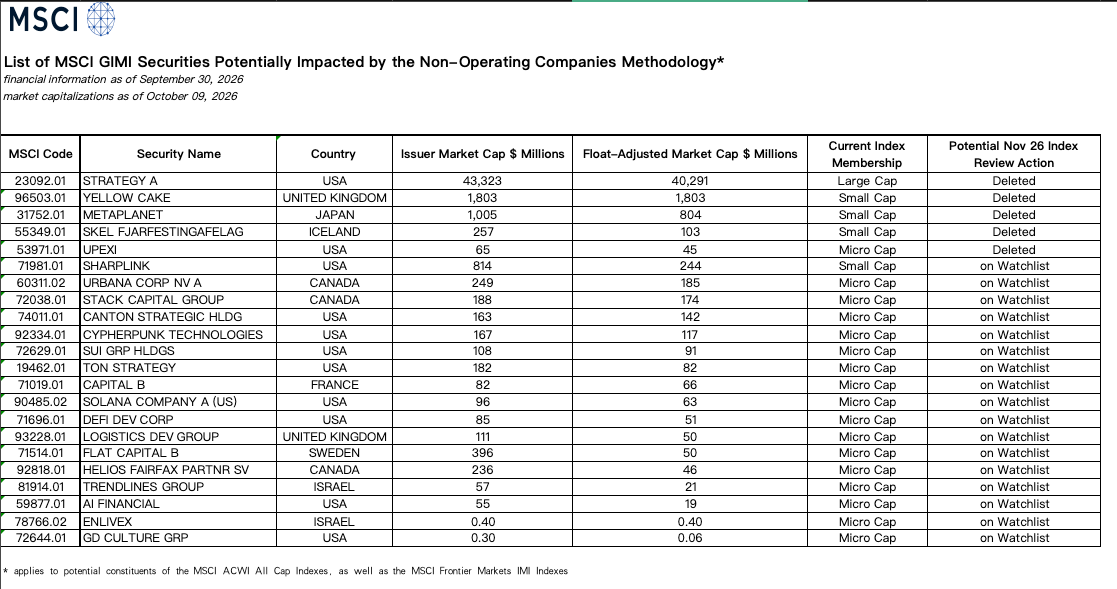
The final list covers 25 securities. Six are marked for removal and 19 are placed on a watchlist. All five companies identified for possible removal in MSCI’s preliminary list released in early October remain in the final action. MSCI also added a sixth removal candidate. Four companies linked to crypto tokens or newer corporate concepts were newly added to the watchlist, including BNB Standard, the listed BNB treasury vehicle.
Six securities face removal
MSCI provides financial services and compiles global equity indexes that many funds use as benchmarks. Inclusion can bring allocations from funds tracking those indexes. Removal requires the relevant funds to adjust their holdings.
Three of the six securities on the removal list are tied to crypto assets: Strategy, Metaplanet and Upexi. The other three are asset-holding companies outside the crypto sector: British uranium investment company Yellow Cake, Icelandic investment company Skel Fjarfestingafelag and British cellular-agriculture technology investor Agronomics. Agronomics is the sixth company added to the final removal list.
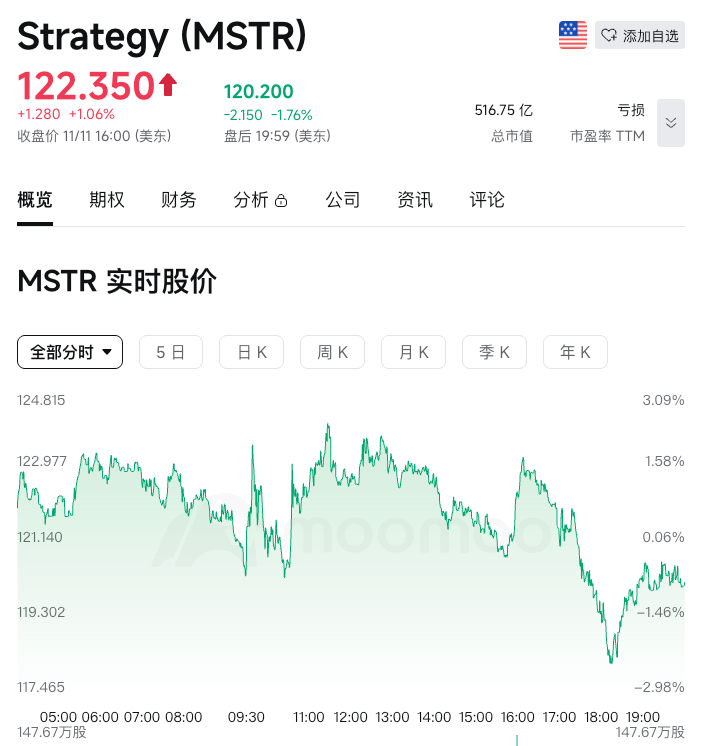
Strategy is the largest company on the list. As of the close of U.S. trading on Nov. 12, the stock stood at $122.35, up 1.06% on the day, with an estimated market capitalization of about $51.7 billion. After MSCI published its final list, the stock fell in after-hours trading to $120.20, down 1.76% from the closing price.
JPMorgan analysts estimate that a full removal of Strategy from MSCI’s flagship stock indexes could lead to about $2.8 billion in outflows from passive index funds.
The index decision does not require Strategy to sell the hundreds of thousands of bitcoin it holds. It does affect the financing cycle built around issuing stock and debt to acquire BTC, lifting the share price and then using the resulting valuation premium to raise more capital. The source article said that, without support from passive allocations, the company’s valuation premium and refinancing threshold could come under pressure.
Strategy had previously argued strongly against being classified as a non-operating company. It said its bitcoin business was a core operating segment and that conventional financial metrics could not fairly assess this balance-sheet model. The final result shows that MSCI did not change its treatment of the company.
BNB Standard joins three new watchlist names
The final list contains 19 securities under observation in addition to the six removals. Four companies were added to the watchlist for the first time compared with the October preliminary list: BNB Standard, Streamex, APG Securities and Quantum Solutions.
BNB Standard trades under the ticker BNC and was formerly known as CEA Industries. After changing its business direction, the company began using BNB holdings to give investors indirect exposure to the token through a listed stock. It also operates retail and industrial equipment businesses.
Data disclosed through the end of July showed that BNB Standard held about 515,500 BNB as its core reserve asset. The source article compared the model with Strategy and described the listed company as a vehicle that gives U.S. stock investors spot BNB exposure. MSCI data puts BNB Standard’s current market capitalization at about $220 million. Its watchlist placement brings the company into the index provider’s review process for companies with heavy token exposure and insufficient operating cash flow.
The other three new watchlist companies have different businesses. U.S.-listed Streamex operates a commodity tokenization platform and has launched tokenized products linked to gold. Japanese-listed Quantum Solutions is involved in AI computing and gaming and has also operated a crypto asset treasury business. APG Securities is a Vietnamese securities company.
SharpLink, SUI Group Holdings, TON Strategy, Capital B, Solana Company and DeFi Development Corp, all of which appeared on the earlier watchlist, remain on the final version. Other companies continuing under review include Urbana, Stack Capital Group, Canton Strategic Holdings, Cypherpunk Technologies, Logistics Development Group, Flat Capital, Helios Fairfax Partners, Trendlines Group and AI Financial.
Including the six companies already named above, 15 companies appeared on both the preliminary October watchlist and the final November watchlist. The final group of 19 companies includes treasury vehicles and other listed companies with exposure to BTC, BNB, SOL, TON and SUI.
MSCI sets out its screening process
Under MSCI’s new rules, a company first undergoes an operating-asset screen. Companies that fail that screen then face five financial-ratio tests. A company may lose index eligibility if at least four of those tests meet an exclusion condition.
For existing index constituents, MSCI requires the company to fail the screening in both of its two most recent annual reporting periods before removing it under the rule. Companies that have not yet met the removal threshold may instead be placed on the watchlist.
MSCI had previously introduced temporary measures for companies with digital assets representing at least 50% of total assets, limiting certain index-weight adjustments for those securities. Those temporary measures will end as the new rules are implemented in the November index review.
Two companies move to micro-cap removal lists
Another detail in the update concerns Enlivex and GD Culture Group. Both companies disappeared from the non-operating company watchlist, but that does not mean they cleared the review and returned to normal status.
Enlivex is associated with biotechnology and prediction-market token concepts. GD Culture Group is a Nasdaq-listed Chinese company that had disclosed a bitcoin treasury plan. Both were on the preliminary watchlist in October, yet neither appeared on the final non-operating company list in November.
MSCI’s micro-cap index changes published on the same day show that Enlivex will be removed from the MSCI Israel Micro Cap Index, while GD Culture Group will be removed from the MSCI USA Micro Cap Index.
MSCI did not explain the interaction between the two reports. The source article noted that Enlivex had previously received a Nasdaq delisting warning and was forced to carry out a 1-for-16 reverse stock split. GD Culture Group, meanwhile, has faced very low liquidity and compliance reviews. The article inferred that the two companies likely left the non-operating company process because their micro-cap valuations or listing status had already fallen below the threshold for inclusion in a micro-cap index, making a second review under the non-operating company rule unnecessary.
MSCI’s changes will take effect after the U.S. market closes on Nov. 30. This article is not investment advice. Markets involve risk, and investors should assess whether the views, opinions or conclusions discussed here fit their own circumstances and bear responsibility for their investment decisions.