

On Oct. 15, MSCI approved a new rule that excludes non-operating companies that fail to meet its standards from the MSCI Global Investable Market Indexes. In an earlier simulation screen, MSTR had already appeared on the proposed removal list. The final result is scheduled for Nov. 11, with implementation set for after the market close on Nov. 30.
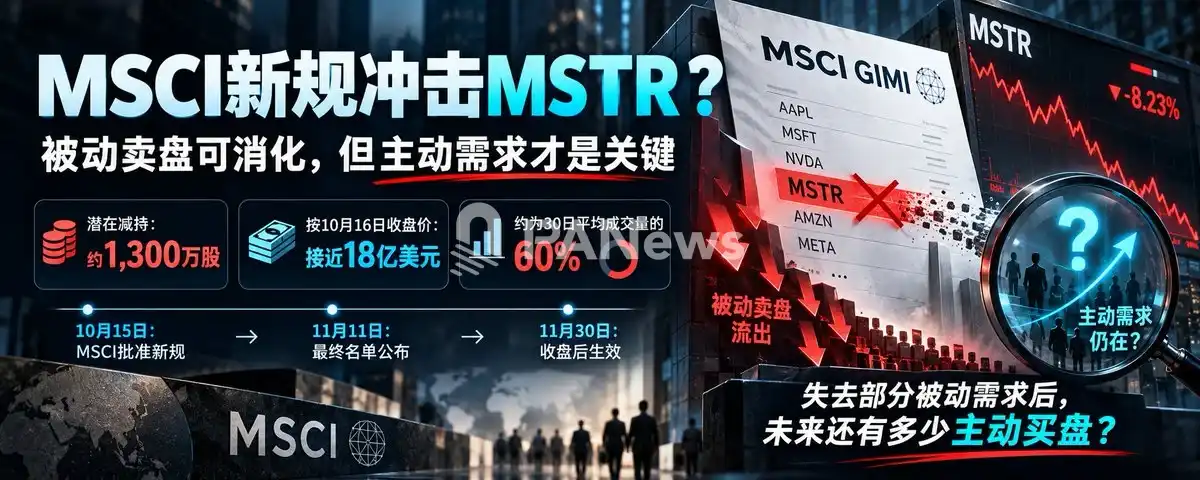
After the announcement, MSTR dropped sharply. That quickly brought back a common question in the market: when choosing between BTC and MSTR, what exactly are investors buying?
Passive selling matters, but it is not the whole story
Murphy starts with the likely selling pressure. By the article’s estimate, funds tracking MSCI-related indexes currently hold about 13 million shares of MSTR. Based on the Oct. 16 closing price, that stake was worth nearly $1.8 billion, equal to about 60% of the stock’s average daily trading volume over the previous 30 days.
That is a sizable overhang if the company is ultimately removed from the index. Still, the article does not frame it as a volume the market could not absorb. The more important issue is what happens after that: if MSTR loses part of its passive bid, can it still attract enough active demand?
Why buy MSTR when spot Bitcoin ETFs already exist?
That leads to the core argument. If a company mainly holds BTC for the long term, why would investors buy its stock instead of a spot Bitcoin ETF and avoid extra management costs, financing costs, and dilution risk?
Murphy’s answer is that Strategy has to show it can do more than simply rise with Bitcoin. It needs to prove that, through capital management, it can keep increasing the amount of net BTC exposure attached to each common share.
If that works, MSTR is no longer just a listed proxy for Bitcoin. It becomes a structure that can expand BTC exposure per share through financing executed at a premium.

The financing flywheel in simple terms
The article uses a simplified example. Assume MSTR holds 100 BTC and has issued 100 shares, so each share corresponds to 1 BTC. If the market values the company at 1.5 times net asset value, or mNAV = 1.5, the company can issue 20 new shares and raise funds equal to 30 BTC.
If it uses those proceeds to buy more BTC, total holdings rise to 130 BTC while total shares outstanding increase to 120. At that point, BTC per share moves from 1 to 1.083, an increase of 8.33%.
In that setup, existing shareholders end up with more BTC exposure per share even if Bitcoin’s price does not change.
Murphy describes this as the core of MSTR’s financing flywheel: use an equity premium to raise capital, then grow BTC reserves faster than the share count grows. If that process can continue, it may draw more active capital, which in turn can support the valuation premium.
Two conditions have to hold
The article also makes clear that this mechanism depends on two conditions.
- The market must be willing to assign a high enough premium, meaning a sufficient mNAV.
- An increase in net BTC per share does not automatically mean MSTR stock will outperform BTC.
The second point is central. MSTR’s share price depends not only on Bitcoin’s price and net BTC exposure per share, but also on how much premium the market is willing to pay. If mNAV contracts sharply, that compression can offset gains from the other two factors.

That is why, in Murphy’s view, the message Saylor most wants to send is that Strategy can generate returns beyond direct BTC ownership through capital management. The market, however, will not accept that on rhetoric alone. It has to be demonstrated in results.
Three variables drive the MSTR trade
The article breaks MSTR’s return profile into three variables:
- BTC price;
- net BTC per share, after accounting for claims such as debt and preferred stock;
- mNAV, the premium investors are willing to pay for the net BTC asset value represented by each MSTR share.
From there, Murphy lays out three possible paths for the stock.
Path 1: BTC rises and mNAV expands with it
If Bitcoin enters a strong bull market, the market regains confidence in MSTR’s financing capacity, and net BTC per share keeps rising, then MSTR could benefit from both BTC appreciation and multiple expansion. In that case, the stock may outperform BTC by a wide margin.
Path 2: BTC keeps rising, but mNAV stays low
If Bitcoin continues higher while more investment demand is absorbed by spot ETFs, MSTR may struggle to win a richer valuation. Even so, if mNAV stays around 1x, the stock could still outperform BTC through capital structure leverage and growth in net BTC per share. In this version, excess return comes more from asset growth than from a higher premium.
Path 3: BTC rises, but mNAV keeps shrinking
There is also a less favorable setup. Bitcoin may rise while MSTR faces pressure from financing costs, dilution, and shifts in market preference, leading to ongoing valuation compression. If growth in net BTC per share is not enough to offset that decline in mNAV, MSTR could lag BTC.

Where valuation stands now
The article closes by looking at current valuation. Strategy changed its mNAV calculation method on July 23 this year. Under the revised method, mNAV fell to 1.01x on Aug. 21, reached about 1.20x in early October, and stood at 1.08x as of the Oct. 16 close.
On that revised basis, Murphy says a 1.08x reading suggests MSTR’s current premium is relatively limited. But a lower premium does not automatically mean the stock is undervalued.
If Strategy can restore stronger financing capacity and keep lifting net BTC per share, the market may assign a higher valuation again. If the flywheel stops working, mNAV may not return to past highs even if BTC keeps climbing.
BTC or MSTR?
Murphy’s conclusion is straightforward: the choice depends on which path an investor believes is more likely.
If Path 1 or Path 2 looks more convincing, MSTR may be the more attractive vehicle, though Path 2 requires a close view on how much net BTC per share can actually grow. If Path 3 is the base case, direct BTC exposure or a spot Bitcoin ETF would be the cleaner choice.
In the article’s framing, buying BTC is a bet on Bitcoin’s long-term value. Buying MSTR adds another layer: a bet on Saylor’s ability to manage capital in a way that improves shareholder exposure over time.



