
Mt. Gox creditors are facing another delay, nearly 13 years after the exchange entered bankruptcy.
On Oct. 16, Mt. Gox trustee Nobuaki Kobayashi announced that, with permission from the Tokyo District Court, the deadlines for three repayment categories — base repayments, early lump-sum repayments, and intermediate repayments — have been extended from Oct. 31, 2026 to Oct. 31, 2027. The move marks the fourth consecutive one-year extension since the original deadline set for Oct. 2023.
About 34,400 BTC are still sitting in linked wallets
Data from Arkham Intelligence shows wallets associated with Mt. Gox still hold about 34,400 BTC, worth roughly $2.8 billion at the time of reporting. Arkham’s tally on Sept. 30 stood at 34,387 BTC.
In September 2023, the trustee disclosed a repayment plan covering about 142,000 BTC, about 143,000 BCH, and 69 billion yen in cash. On that basis, the remaining BTC represents about one-quarter of the planned BTC distribution. When the deadline was extended in October 2025, Arkham data showed the wallet held 34,689 BTC, indicating little change over the past year.
Arkham also tracked an outflow of about 10,400 BTC from a cold wallet in June this year, valued at about $739 million by the report’s calculation. No explanation for that transfer has been provided by the trustee.
What the delay means for the market
For the market, the extension pushes back by another year the point at which roughly 34,400 BTC could be sold. Those coins are not being sold directly by the trustee on the open market. They are being distributed to creditors, who then decide whether to hold or sell, which is why on-chain movements from Mt. Gox-linked wallets have long been watched as an early signal of possible selling pressure.
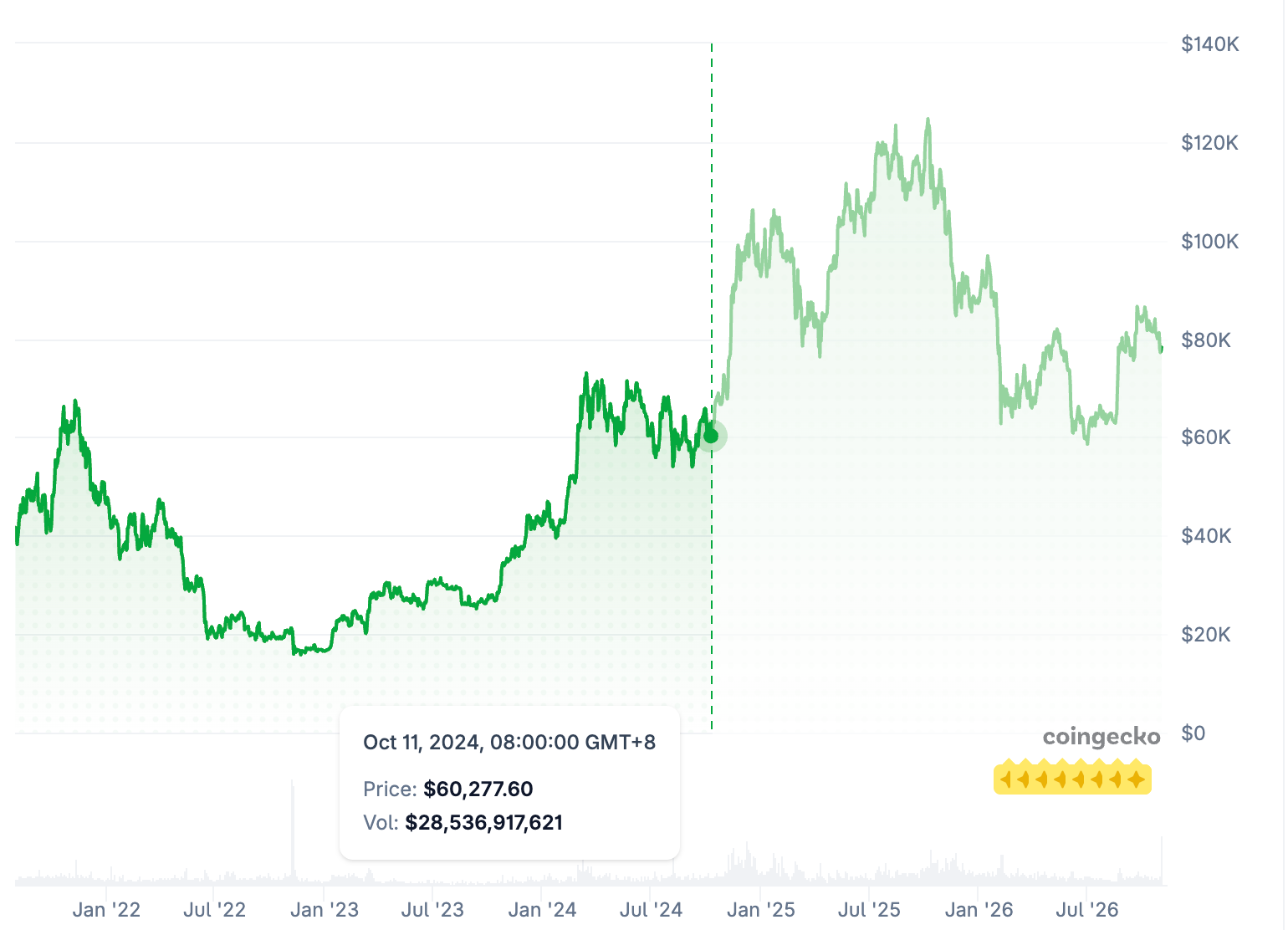
In July 2024, the trustee transferred a combined roughly 96,000 BTC to Bitbank, SBI VC Trade, and Kraken, and BTC briefly fell below $55,000. The remaining 34,400 BTC is about one-third of that transfer volume.
Arkham data shows the wallet balance was about 44,900 BTC in October 2024, about 34,700 BTC in October 2025, and 34,387 BTC on Sept. 30 this year — only about 300 BTC lower than a year earlier. Even after the roughly 10,400 BTC moved out of cold storage in June, the balance did not decline much, and the trustee has not explained what that transfer was for. Roughly $2.8 billion in BTC remains in the wallets.
When Mt. Gox collapsed in 2014, BTC was priced at about $600. That gap is one reason the market has focused on whether creditors might sell once they receive their coins. Still, there is no public data showing how much creditors have actually sold, and the number of unpaid creditors and the amount still owed have not been disclosed. That makes the real market impact difficult to quantify. Any new large transfer would likely remain a key signal to watch.
Repayment has been delayed again and again
Mt. Gox was founded in 2010 and at its peak handled about 70% of global BTC trading. In 2014, the exchange lost about 850,000 BTC in a hacking incident and then entered bankruptcy proceedings. In 2021, the Tokyo District Court approved its civil rehabilitation plan, allowing creditors to recover part of the remaining assets.
The repayment process has been pushed back several times since then. In September 2023, the trustee published the repayment plan and first moved the deadline from Oct. 31, 2023 to Oct. 31, 2024. Cash repayments in yen began later that year.
In July 2024, the trustee started distributing BTC and BCH through Kraken, Bitstamp, BitGo, and Japanese platforms including Bitbank and SBI VC Trade. During that month, about 47,000 BTC was transferred to Bitbank and SBI VC Trade, followed by about 48,600 BTC sent to Kraken. The market briefly focused on possible selling pressure, and BTC fell below $55,000.
The deadline was then extended in October 2024 to October 2025, and on Oct. 27, 2025 — four days before expiry — it was pushed again to Oct. 31, 2026. In March 2025, the trustee disclosed that about 19,500 creditors had already received BTC and BCH. This latest extension was announced about two weeks earlier than the previous one.
Trustee says most eligible creditors have been repaid
According to the trustee’s notice, the three repayment categories have been largely completed for creditors who finished the required procedures and encountered no issues during the repayment process.
At the same time, the notice said many creditors still have not received funds because they did not complete the necessary procedures, while a considerable number ran into various problems during repayment and were unable to collect. The trustee said more time is needed in order to make repayments to those creditors within a reasonable and practicable scope.
The notice only changed the dates. It did not disclose how many creditors remain unpaid, how much is still outstanding, or how any future phased distribution would be arranged. Creditors with questions can contact the official online rehabilitation claim system, though the notice said responses may be delayed because of the volume of inquiries.