

Elon Musk and OpenAI CEO Sam Altman escalated their public dispute on July 11, with the clash unfolding in the same week their AI companies released new flagship models.
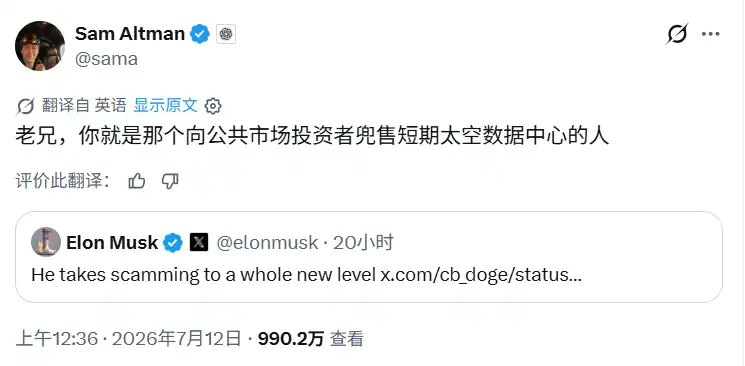
In a post on X, Musk said Altman had taken “fraud to a whole new level,” directing his criticism at OpenAI’s commercial conduct toward users and customers. Altman reposted the comment and answered: “Dude, you’re the one selling short-term space data centers to public market investors.”
The exchange widened as Apple’s lawsuit entered the picture
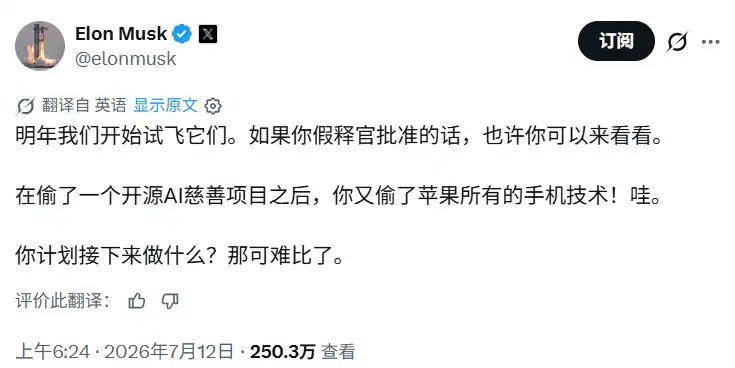
Musk replied that those space data centers would “start flying next year,” then added that Altman could perhaps visit if his “parole officer” approved.

He then went further, accusing Altman of first stealing “an open-source AI charity” and then stealing “all of Apple’s phone technology,” before asking what he planned to do next.
The report links Musk’s reference to Apple technology directly to Apple’s recent lawsuit against OpenAI. Citing information mentioned by Wallstreetcn, it says Apple filed a lawsuit on Friday in the U.S. District Court for the Northern District of California, accusing OpenAI of intentionally inducing Apple employees to leak information, components, drawings, and other materials related to unreleased products to support its in-house hardware plans.
Apple is seeking an immediate halt to the conduct, destruction of all proprietary materials involved, and a redesign of upcoming products to make sure they contain no Apple technology. OpenAI responded that it has no interest in other companies’ trade secrets and remains focused on building innovative technology.
Model launches added to the tension
The lawsuit could affect the direction of the two companies’ partnership, according to the report. OpenAI has long provided key technology support for Apple Intelligence and Siri, and their partnership was formally announced two years ago at Apple’s Worldwide Developers Conference.
During the same week, OpenAI released GPT-5.6 and SpaceXAI launched Grok 4.5. Both are positioned as AI agents, meaning models designed to handle multi-step tasks on their own.
GPT-5.6 and Grok 4.5 target different strengths
Based on the report’s description, GPT-5.6 stands out in broad reasoning, business workflows, and cybersecurity. Grok 4.5 is described as more efficient in autonomous coding and developer workflows, while also costing less to use than GPT-5.6.
On some capabilities, including abstract reasoning, OpenAI’s model still leads Grok. For enterprise users and investors, the distinction points to a more use-case-driven choice: companies looking for broader reasoning may favor GPT-5.6, while developers focused on cost efficiency and code automation may lean toward Grok 4.5.