
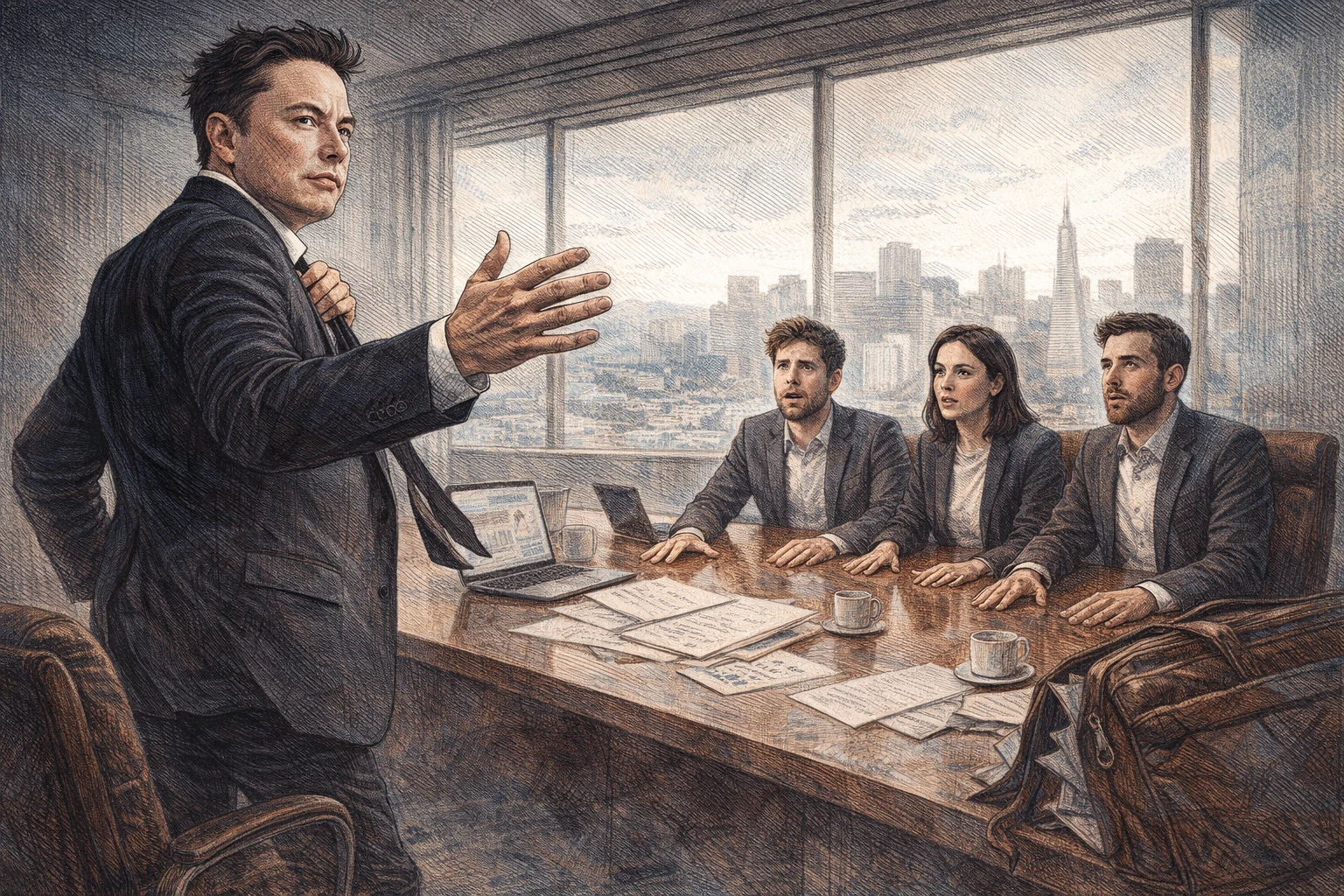
The jury trial in Musk's lawsuit against OpenAI — alleging the company betrayed its founding mission to develop AGI for the benefit of all humanity — opened this week, with the court presenting a series of emails and documents from 2015 to 2017. One equity table from September 2017 shows Musk's requested stake was 51.2%, standing in stark contrast to the founders' stated goal of decentralized control.
2015 Founding: Shared Mission and the 'Freemind' Proposal
In June 2015, Altman sent Musk a five-point founding plan. The governance committee was to include Altman, Musk, Bill Gates, Pierre Omidyar, and Dustin Moskovitz. The mission: "Build the first general AI, aimed at individual empowerment — the safest decentralized future." Musk's reply: "Agree on all."
That November, Musk proposed renaming the company Freemind, explaining the name stood for "AI widely distributed across humanity, opposite to DeepMind's one-ring approach." He also suggested employees could swap their salaries for SpaceX stock, arguing: "SpaceX is private, so I can do almost anything."
On December 8, 2015, OpenAI was formally incorporated. The founding document stated: "The purpose of this organization is to ensure AGI benefits all of humanity. It is not formed for any individual's private gain." This language became the cornerstone of Musk's legal argument that OpenAI's later commercialization violated its original promise.
2016: Musk Personally Asked Jensen Huang for Priority
In April 2016, Musk emailed Nvidia CEO Jensen Huang, requesting that OpenAI be allowed to purchase a supercomputer, stressing: "OpenAI is unrelated to Tesla; it's a nonprofit funded by me and a few friends." Huang replied: "I'll make sure OpenAI gets one." A photo of the two together on delivery day became a visual record of their early rapport.
2017 Fracture: 51.2% vs. the 'Non-Negotiable' Condition
In August 2017, Musk's chief of staff Shivon Zilis reported to him on a meeting with Greg Brockman and Ilya Sutskever. The two co-founders laid down a "non-negotiable" condition: "Regardless of the fate of the three (Greg, Ilya, Sam), there must be an agreement ensuring that after an initial 2-3 year period, control of AGI is decentralized."
Yet an equity table sent a month later by Birchall, manager of Musk's family office, showed Musk's proposed stake at 51.2%, with Altman, Sutskever, and Brockman each at 11.01%. The team demanding decentralized control had designed a structure where one person held a majority — a contradiction that complicates both sides' claims of who betrayed the mission.
When Zilis relayed the core demand for distributed control, Musk responded: "Too annoying. Please encourage them to go start their own company. I'm done." Shortly after, Musk cut ties with OpenAI.
Trial Progress and Advisory Jury
The lawsuit originally had 26 counts; Musk has narrowed it to two: unjust enrichment and breach of charitable trust, with defendants including Altman, Brockman, and Microsoft. A 9-person jury trial is expected to last 2-3 weeks, and Judge Gonzalez Rogers is expected to rule by mid-May. Notably, the jury's verdict is advisory — the final decision rests with the judge.