
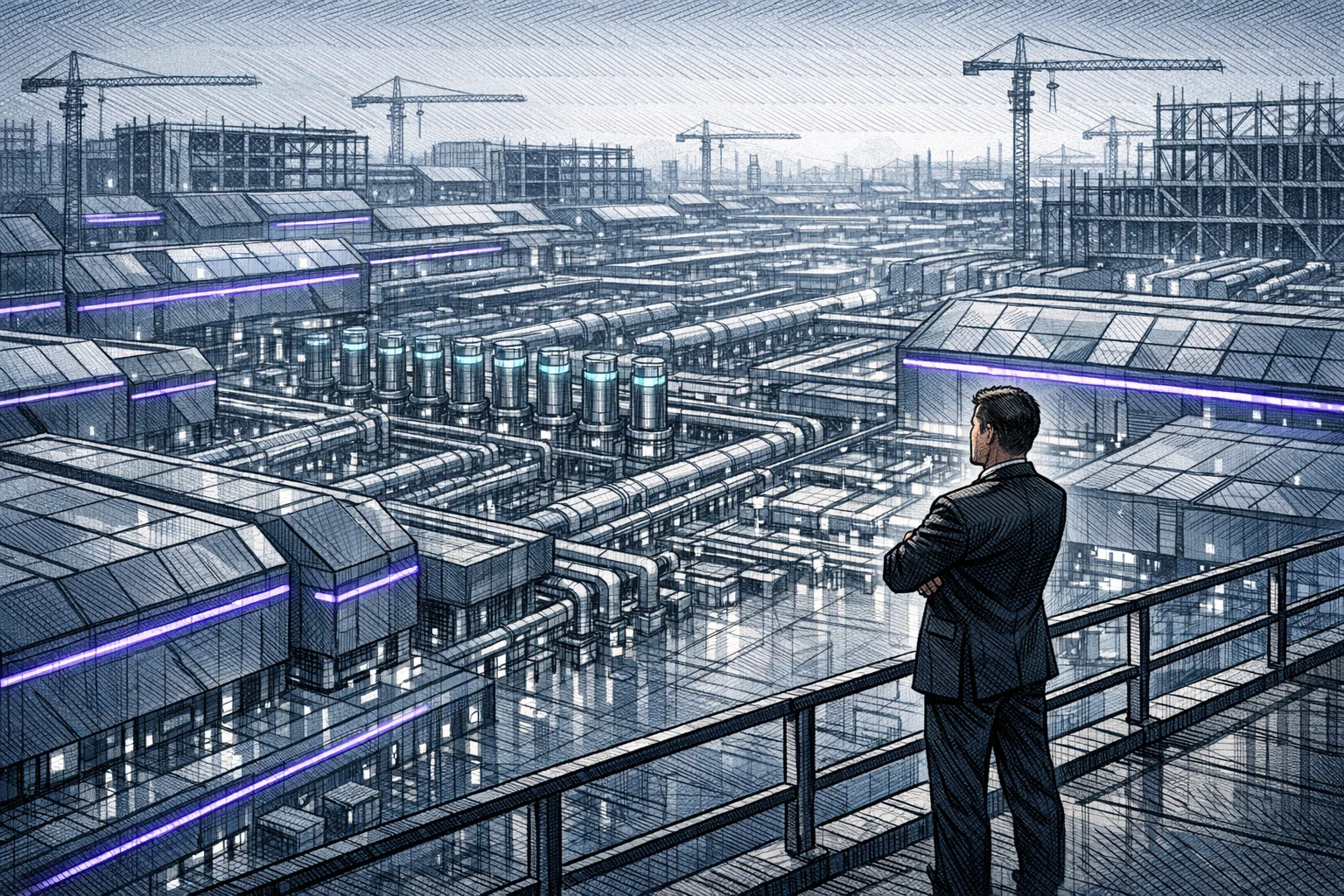
Elon Musk has outlined a new semiconductor manufacturing project called Terafab, a proposed chip complex in Texas backed by Tesla, SpaceX, and xAI. The plan is to build the site north of Giga Texas in Austin and fold chip design, lithography, fabrication, memory, packaging, and testing into one operation. Based on the figures cited in the source, the investment is expected to reach $20 billion to $25 billion.
The scale described is unusually large. Terafab is supposed to start at 100,000 wafers per month and eventually rise to 1 million wafers per month. Musk said that would equal roughly 70% of TSMC’s current global capacity. He also said annual chip output could reach 100 billion to 200 billion units. In the same presentation, he argued that all existing fabs on Earth together only cover about 2% of the chip demand generated by his projects, which he framed as the reason to build an in-house manufacturing base.
Demand is tied to AI, autonomous driving, robotics, and satellites
The business logic behind Terafab comes from the compute needs across Musk’s companies. Tesla needs chips for autonomous driving systems and Optimus robots. xAI needs hardware for Grok and related AI workloads. SpaceX needs compute for Starlink satellites. Musk said current suppliers such as Samsung, TSMC, and Micron are not expanding at a pace that matches his demand, so he wants to bring more of the supply chain under direct control.
The project is also framed as a shared chip backbone for the three companies. According to the source material, 80% of Terafab’s output would go to D3 space chips for SpaceX orbital AI satellites. Musk said space offers two practical advantages: abundant solar energy and a vacuum environment that can help with thermal management. He also claimed that within 2 to 3 years, space-based AI computing could become cheaper than ground-based data centers. The long-range production target he cited was 1 terawatt of compute per year.
2nm manufacturing, EUV access, and site conditions remain major hurdles
The industrial challenge is severe. The article notes that TSMC is building six fabs in Arizona with a total investment of $165 billion, and those facilities are expected to reach volume production for 2nm only in 2029. Terafab is said to be aiming at that same node. A single 2nm fab is estimated in the report at about $28 billion, with a construction timeline starting at 38 months.
Equipment supply is another bottleneck. Advanced EUV lithography systems are only available from ASML in the Netherlands. TSMC, Samsung, and Intel have already been competing for those tools, while Tesla has no known order history or priority position. The proposed location adds another concern. Terafab is planned near the stamping section of Giga Texas, and semiconductor lithography is highly sensitive to vibration. Heavy machinery, truck movement, and roadway vibration can all disrupt precision manufacturing.
The 4680 battery gap has made investors and observers cautious
Skepticism around Terafab is shaped in part by Musk’s earlier manufacturing promises. The article points back to Tesla’s 4680 battery program, introduced in 2020 as a major production breakthrough. Five years later, actual output was said to be around 2% of the original target. Electrek, cited in the report, responded to the Terafab announcement by saying, “We’ve seen this movie before with battery cells, and we know how it ends.”
Funding remains unclear as well. The $20 billion to $25 billion needed for Terafab is not included in Tesla’s disclosed $20 billion capital expenditure plan for 2026. The source also notes Musk’s claim that he wants to reinvent the semiconductor clean room, even describing a fab where engineers could eat cheeseburgers and smoke cigars. That line drew attention, but semiconductor production depends on strict environmental controls and process discipline built over decades.
If built at scale, the project could affect AI compute and crypto infrastructure
The broader significance of Terafab comes from what it could change if it moves beyond the proposal stage. The article argues that a functioning high-volume fab under Musk’s control could challenge the current concentration of advanced manufacturing, GPU supply, and data center compute in a small group of companies. If AI compute becomes cheaper, the impact would not stop at traditional tech.
For crypto, lower compute costs could reduce the price of running AI models and support projects that combine AI with on-chain systems. The source specifically points to DeFi protocols, blockchain oracles, and decentralized AI inference networks, including Bittensor as an example. Even so, Terafab remains a long-dated plan. Tool access, process know-how, staffing, funding, and construction are all unresolved. Based on the timeline in the report, production is at least 38 months away, while the endpoint of 1 million wafers per month could take a decade, or longer.