m&W 1.0 describes itself as an information and cognition discovery network for builders in the AI era, not simply a decentralized crypto news aggregator or content community. The project says its end goal is to build a Trusted Coordination Order, in line with the core mission of m&WDAO: using blockchain to establish order for intelligent networks.
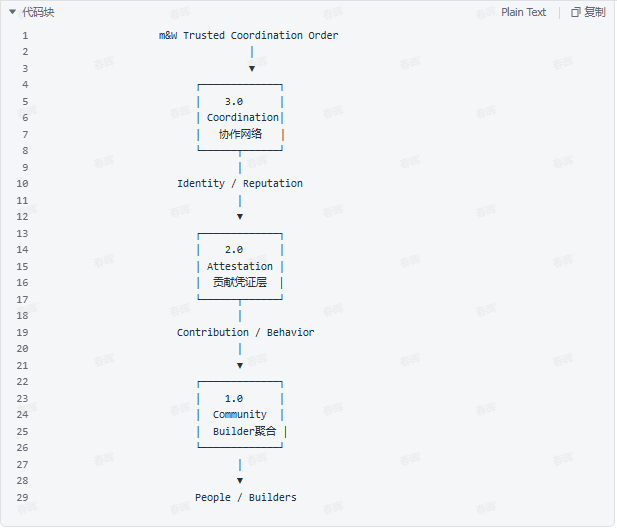
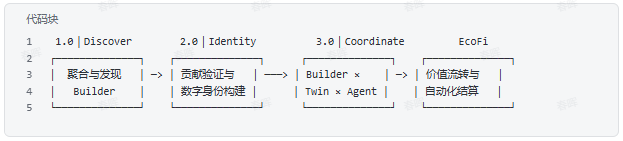
According to the article, m&W aims to bridge trust gaps among human builders, digital twins and intelligent agents. Its proposed distributed collaboration network spans four linked layers: Discover, Identity, Coordinate and EcoFi. In that structure, m&W 1.0 is presented as the first foundation block.
How m&W defines builders, digital twins and AI agents
The project argues that in the AI era, information, content, models and computing power are all expanding at an exponential pace and moving toward oversupply. What remains scarce, it says, is the Human Builder with original creative capacity.
Its framework assigns distinct roles to each participant. The Builder is the primary actor and the one who defines vision and judgment. The Digital Twin is a verifiable and computable mapping of that builder’s identity and cognition in the digital world. The AI Agent is the execution layer that can be authorized to act. The article states that no matter how agents evolve, the Builder remains the source of vision, aesthetic judgment and trust. In that view, agents do not replace builders; they extend a builder’s coordination range through the digital twin.
The coordination problem m&W says current platforms have not solved
m&W places the problem in both Web2 and Web3. Developers and creators are scattered across Twitter, Discord, GitHub, DeSo and other platforms. Some tools already support on-chain address binding or decentralized content storage, but the project says those pieces still do not solve the central coordination issue.
As described in the article, most platforms only record self-claims or isolated social interactions. They do not let a network verify what a person consistently pays attention to, how that person makes judgments, what credible history they have built, or whether they are worth coordinating with across different entities.
That is the reason m&W 1.0 gives itself a specific tactical role: aggregate scattered people, information, opinions and builders into one network, then capture cognitive signals through repeated real interaction. Those signals are meant to help discover, filter and retain builders the network considers valuable. The article says the resulting cognition and behavior data will later serve as a base layer for verifiable identity and digital twins.
It condenses that logic into one line: information comes from the internet, judgment comes from builders, trust comes from long-term contribution, and trust becomes coordination infrastructure.
User entry point, profile structure and on-chain identity mapping
The user flow starts at app.cmw.place, where people connect a wallet or Web3 identity. The article says this is more than opening a community account. It is framed as the starting point of a Builder Identity.
A user page is described as the entry point for cognition and contribution inside the m&W network. Beyond basic profile information, it is meant to record screening preferences, judgment logic, the depth of insight and connections with other nodes in a dynamic way.
On the asset and credential side, the project says on-chain formats such as NFTs and SBTs will become verifiable expressions of builder identity, node level and ecosystem rights. In its telling, these formats allow identity and rights to be recognized and verified by the network, while also making them portable across platforms as digital credentials.
CMW as an early contribution signal
The CMW metric shown on profile pages and content cards is defined in m&W 1.0 as a quantitative signal of community participation and contribution behavior. The article stresses that CMW should not be read as a standard points system. It calls the metric an early experiment in a contribution economy.
Over the longer course of m&WDAO, the project says these early behavior signals will support future contribution records, reputation systems and mappings for node-related rights.
Interaction is centered on interpretation, not content volume
m&W 1.0 draws a sharp line between itself and a conventional content platform. Users do not need to produce more content, the project says, because the internet already has an abundance of information. The real focus is how a builder interprets the same piece of information.
In the article’s wording, the internet provides information, m&W discovers cognition, and builders give information meaning.
Actions such as commenting, discussing and following other builders are treated as more than signs of community activity. They are framed as Collaboration Signals that grow out of cognitive signals. The project says these signals can converge into a Builder Network when users keep tracking a field, engage in deep discussion with specific nodes and repeatedly flag information that later gains consensus validation.
The stated objective in version 1.0 is not to reward meaningless high-frequency posting, but to let the network identify builders with deeper judgment more precisely.
Why the first step is a community MVP
The article asks why a project whose end goal is a trusted coordination order would begin with a community MVP. Its answer is that any durable order first needs trustworthy coordination subjects.
m&W lays out the sequence like this:
- Builder
- Identity
- Digital Twin
- Coordination
Under that logic, every judgment, comment and interaction generated in version 1.0 adds to a stream of cognitive signals. Over time, those signals form what the project calls a Cognitive Profile. That profile is intended to become the behavior and preference base for a future digital twin, allowing the twin to reflect a builder’s aesthetic sense, capabilities and judgment.
Version 2.0: from behavior to verifiable contribution and identity
The second stage is labeled Identity and is framed around the question, “What have you actually done?” To answer that, m&W says it will introduce an Attestation Layer that converts behavior accumulated in 1.0 into verifiable contribution.
In this setup, attestation is the base credential, while NFTs and SBTs serve as verifiable carriers of identity and rights. The article says on-chain credential mechanisms would move contribution away from self-claim and toward network verification, giving builders an on-chain identity backed by cryptography.
Version 3.0: from builder identity to a digital twin network
The third stage is labeled Coordinate and is framed around the question, “How do you enter the AI coordination network?” At that point, the Builder remains the main subject, the Digital Twin is the digitized identity and cognition map, and the AI Agent is the authorized execution layer.
The article gives the following formula:
- Digital Twin = Identity + Capability + Contribution + Reputation + Relationship
It defines the digital twin as a verifiable, computable and coordination-ready digital mapping of a real-world builder. The AI agent, by contrast, extends that builder’s automated execution capacity. In version 3.0, the project says Human Builder, Digital Twin and AI Agent would operate as a three-part unit and form the basic element of a distributed coordination network.
That is why m&W describes its progression not as a move from “community” to “protocol,” but as a path from “discovering builders,” to “verifying builders,” to “bringing builders’ digital twins and agents into trusted coordination.”
EcoFi and the loop linking contribution, reputation, coordination and value
Looking further out, m&WDAO says the intelligent-network era will raise a set of basic questions: who represents whom, who authorizes whom, how actions can be held accountable and how value should be settled. The article presents those questions as the core substance of a Trusted Coordination Order.
At the economic level, m&W says it rejects what it calls the traditional Web3 logic of “minting tokens out of thin air” and instead follows this chain:
- Contribution → Reputation → Coordination → Value
In the project’s model, real contribution accumulates reputation, reputation opens coordination opportunities, and coordination creates value flow. The EcoFi protocol is meant to route the value generated by real collaboration back to contributors more precisely. The article adds that CMW’s role in recording cognitive signals during 1.0 is the earliest experimental base for that contribution economy and future coordination settlement system.
The user progression m&W sketches out
In the closing section, the article describes a staged identity path inside the ecosystem:
- Participant
- Contributor
- Builder
- Trusted Builder
- Consensus Node
The project argues that as AI advances, it will not only replace part of a builder’s work but also redraw the boundary of builder productivity. In its framing, the builders who matter will anchor themselves in their own cognition, judgment and aesthetic sense, then use Digital Twin and AI Agent to extend personal capability into a sustainable digital coordination network.
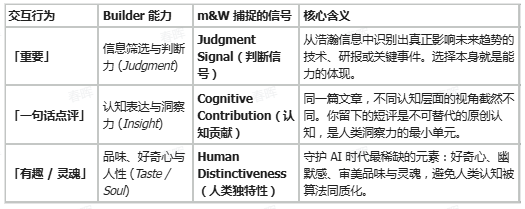
m&W also says users do not need to keep producing redundant information. What matters is proving how they understand the world. What they share shows judgment, how they comment shows insight, what they find interesting shows taste and soul, and the accumulation of those choices forms a Builder Identity.
The article ends by saying that one share on app.cmw.place may look small today. But if real cognitive actions are continuously recorded, attributed, verified and connected, then gradually turned into verifiable on-chain contribution and identity, they can converge into a durable digital identity base for the AI era and open the door to a trusted coordination order. In the project’s words, m&W 1.0 is not the end point; it is the first step toward becoming a builder in the AI era.
The original article also carries a disclaimer stating that markets involve risk and the piece does not constitute investment advice.