
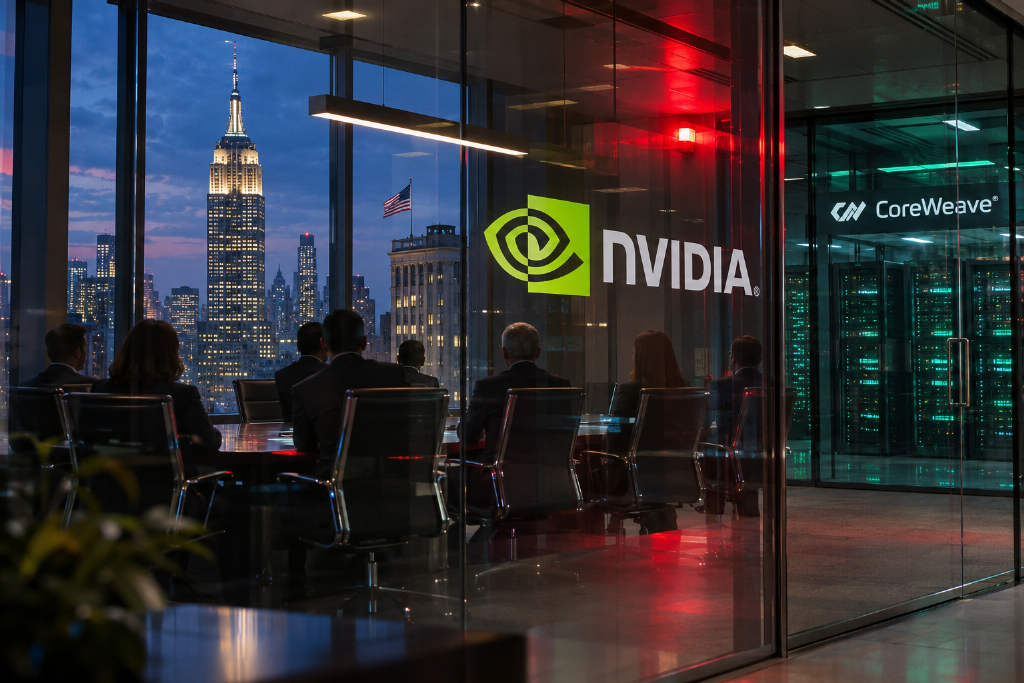
AI stocks rebound before Nvidia governance risk hits after hours
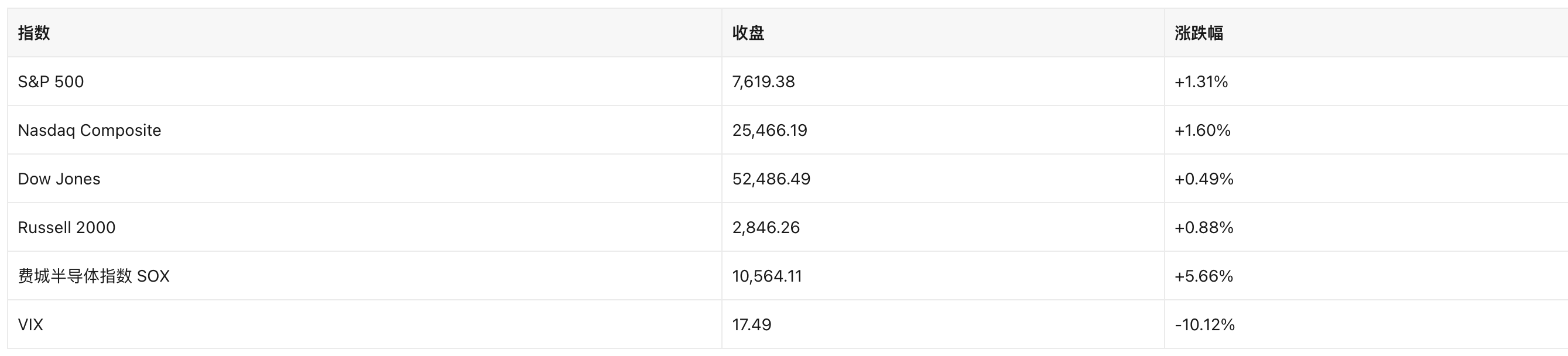
U.S. technology stocks rebounded on Nov. 11 after CoreWeave’s earnings report eased concerns about debt in the AI infrastructure sector. The company reported third-quarter revenue of $3.7 billion, up 168% from a year earlier, and raised its full-year revenue guidance to $13 billion-$13.3 billion. CoreWeave shares climbed 24.71%, their strongest single-day gain since April 2025, helping the Nasdaq Composite rise 1.60% and the Philadelphia Semiconductor Index gain 5.66%.
The market’s focus shifted sharply after hours to Nvidia. The Wall Street Journal reported that Nvidia’s board was preparing to discuss whether to remove Chief Executive Officer Jensen Huang. The report followed New York Times coverage of an alleged extramarital relationship involving Huang and Kimberly Powell, the company’s vice president of healthcare. The source material also says Huang had previously acknowledged a relationship with a woman suspected of being linked to China’s Ministry of State Security. Nvidia’s board has hired Wachtell, Lipton to conduct an independent investigation.
Nvidia shares traded at $158.78 at 8 p.m. ET, down 8.6% from the close. CNBC described the decline as more than 9%. Nvidia closed the regular session at $173.73, up 2.92%, but the after-hours move added management risk to the company’s upcoming earnings uncertainty. Nvidia is scheduled to report on Nov. 17. The source material says the stock had already fallen 7% earlier in the week and was facing a sixth consecutive weekly decline.
Index rebound follows a sharp AI selloff
The rebound came after a selloff in AI infrastructure stocks earlier in the week. The Nasdaq dropped 5.5% on Nov. 5 and briefly entered a technical correction. Investors had been pricing the midterm election result, ballot measures restricting data centers and concerns about AI infrastructure debt together. The Nov. 11 move was described as a short-covering rebound.
CoreWeave said asset-level debt financing costs were expected to fall to 7%-7.5%, easing concern that its credit default swap spread had moved above 11%. The valuation anchor for the AI compute chain temporarily shifted from debt sustainability back to orders and capacity. CoreWeave’s chief executive said the company’s remaining 2027 capacity was 10 times oversubscribed. The company also emphasized a move toward asset-level debt financing, which it said had received high investment-grade ratings and was expected to price at 7%-7.5%.
The S&P 500 remained 2.5% below its record high of 7,811.54, while the Nasdaq was also below its peak. The move was a structural repair rather than a fresh index high. A further realization of Nvidia’s governance risk at the Nov. 12 open could erase a substantial portion of the previous session’s index gains.
Inflation data strengthens the December rate-hike trade
U.S. October consumer prices were released on Nov. 10. Seasonally adjusted CPI rose 0.4% month over month, exceeding expectations for a third straight month. Core CPI increased 0.3% month over month. Because a government shutdown in October 2025 created a data gap, the Bureau of Labor Statistics did not publish a 12-month CPI comparison this time. Investors therefore had to rely on monthly changes to judge the inflation trend.
The source material identifies tariff pass-through and services inflation as sources of pressure. Goolsbee described the reading as disturbing and close to alarming. Waller said a December rate hike was highly likely. If core CPI stayed near 0.3%, he said a 50-basis-point move should be considered. Logan argued for two more 25-basis-point increases and said policy could move faster in winter. Schmid warned against treating an oil-price shock as temporary.
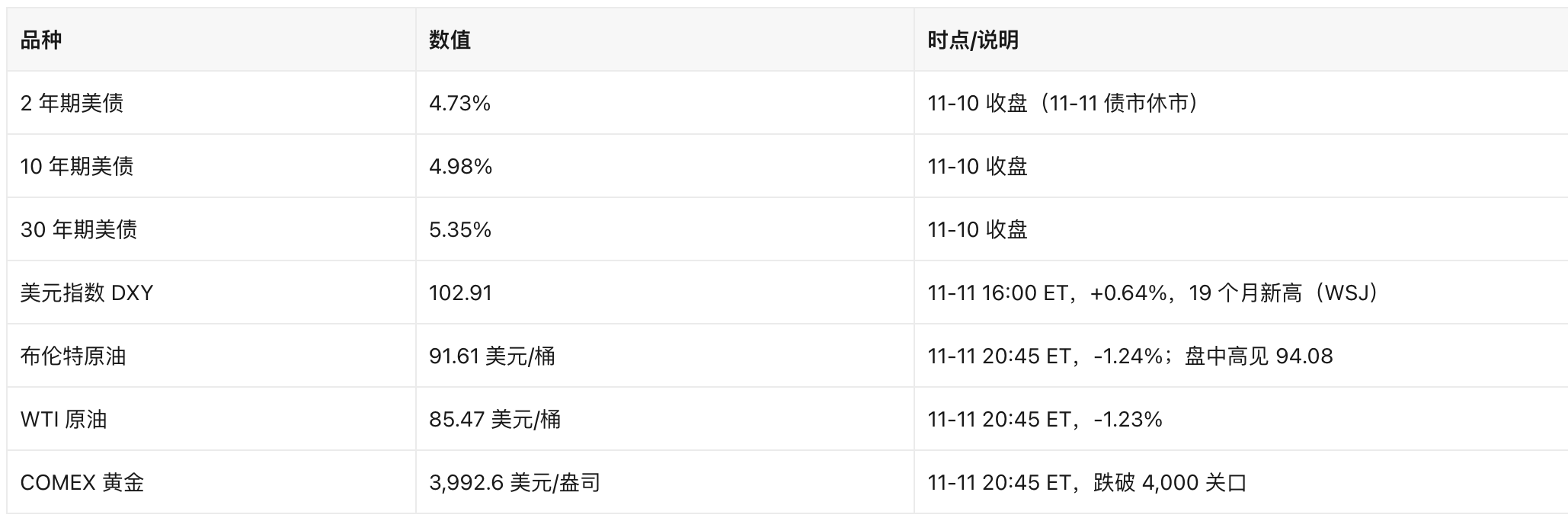
CME FedWatch put the probability of a December rate hike at 88% on Nov. 11. The market had shifted from pricing rate cuts to pricing rate increases. The 30-year and 10-year Treasury yields stood at 5.35% and 4.98%, respectively. Higher rates, term premium and Treasury supply continued to pressure the valuation center of high-growth assets. Technology stocks still rose, showing that short-term pricing power had returned to the AI fundamental story.
AI infrastructure, semiconductors and software diverge
CoreWeave closed at $60.77, up 24.71%. Alongside its $3.7 billion third-quarter revenue and 168% year-over-year growth, the company gave full-year revenue guidance of $13 billion-$13.3 billion, above the $12.86 billion LSEG estimate. Its adjusted operating income guidance was $1.275 billion-$1.375 billion, above Visible Alpha’s $1.07 billion estimate.
NBIS gained 15.44% and APLD rose 7.37%. Oracle added 8.82% to close at $128.38 as investors repriced its position as a data-center landlord. AMD closed at $552.90, up 7.32%, after committing $2.5 billion to an investment in Anthropic and appearing on Goldman Sachs’ preferred list. Intel rose 7.52% to $62.50, while Marvell and TSMC also advanced sharply. The semiconductor group gained broadly. Alibaba announced plans to spin out and list its T-Head chip business, which is positioned as a competitor to Nvidia chips; the source material identifies the medium-term competitive picture as a variable.
Software and mega-cap platforms faced a different repricing. Microsoft closed at $521.13, down 2.26%. Anthropic released Claude Sheets, targeting Excel and Office, raising concerns about the strength of Microsoft’s Copilot moat. Microsoft’s $1 billion investment in Anthropic also created a valuation tension in which a partner is also a competitor. Meta fell 1.97% and Amazon declined 1.74% as questions about returns on AI capital spending persisted. Meta’s infrastructure chief is scheduled to leave in early 2027. Apple rose 2.04%, Alphabet gained 2.11% and Tesla advanced 2.91%, showing a rebalancing between AI spenders and companies collecting revenue from AI demand.
Energy and brokerage shares
The energy ETF XLE rose 1.87%. Exxon Mobil closed at $166.71, up 1.36%, while Chevron ended at $213.28, up 0.98%. Brent crude briefly reached $94.08 before retreating. The source material links the move to the tension between Iran’s refusal to surrender enriched uranium and hopes for a diplomatic solution after the midterm election. Higher oil prices also feed into the Federal Reserve’s rate decision.
Interactive Brokers closed at $82.49, up 6.32%. High volatility and record trading activity improved expectations for brokerage revenue, making the stock a representative beneficiary of market turbulence.
MSCI removal creates passive-selling risk for digital-asset treasury companies
MSCI confirmed that Strategy, Metaplanet and Yellow Cake will be removed from its global indexes after the close on Nov. 30. The decision follows a new non-operating company rule. Companies whose assets are mainly cryptocurrency holdings will no longer be included as operating companies under the index methodology.
JPMorgan estimated that Strategy alone could face $2.8 billion in forced selling by passive funds. Some sell-side estimates put the upper end at $8.8 billion. The source material describes this as the first systematic downgrade of the digital-asset treasury, or DAT, model by mainstream index rules since the model was established in 2020.
The proposed transmission chain is index removal, passive selling before Nov. 30, a wider mNAV discount, weaker equity issuance capacity and a slower bitcoin-purchase flywheel. The source describes the pressure as structural rather than one-off.
Strategy reaches a record bitcoin holding while trading below treasury value
Strategy closed at $122.35, up 1.06%, with a market capitalization of $51.68 billion. Its 52-week range was $81.81-$239.24. The company held 850,364 BTC at an average cost of $75,451 per coin. On Nov. 9, it bought 1,036 BTC for $82 million and repurchased $188 million of STRC preferred stock.
At a BTC price of $73,621, the holdings were worth about $62.60 billion. The market-capitalization-to-bitcoin-value ratio was 0.83 times. The calculation excludes debt and preferred stock and is based on public data. BTC was 2.4% below Strategy’s average cost, meaning an unrealized loss had appeared on bitcoin bought through high-level issuance.
The MSCI removal window overlaps with the equity-issuance window. If Strategy continues to raise capital through an at-the-market program or convertible debt, issuing securities at a discount could increase dilution of bitcoin exposure per share.
DAT companies shift from entry to exits and reductions
Hyperscale Data exited its bitcoin strategy by selling its final 211.56 BTC. It abandoned a planned $100 million bitcoin treasury program and redirected funds to an AI data center in Michigan and debt reduction. The source material calls the move a clear signal that AI compute returns were being favored over returns from holding coins.
Mining companies were also selling coins to fund compute capacity. MARA reduced its bitcoin holdings while reporting $634 million in third-quarter profit. RIOT and Hut 8 likewise monetized holdings and directed funds toward AI and high-performance computing infrastructure. An industry statistic showed listed companies as a group recording $869 million of net bitcoin sales in one week, an unusually high level in recent months. The statistic came from a third-party compilation, had not been checked against company announcements transaction by transaction, and was labeled unverified.
Trump Media pledged 11,385 BTC and faces a $1 billion convertible-bond put option, creating a risk of forced selling. The information came from media reports and had not been confirmed by the company.
Crypto equities rise with AI risk appetite rather than bitcoin
The latest rise in crypto-related equities had almost no correlation with BTC. Bitcoin was up 0.1% over 24 hours, while the main pricing factor for crypto stocks was a recovery in risk appetite for AI infrastructure. If the AI narrative weakens again, the stocks would have less support from coin prices and could show larger downside moves.
IBIT closed at $42.24, up 1.34%, and FBTC ended at $64.88, up 1.30%, with both funds following a modest rise in BTC. IBIT had recorded net outflows for seven straight trading days. During the week of Nov. 3-7, U.S. spot bitcoin ETFs recorded combined net outflows of $1.28 billion, including $1.21 billion from IBIT. The figures use the Farside methodology and were relayed by multiple media outlets. Single-day flow data for Nov. 11 had not yet been released, while CoinDesk reported that selling pressure had eased.
The source material lists the theft of $6.3 billion in Binance assets, hacking activity linked to North Korea, a chief financial officer change and a reversal in regulatory expectations after the midterm election as relevant triggers.
Regulatory, index and accounting risks
Warren is scheduled to become chair of the Senate Banking Committee in January. Blumenthal has set a Jan. 4 response deadline for Binance, Tether and others. The source material says DAT companies and stablecoins face investigative-style regulation rather than friendly regulation.
MSCI’s non-operating company rule could be copied by other index providers, including FTSE and S&P DJI. The source identifies this as a systemic risk at the accounting and index-methodology level, with a potentially wider reach than a single enforcement action. Russia’s central bank approved exchanges to open BTC trading on Nov. 22; this is included only as overseas regulatory background.
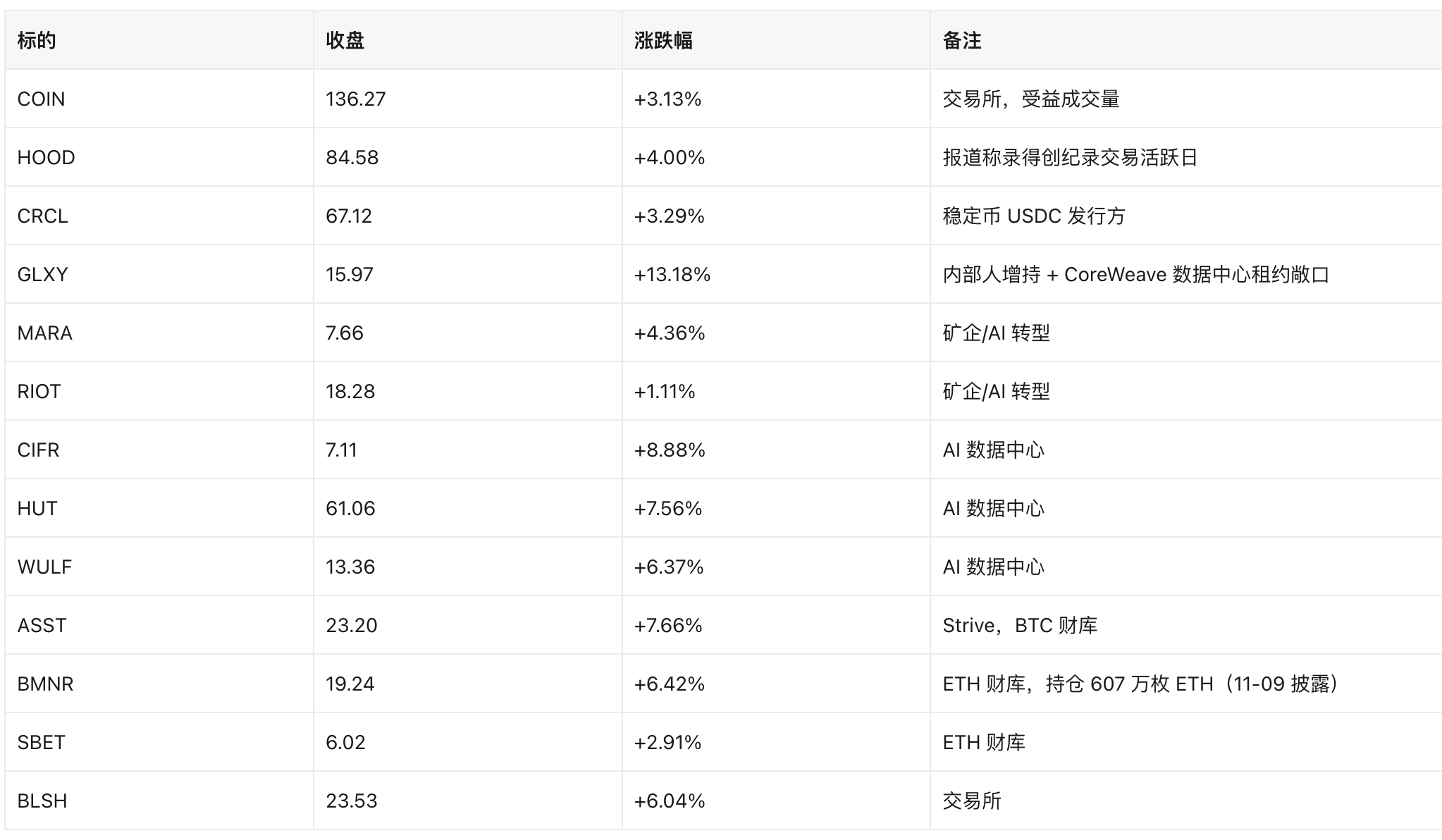
Hyperscale Data was removed from the current watch list after selling 211.56 BTC and abandoning its $100 million treasury plan. New risk-watch names include Trump Media and Twenty One Capital. Twenty One Capital trades under XXI at $5.26, with a market value of $2.96 billion. It is a Tether-linked treasury company whose market value has fallen below the $3.9 billion value of its bitcoin treasury, leaving its discount under observation.
Geopolitics, oil and policy pricing
Iranian parliament speaker Ghalibaf said the Strait of Hormuz would never return to its prewar condition. Iran said it had given a clear response to a U.S. proposal and was waiting for Washington’s decision. U.S. media reported that Trump was considering another military strike or tougher sanctions. Iran also said it had attacked an island in Oman that it claimed was used for U.S. military operations.
The source material describes the chain as follows: shipping through the strait has not returned, Brent remains above $90, and the U.S. Energy Information Administration expects the price to approach $100 before year-end. U.S. gasoline prices have fallen below $4 per gallon, but energy remains a major upside risk for CPI. That could strengthen expectations for a December rate hike, keep long-term yields and the dollar high, and pressure high-valuation technology stocks and crypto assets.
A diplomatic breakthrough could send oil prices down by more than $10 and support risk assets. The source describes this as the variable most capable of reversing the rate-hike trade.
After the midterm election, Democrats won majorities in both chambers and Republicans became the minority party. Thune and Jordan serve as minority leaders. Sixteen House districts remained undecided, but control had been determined. Ballot measures restricting data centers passed, and Democratic lawmakers called for a national data-center moratorium, directly pressuring AI infrastructure. Expectations for healthcare and financial regulation rose. Fiscal expansion became more constrained, although pressure from long-term Treasury supply might not ease.
For crypto, Warren’s expected leadership of the Senate Banking Committee and a possible shift in stablecoin and DAT policy toward investigations form part of the policy backdrop to spot crypto ETF outflows. AI stocks still rallied sharply on Nov. 11, suggesting that some policy negatives may already have been priced in. Implementation will not come until the new Congress takes office in January.
Canada’s ambassador to the United States warned that Trump’s tariffs would raise costs and threaten investment in the United States. Goolsbee has explicitly identified tariff pass-through into CPI as one structural source of persistent inflation.
What to watch over the next 24 hours
Before the Nov. 12 open, investors will receive NBIS results, which may show whether the CoreWeave-led move can continue. After the close, attention will turn to Cisco, Applied Materials, Nu Holdings and Cerebras, listed under the tickers CSCO, AMAT, NU and CBRS. Applied Materials will offer a direct read on semiconductor-equipment conditions and on whether the Philadelphia Semiconductor Index’s 5.66% gain can persist.
Nvidia governance risk remains the top priority. The key questions are whether the board issues a formal statement on Huang’s position, whether Congress advances tighter restrictions on chip exports to China, and whether sell-side firms cut ratings or price targets. A decline of more than 5% at the open could pull the Nasdaq back toward the previous session’s gains.
On the macro side, the Nov. 12 OPEC monthly report is due. Mortgage Bankers Association data showed the 30-year mortgage rate falling to 7.21% from 7.30%. On Nov. 13, markets will watch initial jobless claims, expected at 194,000, existing-home sales and a 30-year Treasury auction. The previous auction yield was 5.618%. Barr, Goolsbee, Daly, Schmid and Williams are also scheduled to speak. Demand for long-duration Treasuries will be a test of whether the rate-hike trade has become too aggressive.
In crypto, the focus is on passive rebalancing before MSCI’s Nov. 30 removal takes effect, support for Strategy near $122 and the Nov. 11 flow data for U.S. spot bitcoin ETFs. The data is usually released the following morning Beijing time, and investors will look for signs that IBIT can end its seven-session outflow streak. New announcements from listed companies buying bitcoin for the first time or converting to a DAT model are also on the watch list. Such announcements are considered less likely in the current environment and would represent a move against the prevailing trend.
In the primary market, media reports put Anthropic’s pricing range at $70-$78 and its planned listing date at Nov. 19. Because the information had not been independently verified against a prospectus, the source material did not adopt a specific valuation figure. Roadshow demand could affect the valuation anchor for AI stocks and trigger a reassessment of Microsoft and Amazon’s holdings.
The source data includes Msx, Yahoo Finance and Nasdaq market data; the U.S. Treasury’s Daily Treasury Par Yield Curve; the Bureau of Labor Statistics; Nasdaq Calendar; and crypto prices from Msx as of Beijing time on Nov. 12, 2026. This article is an information summary and analysis, not investment advice.



