
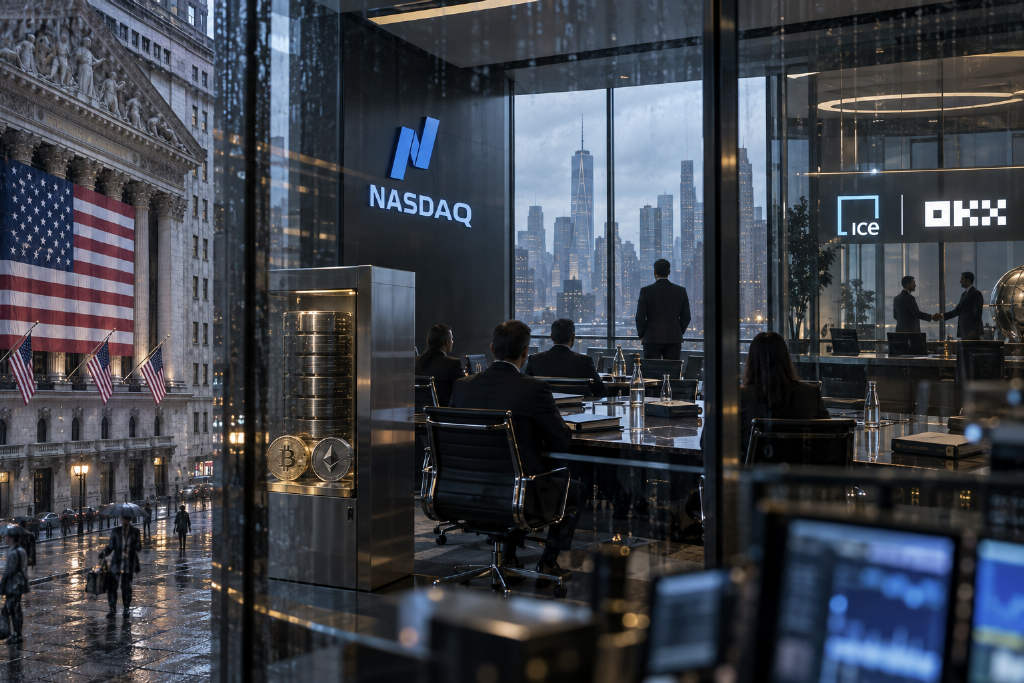
Nasdaq said on Sept. 10 that it invested $100 million in Payward, the parent company of Kraken, through one of its investment arms. The transaction values Payward at $21 billion after closing.
At the same time, Intercontinental Exchange (ICE) and OKX had already announced in June that they were forming a 50:50 joint venture. Once regulatory approval is secured, the venture plans to operate as a U.S.-registered broker-dealer and futures commission merchant, giving OKX users access to ICE futures markets and the New York Stock Exchange’s tokenized stock market.
Traditional exchanges move on crypto access points
According to the report, the two deals point in the same direction: traditional exchange groups are no longer limiting themselves to studying blockchain-based market structure. They are moving directly to acquire access points, licenses and on-chain settlement capabilities.
Other exchange operators are making similar moves. Deutsche Boerse bought roughly 1.5% of Payward in April for $200 million. The London Stock Exchange is also working with Payward on xStocks tokenization for London-listed shares. Nasdaq, NYSE, Deutsche Boerse and the London Stock Exchange are now treating crypto platforms as next-generation market pipes rather than competitors.
Payward valuation and IPO timeline
The report said Payward raised $800 million in November 2025 at a $20 billion valuation and confidentially submitted an S-1 filing to the U.S. Securities and Exchange Commission. Its IPO, however, has been delayed to no earlier than the second quarter of 2027.
Nasdaq’s investment at a $21 billion valuation marks a new high for Payward over the past year. The report said that shows traditional exchange operators are willing to pay a premium for tokenization channels.
Regulatory approval remains a hurdle
Regulatory clearance is still a key condition. The ICE-OKX joint venture needs U.S. broker-dealer and FCM licenses, while Nasdaq’s equity token plan must align with the existing securities framework.
The report said Wall Street is no longer just watching crypto from the sidelines. It wants to fold crypto into its own trading hours, clearing networks and retail distribution channels.