
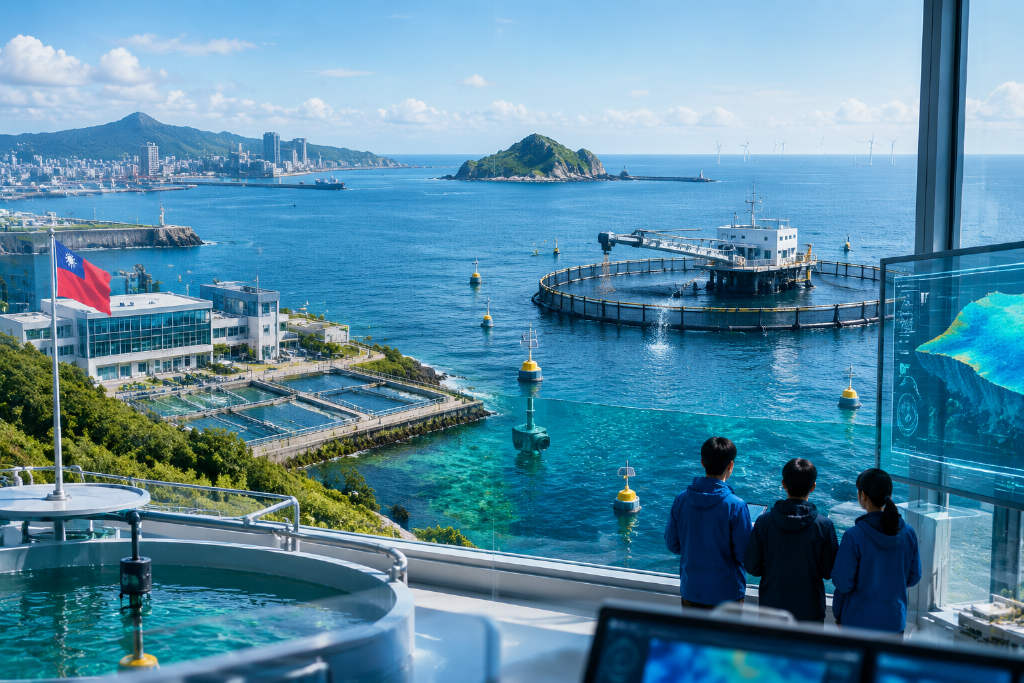
National Taiwan Ocean University presented six forward-looking patented technologies at this year’s Taiwan Innotech Expo, with projects spanning aquaculture, biotechnology, marine governance, and fisheries digitization.
According to a report cited from Science in View, Taiwan began introducing artificial intelligence into the aquaculture industry on a broad scale around five to six years ago. AI-based aquaculture systems use multiple sensing components and algorithms to build automated workflows that monitor underwater environmental changes around the clock. The university’s research teams combine water-color observation with water-quality data, underwater imaging for fish weight estimation, and splash intensity during feeding to support precision feed control, reduce feed waste that accounts for more than half of farming costs, and build datasets for the transformation of Taiwan’s fisheries sector.
AI feeding systems turn experience-based farming into data-driven management
Traditional aquaculture has relied heavily on manual interpretation of water color and direct observation of fish behavior, a process that can lead to wasted resources and blind spots in monitoring. The research team at National Taiwan Ocean University introduced optical cameras with color-card calibration and combined them with pH and dissolved oxygen data to make those judgments measurable.
The team also uses underwater image recognition to estimate fish length and weight, then pairs that with observations from feeding machines to measure how intense the water splash becomes when fish gather to eat. That setup enables AI-based automated feed control. Since feed accounts for more than 50% of aquaculture costs, more precise feeding can directly improve profitability. Round-the-clock monitoring can also detect abnormal feeding behavior early and issue warnings that may reduce the risk of disease spread. In periods of high temperatures and prolonged drought, water-quality monitoring and decision databases can also help fish farmers respond to salinity shifts and cut the trial-and-error burden involved in passing operations to the next generation.
Award-winning work includes preservation and precision feed delivery
In aquaculture and biotechnology, Associate Professor Pan Yen-Ju’s team received a bronze medal for its "Dormant Zooplankton Egg Preservation System and Method." The group established what the report described as an optimal preservation process for dormant zooplankton eggs, allowing effective control of microbial contamination, slower decline in biological activity, and maintained hatching quality after long-term storage.
The project addresses a longstanding limitation in conventional live-feed production, which usually requires continuous resource input for cultivation, and offers an innovation platform for stable seedling production in aquaculture.
Another project, developed by Professor Chang Chung-Cheng’s team, focused on precision aquaculture. Its "Aquaculture Area Feed Delivery System" moves away from blind feeding based on fixed schedules and fixed quantities. Instead, it monitors ripple dynamics generated when aquatic organisms gather in real time and calculates a feeding volume that better matches actual consumption needs. The target is twofold: reducing feed waste and protecting water quality in farming areas.
3D dynamic marine mapping is being used in offshore governance
The research team also developed a domestic "Next-Generation Global 3D Real-Time Dynamic Ocean and Fishery Geographic Information Analysis System." It integrates data from the Automatic Identification System (AIS), Vessel Monitoring System (VMS), and Vessel Data Recorder (VDR).
The system divides the sea into latitude-and-longitude grids. It uses a resolution of 0.25 degrees, or about 25 kilometers, in distant-water areas, and 0.001 degrees, or about 100 meters, in coastal and nearshore waters. The result is a 3D presentation of vessel tracks and catch height data. Officials can use it to assess whether a vessel is engaged in fishing operations and cross-check that information against catch permits and quota records to help block illegal, unreported, and unregulated fishing, or IUU fishing.
The same technology is also being applied in offshore wind development. Through 3D layers, it is used to clarify the actual effect of wind farm construction on the operating intensity of traditional fishing grounds.
Electronic Monitoring system raises efficiency in catch review
To improve catch documentation in the field, the team developed an Electronic Monitoring system designed to cope with non-standardized deck layouts on Taiwan fishing vessels and poor nighttime lighting. In complex conditions, including visual obstruction and water splashes hitting the camera, the AI system can still identify fish species with accuracy above 80%.
Under that workflow, reviewers only need to confirm key marked timestamps to complete the audit. For the species-rich coastal and nearshore segment, the team is continuing to expand its recognition model library and is also developing a civilian mobile communication app to simplify paper-based reporting.
Work also extends to alternative protein and MSC certification
The report said the broader research effort stretches from alternative protein development on the aquaculture side to work tied to Marine Stewardship Council, or MSC, sustainability certification in distant-water fisheries. As field knowledge is converted into digital assets, AI-based smart fish farming is being positioned in the report as a key tool in Taiwan’s effort to balance economic returns with ecological sustainability.