

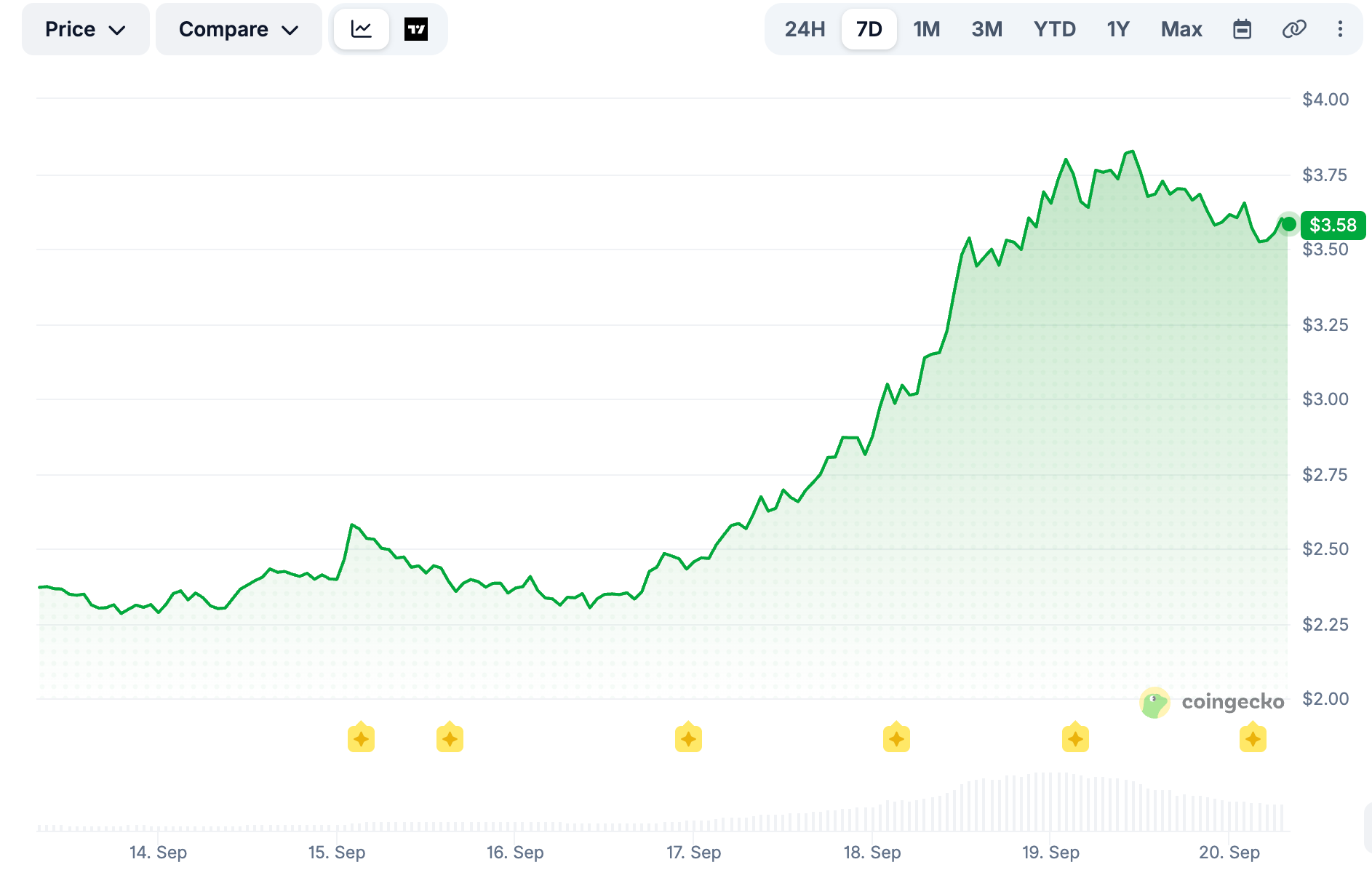
NEAR rose from around $2.3 to above $3.9 over the past week, with gains at one point exceeding 50%. That made it one of the strongest-performing major altcoins in recent trading and one of the most discussed names in the market.
The story around the move is different from NEAR’s older pitch centered on sharding and high-performance base-layer infrastructure. This time, the network is trying to tie together several active sectors at once, including cross-chain trading, privacy, perpetual futures and AI agents, and present them as part of a single product stack built around actual trading demand.
NEAR@3.33 links token unlocks to TVL and price
In June, NEAR launched the NEAR@3.33 milestone incentive program to reward users who use privacy trading features on near.com. The first reward pool contains 333,333 NEAR, and two targets must be met before the rewards fully unlock.
The first target was for assets held in near.com privacy accounts to reach $70 million. That threshold was met on Sept. 17, which triggered the first snapshot. Accounts that held more than $100 in privacy assets at the time and completed at least one private swap are eligible for the distribution. Final allocations will be calculated based on holding duration, asset size and trading activity. A single wallet can receive no more than 2% of the pool, a cap designed to prevent the rewards from being concentrated among a small number of large holders.
The second target is for NEAR’s three-day volume-weighted average price to exceed $3.33. After the snapshot, users receive NEAR@3.33 milestone tokens that cannot be traded or transferred. Those tokens convert 1:1 into liquid NEAR only if the three-day volume-weighted average price reaches or exceeds $3.33.
At $3.33, the first-round rewards are worth about $1.11 million. NEAR had already stayed above $3.33 for two straight days starting Sept. 18, and Sept. 20 was the final day in the three-day price test. If the volume-weighted average price remained above $3.33 on that day, the unlock condition would be satisfied.
From a general-purpose chain to a cross-chain trading entry point
NEAR’s product positioning has shifted in a visible way.
For a long time, the market mainly associated the chain with sharding, high TPS and low gas fees. Those features matter, but they have been hard to turn into a clear point of separation from other blockchains. NEAR is now putting more weight on NEAR Intents and near.com, with the aim of becoming a unified trading entry point that connects multiple chains rather than limiting activity to its own ecosystem.
NEAR Intents is built around a model where users specify the outcome they want without defining the execution path. In a conventional cross-chain swap, a user often has to choose a bridge, move assets to the destination chain, prepare the right gas token and then complete the trade on a DEX. With NEAR Intents, the user only states what they are willing to give and what they want to receive.
If a user submits an order to swap ETH on Ethereum for ZEC, for example, the system sends that request to multiple market makers, which compete on price, speed and execution quality. The user does not need to know which bridges or liquidity pools are involved, and does not need to hold gas on the destination chain in advance. As long as the final amount received is not lower than the quoted amount accepted at signing, the trade can go through.
NEAR Intents is not limited to near.com. It can also be integrated into other wallets and applications through the 1Click API and trading components. According to the article, Ledger, Brave Wallet, Infinex, THORSwap and HOT Wallet have already adopted its cross-chain trading service, and Stargate has integrated NEAR Intents on some cross-chain routes. That means some users may already be using NEAR Intents for pricing and settlement through third-party products without ever visiting near.com.
NEAR Intents has now connected more than 30 blockchains and processed more than $30 billion in cumulative cross-chain volume. At the protocol layer, it charges 0.0001% per transaction. Wallets and apps that integrate the 1Click API can add their own platform fee on top. In practice, this means NEAR is no longer insisting that assets and applications move onto its own chain. Instead, it can sit in the background and provide routing and settlement for assets that originate elsewhere.
Privacy trading becomes a new point of differentiation
After building out cross-chain execution, NEAR added privacy features on top of NEAR Intents through a product called Confidential Intents. The goal is to address a familiar problem in on-chain trading: order information can become visible before execution.
When a standard on-chain transaction enters a public mempool, outside observers may be able to see the wallet address, the asset involved, the size and the timing. For larger trades, that can expose positions and trading strategies and create room for front-running, sandwich attacks and other forms of MEV.
Confidential Intents sends trade requests to a private shard on Near. Quotes and execution do not appear in the public mempool, and that shard does not provide a public RPC endpoint or block explorer. As a result, outside observers cannot directly see what order a user submitted or what quotes different market makers returned. Once the trade is completed, assets still arrive at the public chain address chosen by the user, but it becomes harder to fully connect the funding address, the trade direction and the final receiving address. Users can also generate viewing keys and disclose records to auditors or other designated parties.
ZEC is presented as a representative case of how NEAR is combining cross-chain execution with privacy demand. Zodl Wallet has integrated NEAR Intents, allowing users to swap BTC, USDC or assets from the Solana ecosystem directly into ZEC held in a privacy pool. That removes the need to first move funds to a centralized exchange and then withdraw them to a Zcash privacy address. In this setup, ZEC provides the privacy asset and shielded address layer, while NEAR Intents aggregates liquidity from other chains and acts as the cross-chain access route into the Zcash privacy ecosystem.
Alex Shevchenko, head of NEAR Intents, said, 「Privacy is rapidly becoming a core industry need, and NEAR is becoming the infrastructure that helps make private trading the default choice. By combining cross-chain liquidity with protection against front-running and strategy leakage, institutions and DeFi users can execute large trades while preserving privacy.」
As interest in ZEC trading rises, demand from users moving into Zcash from BTC, ETH and Solana ecosystems could bring more volume and fee generation to NEAR Intents. NEAR is not itself a privacy coin, but by offering a cross-chain entry point for privacy assets and obscuring trade paths and execution details, it is increasingly being discussed within that theme.
Hyperliquid integration extends the model into perpetuals
In June, near.com integrated Hyperliquid perpetual futures. Users can trade more than 50 perpetual markets provided by Hyperliquid directly on near.com, with leverage of up to 40x. On Sept. 17, the feature was expanded with a privacy mode.
Under the usual flow, users who want to trade on Hyperliquid need to prepare supported margin assets and deposit them through the required network. Near.com folds cross-chain funding into that process. Users can deposit different assets from more than 30 blockchains, and NEAR Intents handles the swap in the background, converting them into the USDC margin accepted by Hyperliquid before sending the funds into the trading account.
The privacy mode is mainly designed to obscure the funding path into Hyperliquid. Orders and positions still appear on Hyperliquid, but it becomes harder for outside observers to connect the trading account, the deposit path and the user’s main wallet. In other words, the feature does not hide the perpetual trade itself. It reduces the chance that a user’s source of funds and primary wallet can be tracked together.
In this arrangement, Hyperliquid provides the perpetual markets, order book, liquidity and execution. Near.com handles the account entry point, cross-chain deposits and privacy processing. Near.com can also collect an extra front-end service fee through Hyperliquid’s Builder Code when users trade. That gives it a path to evolve from a one-off cross-chain swap tool into a trading gateway with recurring fee income. Compared with a single swap, perpetual trading happens more frequently, which creates a more durable fee opportunity for near.com.
AI agent thesis offers longer-term upside, but remains early
Beyond cross-chain trading, privacy and derivatives, NEAR is also positioning itself as settlement infrastructure for AI agents. The idea is to let AI systems manage assets safely and carry out trading, payments and tool calls on their own.
NEAR co-founder Illia Polosukhin said, 「Only if agents are secure enough can an agent economy truly take shape.」 To support that goal, NEAR has assembled a set of products designed to work together. NEAR AI provides private inference. IronClaw isolates tools and account credentials inside a trusted execution environment so private keys and user data are not directly exposed to the model. Chain Signatures allows agents to sign transactions across different blockchains. NEAR Intents handles cross-chain swaps and settlement. Combined, those components allow an agent to move assets across multiple chains based on user instructions without manually dealing with bridges and gas on each network.
Still, this part of the strategy is at a much earlier stage than NEAR Intents, which has already generated tens of billions of dollars in trading volume. Whether AI agents can create on-chain payment and trading demand at scale, and whether that activity can eventually translate into protocol revenue for NEAR, will require more real-world data.