
Strong headline results mask execution issues
Nebius (NBIS.US), the AI cloud company, released its third-quarter 2026 results before the U.S. market opened on Nov. 12. Revenue and earnings came in above consensus, and GAAP operating profit turned positive for the first time. The stock had already gained about 15% the following day after CoreWeave reported strong results, meaning part of the quarter’s strength had been priced in before Nebius reported.
The detailed numbers were less straightforward. Capacity deployment was delayed, order growth slowed and cash flow deteriorated as capital spending continued to rise.
Revenue rose 68%, but a large portion was one-time revenue
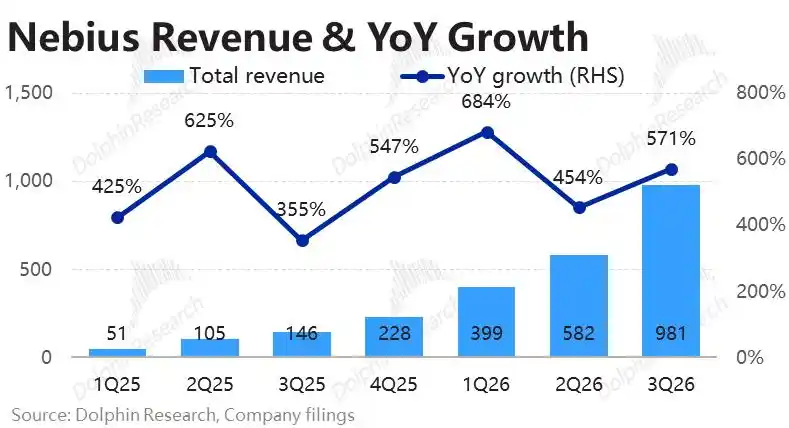
Third-quarter revenue reached $980 million, up 68% quarter over quarter and roughly $400 million higher than the previous quarter. The figure was above the $930 million consensus estimate. AI cloud revenue contributed $970 million, or about 99% of group revenue.
About $330 million, however, came from one-time activation revenue tied to the first phase of an asset-light partnership model. Nebius expects this type of revenue to become more recurring over time. Because the company also experienced delays in building out capacity, the revenue beat may have been driven disproportionately by that one-time item.
Quarter-end annual recurring revenue stood at about $6.4 billion, more than double the $3 billion recorded at the end of June and nearly 40% above consensus. The metric may also have been inflated by the one-time revenue. Nebius said it would stop using ARR as a business measure and moved its previous year-end ARR goal of $7 billion-$9 billion to a target of exceeding $7 billion in February 2027.
Pricing improved, while RPO barely moved
New contracts signed during the quarter generated more than $25 million in annualized revenue per megawatt, compared with more than $20 million in the prior quarter. The average price per GPU hour was also more than 20% above the second-quarter average. Nebius again said that three- to six-month cluster pricing is more than twice the price of contracted capacity.
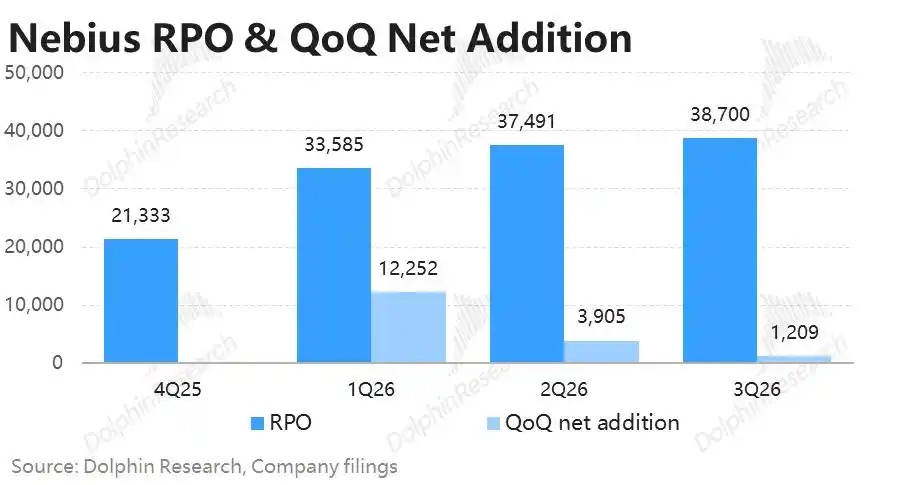
Those higher rental prices were already reflected in the recent recovery in the stock and did not represent a new source of upside. Remaining performance obligations reached about $38.7 billion, up only 3% from the previous quarter, an increase of roughly $1.2 billion. That could mean Nebius was directing more capacity toward flexible short-term contracts, or that it encountered difficulty signing new deals during the third quarter.
The company said it had signed more than $12 billion in contracts since the start of the third quarter, including several billion dollars of five-year agreements. Most were signed after the quarter ended and will be reflected in fourth-quarter RPO. Contract activity has therefore improved from the weak third-quarter booking pace.
Third-party site delays push back capacity deployment
Several third-party hosted sites were delayed until the first half of 2027. At the New Jersey project being built for Microsoft, more than half of the contracted capacity is expected to be delivered by the end of 2026, while the remaining batches are scheduled for the second quarter of 2027. Nebius said its own sites were on schedule or ahead of schedule, and that the U.S. election had not affected either its owned or hosted sites.
The company’s New Jersey and other third-party projects faced power-related issues. Site owners removed temporary generators earlier than expected, while replacement fuel cells did not ramp up quickly enough. Since late October, Microsoft has said that some third-party capacity deliveries were delayed. Reports also emerged that the New Jersey project was being pushed back and that Microsoft was narrowing its list of new-cloud partners. Management said the delay would last only several months, that Microsoft had participated in rescheduling and that the contracts remained in place.
The delays led Nebius to lower its fourth-quarter revenue outlook and postpone the point at which ARR would exceed $7 billion. For a new cloud provider that must move quickly from financing to construction, deployment and revenue generation, spending that has not yet produced revenue is a material execution problem. From 2027 onward, more new capacity will be built at owned sites, leaving Nebius to carry more of the construction risk itself.
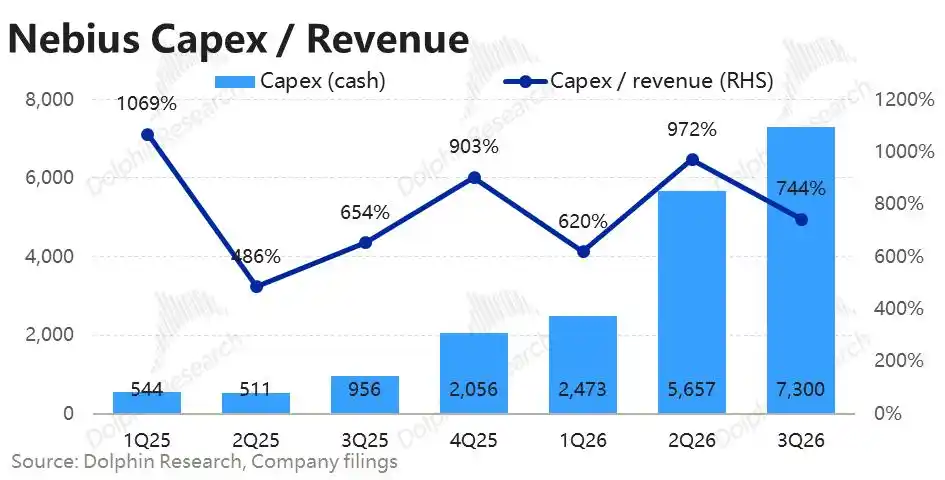
Capital expenditure was about $7.3 billion in the quarter, up nearly 30% sequentially and broadly in line with consensus. It was equivalent to roughly seven times quarterly revenue. Excluding the one-time asset-light revenue, capital expenditure was about 11 times cloud-rental revenue. Spending therefore continued to increase even as the pace of capacity deployment slipped.
Operating cash flow turned negative
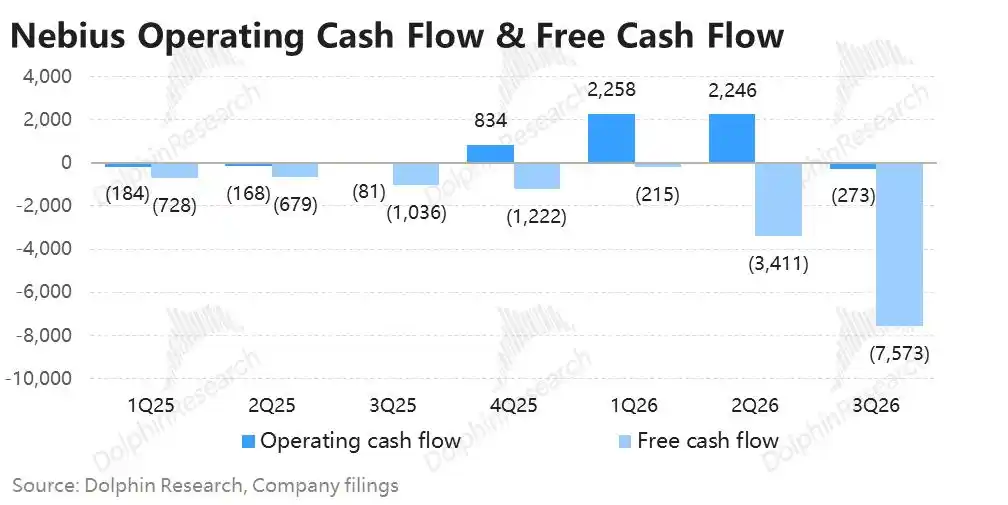
High capital expenditure pushed third-quarter operating cash flow to negative $270 million. The previous two quarters had each generated about $2.25 billion of net operating cash inflow. Free cash flow outflow was about $7.6 billion, well below expectations.
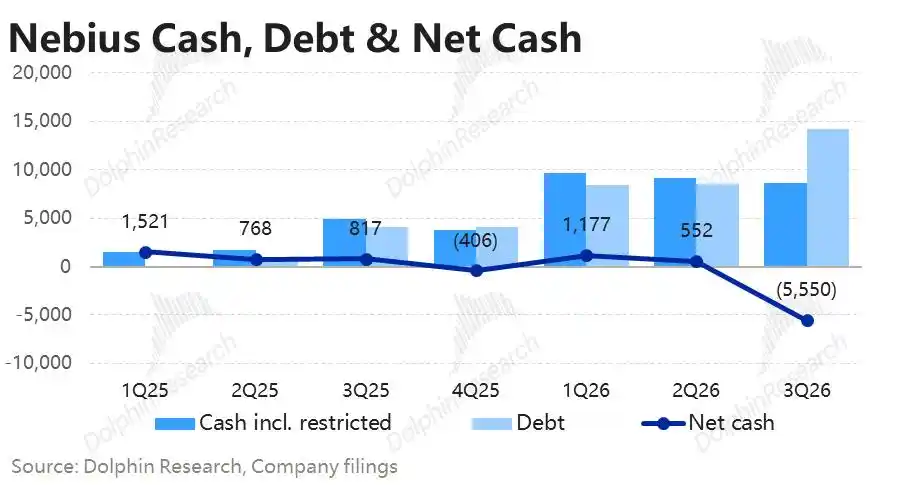
Cash declined while Nebius added about $5.7 billion of debt. The company consequently moved from a net-cash position to roughly $5.5 billion of net debt. Nebius had previously relied mainly on equity financing, but the scale of spending has now produced a clear deterioration in its balance-sheet structure.
The weak operating cash flow was mainly linked to a roughly $3.8 billion increase in accounts receivable, indicating that customers’ cash payments were delayed. Nebius said more than 90% of contracts longer than one year signed in the third quarter included upfront payments. Those payments covered 100% of the capital expenditure required for the related contracts, compared with 50%-60% in the prior quarter.
Nebius also signed its first five-year AI-cloud contracts. These were expansions by existing customers into new capacity. The company added multiyear agreements with Databricks, Datadog and Snowflake, which are not AI labs, continuing a move toward a more diverse customer base.
Profitability benefited from one-time revenue and low depreciation
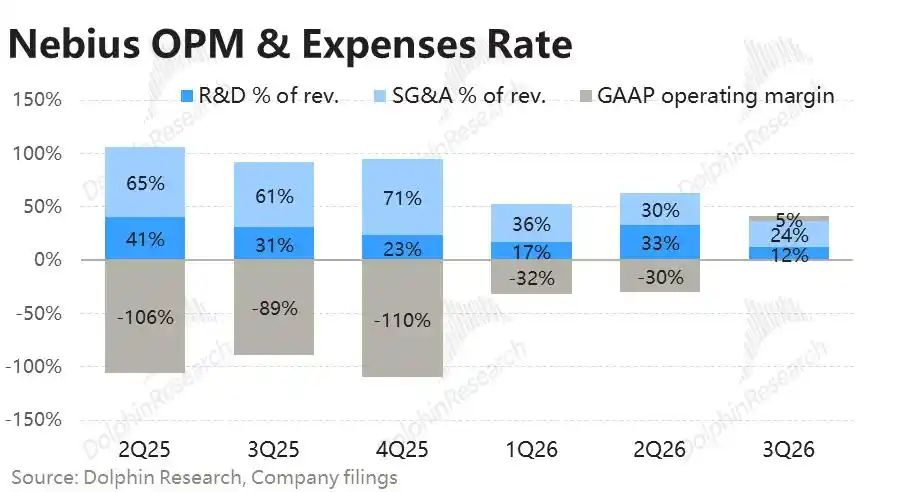
Group adjusted EBITDA was $470 million, producing a 47.5% margin. That was about nine percentage points above consensus and marked the third consecutive quarter of margin expansion. The AI cloud segment posted a 53.2% adjusted EBITDA margin, compared with 49.7% in the previous quarter. GAAP operating profit was $50 million, also a first for the company.
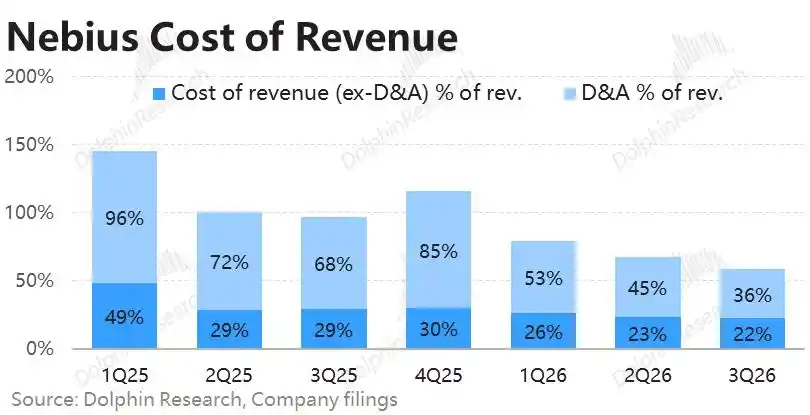
Two factors make the profit beat less representative. First, roughly $330 million came from the asset-light one-time activation revenue. When Nebius introduced the model in the second quarter, it said the model carried high margins and required almost no capital investment. Second, depreciation was only $350 million, about 40% below consensus. Depreciation as a share of revenue fell to 36.2% from 44.6% in the previous quarter.
The delay in capacity construction likely left a large amount of equipment not yet in service and therefore not yet depreciating. On that reading, much of the GAAP operating-profit beat came from the lower depreciation charge. Depreciation could rise sharply once the delayed capacity is brought online.
Nebius’ chief financial officer said the company would have to absorb rent, power and personnel costs before new sites go live in the fourth quarter. The full-year margin guidance of about 40% implies a fourth-quarter margin of roughly 35%.
2026 guidance cut while capex guidance rises
Because some third-party capacity has been delayed into the first half of 2027, Nebius cut its 2026 revenue guidance from $3.0 billion-$3.4 billion to $3.0 billion-$3.2 billion. The revised range implies fourth-quarter revenue of roughly $1.04 billion-$1.24 billion, about 17%-31% below consensus. The full-year EBITDA margin guidance implies a fourth-quarter margin of approximately 35%-36%, also below expectations.
Full-year capital expenditure was raised to about $27 billion. That implies roughly $11.6 billion of fourth-quarter capex, around 27% above consensus. Revenue growth is slowing while spending is being accelerated. The company kept its year-end contracted-power target at 5 gigawatts.
2027 revenue outlook is modest, but investment is higher
Nebius guided to 2027 revenue of $12 billion-$13 billion, roughly four times the expected 2026 figure. The midpoint is about 1% below consensus. Management said the guidance assumes a conservative construction schedule and excludes asset-light revenue. It also said prices for capacity delivered in 2027 were rising and customers were already seeking capacity for 2028.
Capital expenditure is expected to reach $40 billion-$45 billion in 2027, with the midpoint about 34% above consensus. The investment upgrade is much larger than the revenue adjustment. Nebius expects customer upfront payments of $17 billion-$20 billion in 2027. Together with financing backed by long-term contracts, those sources could cover 75%-85% of capex.
The company expects to reach pretax breakeven in the fourth quarter of 2027, including interest, although it did not specify whether the figure would be calculated under GAAP. The expected timing for positive margins is earlier than consensus.
Dolphin Research focuses on deployment speed
Dolphin Research said the quarter looked strong at first glance, but the delay in bringing capacity online was the central issue. The benefits of using customer collections and contract-backed loans to fund capex had already been disclosed and absorbed by the market through CoreWeave’s results. Since NBIS had also rallied before reporting, the quarter combined known positives with an unexpected negative.
In Dolphin Research’s view, higher pricing is already known. The more important variables are the pace of capacity deployment and the ability to win contracts. Large additions to property, plant and equipment in the prior quarter did not translate into revenue in the third quarter. The direct cause was the power issue at third-party hosted sites such as New Jersey. Management described the delay as lasting several months, but from 2027 new capacity will shift more toward owned sites, leaving Nebius with greater construction and deployment risk.
Third-quarter bookings were limited, with several large deals signed after quarter-end. Fourth-quarter revenue and margins will also be affected by deployment delays. Dolphin Research said the 2027 revenue target does not currently appear difficult because management’s assumptions for deployment timing are conservative and do not include asset-light revenue. The funding and revenue targets still depend on continued excess demand for compute and a willingness among large customers to sign contracts.
Management acknowledged during the earnings call that supply and demand would eventually move toward balance. If that balance shifts, bookings, upfront payments and financing could contract at the same time.
Upfront payments ease funding pressure but reshape the business
Customer upfront payments have become a major source of construction funding. Payments on newly signed long-term contracts can cover the related investment. In 2027, upfront payments combined with loans backed by long-term contracts are expected to fund most capital expenditure.
Management also said Nebius would adjust the mix between long- and short-term contracts according to financing conditions. If financing is difficult, it would sign more long-term agreements and collect more upfront payments. If financing becomes cheaper, it would retain more capacity for higher-priced short-term contracts and spot sales.
Dolphin Research said this shows that new cloud providers are finding it increasingly difficult to raise funds independently in the current market. They must rely on long-term customer orders and upfront payments to support secured borrowing. That reliance also leaves Nebius with less capacity for short-term contracts, where pricing is more flexible, and may reduce its bargaining power with long-term customers. The company’s original equity-funded model is moving closer to CoreWeave’s contractor-like structure.
Forecast changes and investment view
After the results, Dolphin Research revised its fourth-quarter and 2027 forecasts for revenue, capex and customer upfront payments. Based on management’s statement that the company would add more than 1 gigawatt each year, it also raised its expected deployment pace for 2027-2030.
For financing, the research firm assumes that 80% of capex in 2027-2029 will be tied to long-term contracts and funded by customer upfront payments and borrowing secured by those contracts. Operating cash flow would fund the remainder first, with any gap filled through equity issuance.
For 2029, the valuation year in its model, Dolphin Research forecasts revenue of about $40.2 billion and adjusted EBITDA of about $31.4 billion, respectively 3% and 26% above consensus.
The firm said cloud compute remains undersupplied and rental prices are still rising. Nebius has a larger share of short-term contracts than CoreWeave, giving it more flexible pricing and allowing price increases to flow into revenue more quickly. That gives NBIS greater earnings elasticity during an upswing in prices.
Over the medium and longer term, however, a reversal in the supply-demand balance could create greater risk for Nebius than for CoreWeave. Short-term contracts would need to be repriced at market rates when they expire, creating more downside sensitivity for both revenue and the valuation premium the company currently enjoys.
Nebius previously traded at a clear valuation premium to CoreWeave because of its higher share of flexible short-term contracts and lower leverage. As its own financing capacity weakens and it becomes more dependent on long-term customer agreements, upfront payments and contract-backed borrowing, those advantages are fading. The valuation gap between the two companies could narrow.
Dolphin Research said it remains cautious on NBIS because a falling share price would further weaken the company’s financing capacity. If investors must choose a new cloud provider at this stage, it views CoreWeave as temporarily preferable to Nebius.



