
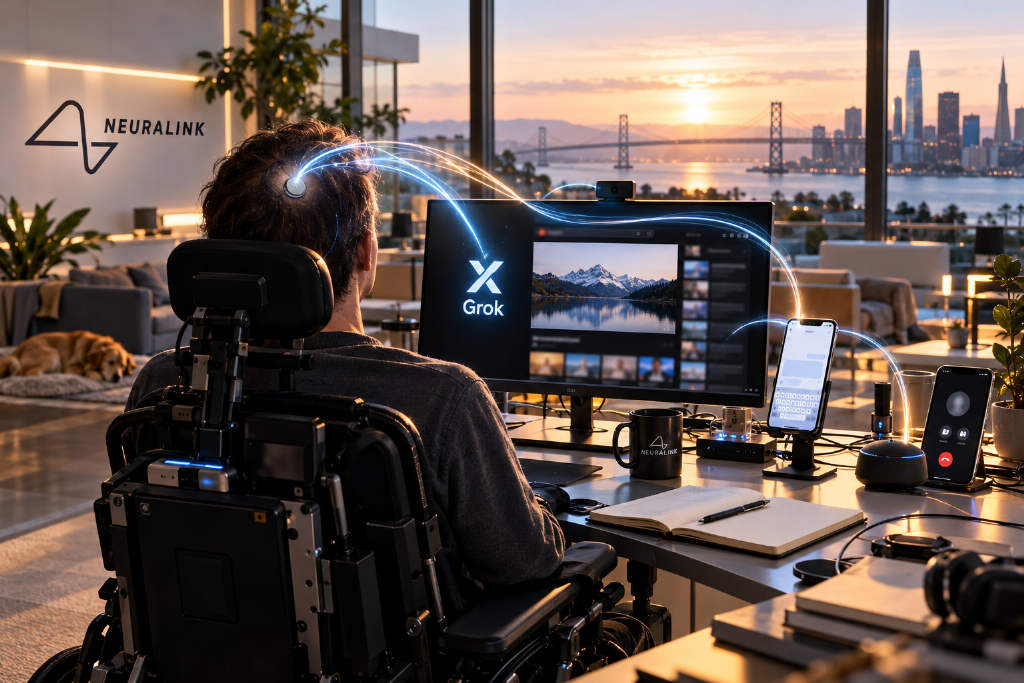
Neuralink has presented a new brain-computer interface update in which a participant can mentally say 「Hey Neuralink」, think of a task, and trigger a Grok agent to carry it out on a computer. In the demonstration described in the report, the agent then took over the screen and opened YouTube.
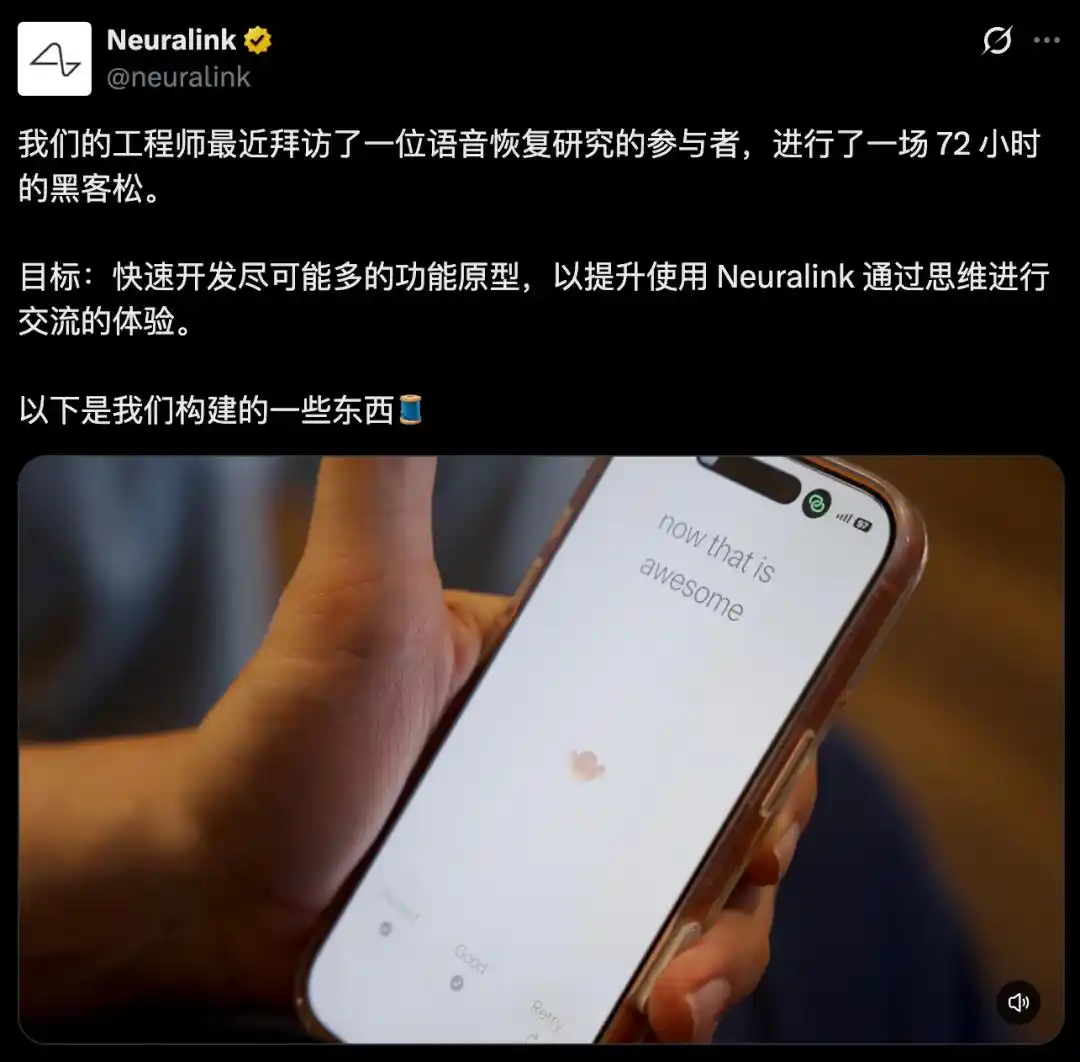
The participant is identified as Kenneth, a Neuralink P21 subject who has lived with amyotrophic lateral sclerosis, or ALS, for seven years. The report quotes him as saying, 「ALS is bad, but my life is not.」
A 72-hour sprint produced eight new prototypes
According to the report, the update came out of a 72-hour development push in which several core engineers moved into Kenneth’s home and worked alongside him. Over three days, the team built eight new feature prototypes.
Before this round of work, brain-computer interfaces were still widely associated with thought-controlled cursor movement. The report says that after this sprint, the brain was used as a native input channel for AI.

From cursor control to agent-driven intent execution
The most prominent feature in the report is the Grok integration. Kenneth only needs to imagine saying 「Hey Neuralink」 and add the task he wants completed. That triggers a Grok agent, which then operates the computer on its own.
The report breaks the process into two parts. The brain-computer interface converts intent into usable input, and the Grok agent receives that task and handles the computer operations. In a conventional thought-controlled cursor setup, the brain outputs low-level actions such as moving left or clicking, and a single task can require dozens or even hundreds of steps. In the agent-based version shown here, the brain outputs one intent, while the AI handles step breakdown and interface control.
The report also says one of the long-standing constraints in brain-computer interfaces is bandwidth, limited by electrode count and decoding speed. In that framing, the value of an agent is that it expands one sentence into a chain of actions without adding electrodes, increasing how much each thought can accomplish. Neuralink described the work as an early exploration, but the demonstration was presented as evidence that smoother communication between brain and computer can narrow the gap between thinking and doing.

Neural voice activity detection removes the physical switch
The report says that before this hackathon-style sprint, Kenneth still had to press a button manually to tell the software when to start and stop recording if he wanted to speak through thought. For people with ALS or high-level paralysis, that step itself can be difficult.
To address that, engineers rewrote a neural voice activity detection system, referred to as Neural VAD. The system continuously monitors the stream of brain signals returned by the implant and distinguishes between a resting state and a state in which the motor cortex is preparing to speak.
Once the system detects an intent-to-speak pulse, the app starts decoding within milliseconds. When the utterance ends, the system goes back to sleep automatically. The report describes the result as a zero-button, hands-free way to begin speaking by thought alone.

Real-time neural visualization lets the participant train with the model
The report says the team turned the implant’s detected signal strength and spatial distribution into a live visual display for Kenneth. That allowed him to try different ways of internally vocalizing and immediately see which approach produced stronger neural activity.
In the report’s description, this is a form of closed-loop neurofeedback. The model adapts to the brain, and the brain also adapts back to the model. What had been an opaque tuning process became a training loop with immediate feedback.
Bloom and iPhone input move the system into daily use
Over the past few months, Neuralink had been developing an app called Bloom with the goal of putting its speech-decoding brain-computer system into a phone, according to the report. During the sprint, engineers took Kenneth and Bloom into a noisy public setting. In a real cafe, Kenneth used Bloom on a phone to order himself a coffee by thought.

The report says Apple’s built-in software keyboard and Siri dictation are nearly unusable for ALS patients, so the team called lower-level iOS interfaces and built a system-wide brain-computer input method called BCI Keyboard Dictation. Once the keyboard is open, the words Kenneth wants to say are decoded from neural signals and entered into any app on the iPhone.
That setup can be used for notes, messages, and social apps without switching between separate modes. Because decoding errors still happen, engineers iterated through several correction interfaces during the sprint and embedded a predictive editing flow directly into the keyboard. When recognition drifts, high-probability candidate words appear above the keyboard, and Kenneth can select a replacement by thought.
The report also says the team used iPhone Live Activities and the Dynamic Island so Bloom could remain available from the lock screen. Kenneth does not need to unlock the phone to check connection status, and he can begin speaking from the lock screen as soon as the display turns on.

Thought-generated speech was routed into a live phone call
Among the features described, the one that carried the most emotional weight was the ability to place a phone call by thought. Technically, the team connected Bloom with iPhone calling so that speech generated by the brain-computer interface could be injected directly into the microphone audio stream.
The report says Kenneth’s relationship with his wife began over phone calls. As his illness progressed, speaking became increasingly difficult. After the calling feature was completed, he picked up the phone and called her. He did not move his mouth. The words he wanted to say were captured by the implant, translated by the decoder, synthesized into speech, and sent into the call.
According to the report, his wife laughed on the other end, and the two began joking with each other the way they once had on the phone. Neuralink later described that moment as one of the most unforgettable of the week.

A step toward direct brain-to-AI interaction
The report frames the shift in simple terms. In the past, limited brain bandwidth meant people had to feed machines information one letter or one click at a time. In this demonstration, the brain outputs a single intent, while AI handles decomposition, execution, and interface control. With Grok connected to the brain-computer interface, the report says the brain may be moving toward becoming a direct input source for AI.
It adds that more electrodes, faster decoding, and smarter agents could eventually move this kind of interaction beyond the lab and into more everyday settings.
The original article was published by MarsBit and credited to the WeChat public account 「新智元」, with authorship attributed to ASI 启示录.


