


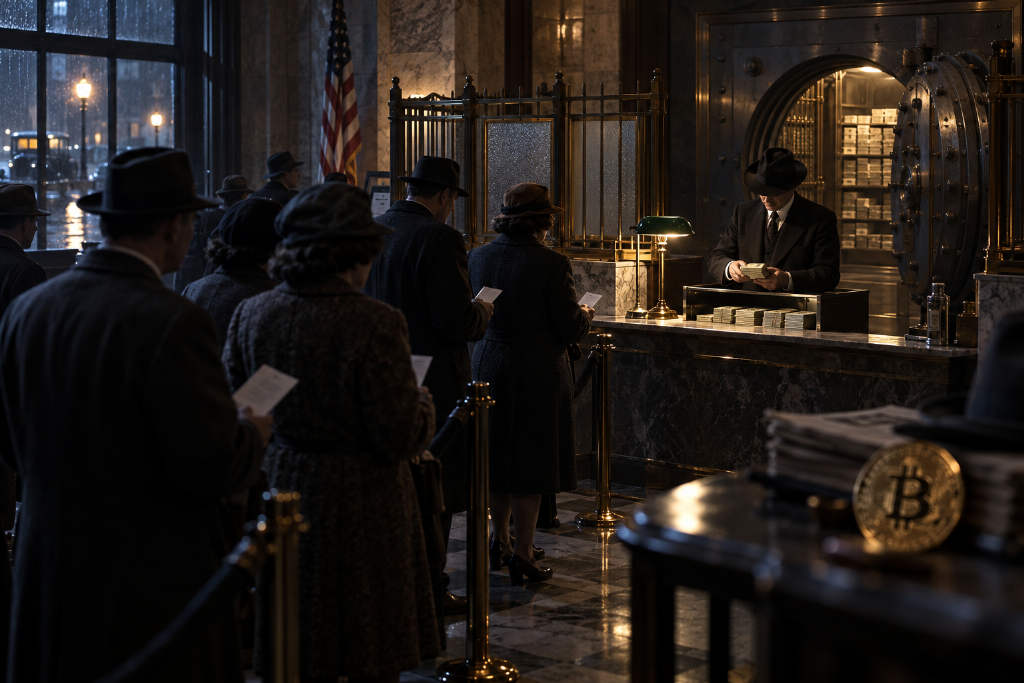
A new study takes aim at a claim you hear all the time in crypto: that fractional-reserve banks are so brittle a bank run can kill even a sound institution.
In a market analysis by Byron Gilliam, later republished by PANews and translated by TechFlow, the target is a familiar Bitcoin talking point. People in that camp often call fractional-reserve banking a Ponzi scheme and assume that once depositors stampede for the door, even good banks are finished. But this new study goes back through a long list of bank-run episodes and comes out somewhere else: most of the time, the panic cooled off before it killed the bank.
From George Bailey to Rothbard
The piece starts with George Bailey explaining banking in plain terms: "You’ve got it all wrong, as if I keep your money locked in a safe." The article treats that line as the basic promise of banking, stripped down to its core — everyone can get their money back at any time, as long as everyone does not ask for it at once.
Bailey tells the frightened customers their money is not sitting in a vault. It has been loaned to families building homes, and those borrowers are working to pay it back. In the version of the story the article cites, that speech does not calm people immediately. Bailey has to put up his own $2,000 to slow the run, and the bank is only fully saved at the end when friends and customers chip in enough to fill an $8,000 hole on the balance sheet.
Then the article pivots to Austrian economist Murray Rothbard, who called fractional-reserve banking "a fraud, a Ponzi scheme, a swindle." His point was that bankers like George Bailey hide what they are really doing when they make so many loans.
Rothbard said in a speech that people are accustomed to thinking banks simply accept deposits and lend them back out, which makes it hard to see banking as a legalized way of creating money. Push that argument all the way, and you get this: if depositors really grasped how banks create money "out of thin air," they would all demand their funds at once, and even the best banks would go under.
The classic model and the new challenge
The article says this grim view has had academic support for years. Economists Douglas Diamond and Philip Dybvig laid out the case in their famous paper, Bank Runs, Deposit Insurance, and Liquidity.
That model gave formal shape to a version of Rothbard’s instinct. A bank that finances long-term loans with demand deposits can be exposed to a run even when its assets are sound in a basic sense. As the paper explains, depositors may race to withdraw because they expect failure, and that sudden scramble for cash can force a bank to sell assets at a loss and then collapse.
Diamond and Dybvig also said this process does not have to be tied to fundamentals. In the article’s summary, just about anything that makes depositors expect a run can set one off. And that is where the stronger takeaway usually comes from: even a "healthy" bank can fail.
The new study argues the real world is messier than that. Every bank-run case in its dataset was pulled from newspaper coverage by a large language model and entered on a website explaining how the run began and how it ended.
What the study found
The central finding is blunt: more bank runs ended without failure than with it. Put differently, runs often fizzled before they became lethal to the institution.
That sits badly with the strongest self-fulfilling reading of the Diamond-Dybvig model. Even among banks with "very weak" fundamentals, only 59% failed after a run, according to the article’s summary of the research. Rothbard, the author says, probably would have expected that figure to be 100%.
At the other end, banks with the strongest fundamentals "rarely fail" even when they do face runs. The study’s conclusion, quoted in the article, is that this pattern weakens the hardline claim that liquidity trouble by itself can spark severe financial distress.
The article’s own gloss is harsher. In the polite phrasing of academia, it says, the evidence points to the same basic conclusion: Diamond, Dybvig, Rothbard, gold bugs, and Bitcoin believers all misread fractional-reserve banking when they take the bleakest possible view.
Historical runs were often triggered by rumor or confusion
The piece still gives Diamond and Dybvig one thing. Their model says bank runs are driven by changing expectations, and expectations can flip for almost any reason. The historical record in the database gives several examples. Strange ones, too.
In 1910, Los Angeles-based Merchants National Bank got hit by a run after boxer Jim Jeffries appeared at the bank and drew a crowd of fight fans. One newspaper account said dozens of depositors assumed something was wrong and rushed to pull cash, only settling down after Jeffries left. He had simply come to open an account and deposit part of his prize money.
In 1924, Metals Bank & Trust Company in Butte, Montana, faced a run because someone overheard a joking bet that the bank would not open the next day. According to the newspaper report cited in the article, the bank remained open four hours past its normal closing time to meet withdrawals and stopped only when darkness made it unsafe to continue. The punchline was almost absurd: the bank really was not opening the next day because it was Lincoln’s Birthday.
In 1929, Bay Ridge Savings Bank in Brooklyn faced withdrawals after a rumor spread that its president had died. The article says the bank caught wind of the false rumor early enough to line up $14 million in cash for customers. The reality was far less dramatic: the president had gone to Connecticut to have a boil removed from his neck, and he survived the operation.
Some runs did become destructive
The article does not say runs never end in failure. It points to a 1930 case at Chicago’s Independence State Bank. The trigger, according to the newspaper account it cites, was a fight two doors away from the bank. A police car answering a call to a restaurant stopped in front of the building, and word spread that the bank was being run.
More than $1.6 million was withdrawn from $5.6 million in deposits. The article says that probably drained the bank’s liquid assets, and state officials chose to shut it down.
The Bank Runs website does not say whether Independence State Bank was sound at a fundamental level. Even so, the article argues that if it was, the study’s findings suggest it would have been very likely to survive.
Cash on display often stopped the panic
Many runs, the article says, were contained by something very simple: showing people the cash.
One run in 1907 was stopped by putting large piles of bills and cash on the counter where depositors could see them. Back in 1857, an "unprofitable run" on an Alabama bank ended after customers saw what a newspaper called a towering "fortress of gold Malakoff and a fortress of silver Redan" on the cashier’s desk, references to famous Russian fortifications.
The same basic move showed up again in 1924 in Brooklyn, where a bank manager stopped a run by stacking banknotes in the front window, including $1,000 bills, "carelessly stacked in a huge heap" where everyone could stare at them.
The article’s closing point
The article closes with a question: did bank customers understand that no matter how tall the pile of cash looked, it still would not be enough if everyone asked for their money at once? The author’s answer is brief: "I guess they did."
The larger point is not that fractional-reserve banking has no liquidity limits. It does. But real bank runs do not always play out the way the most hard-edged, theory-first version of the crypto argument says they will. And for investors using banking fragility as part of the case for crypto, this study offers evidence pointing the other way.