
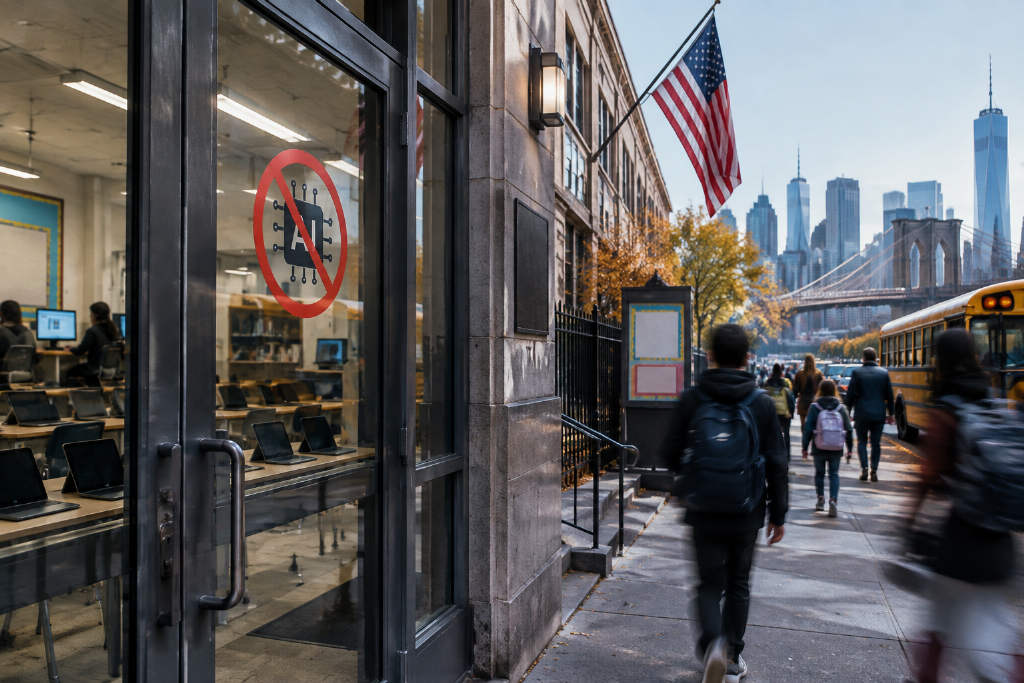
New York City has announced a new artificial intelligence policy for public schools that will impose a one-year ban on generative AI for K-8 students in the 2026-2027 school year. The measure covers students from kindergarten through middle school and is expected to affect about 600,000 students. The source describes it as the largest school AI restriction currently introduced in the United States. City officials framed the move as an effort to prioritize real-world human interaction and independent thinking in foundational education.
K-8 students will be barred from generative AI tools
Mayor Zohran Mamdani and Schools Chancellor Kamar Samuels presented the policy at a press conference. Under the rules, K-8 students will be prohibited from using generative tools including AI chatbots and AI tutors. The city will also block AI companion chatbots across school environments for students in all grades.
High school students face controlled use and required AI literacy training
Students in grades 9 through 12 will not face a blanket ban, but their access will be limited. New York City plans to use a controlled model for high school students, requiring them to take regular AI literacy and critical thinking courses. They will only be allowed to use approved software under teacher supervision.
The policy also sets daily screen-time caps by grade level. Students below second grade will not be allowed to use personal devices at all. Students in grades 3 through 5 will face a daily cap of 30 minutes, while students in grades 6 through 8 will be limited to 45 minutes per day.
Exemptions cover teaching work and specific classroom needs
The rules include exemptions for teacher lesson preparation and administrative work, assistive technology in special education, support for multilingual learners, and certain computer science classes, according to the source material.
Policy rationale centers on peer interaction and independent thought
The source says the city’s temporary pause on generative AI use in K-8 is meant to reduce the risk of students outsourcing their thinking process to machines. With less direct software intervention, classroom learning is expected to shift back toward in-person peer collaboration and small-group discussion. When students face unfamiliar questions, the policy is designed to push them toward direct exchanges with classmates and teachers.
The original report says this approach is tied to the idea of Productive Struggle, described there as a way to build communication skills, frustration tolerance, and emotional resilience. Combined with broader limits on total screen exposure, the policy is intended to preserve physical social space on campus, including direct interaction during breaks and lunch periods.
Data protection and software controls are being tightened as well
Alongside restrictions on student-facing tools, New York City is also building stronger safeguards around education data and technology vendors. According to the source, the city’s education department has already disabled more than 38 existing software products that did not meet security review standards. It is also tightening limits on commercial companies seeking to collect minors’ personal data and behavioral records through school channels.
The report says the measure reflects a governance approach that places student privacy and long-term cognitive development ahead of commercial interests. The one-year pause is also intended to provide observation data for later evaluation of AI’s real impact on early education.
Key points of the policy
- New York City will impose a one-year generative AI ban on K-8 students beginning in the 2026-2027 school year, affecting about 600,000 students.
- High school students will be placed under a controlled-use model with required AI literacy classes and teacher-supervised access to approved tools.
- AI companion chatbots will be banned on school devices across all grades.
- Personal devices will be banned below second grade; screen time will be capped at 30 minutes for grades 3 through 5 and 45 minutes for grades 6 through 8.
- Exemptions apply to teacher preparation and administration, special education, multilingual learning, and computer science courses.
- More than 38 software tools that failed security review standards have already been disabled by the education department, and companies face tighter limits on collecting student data.