
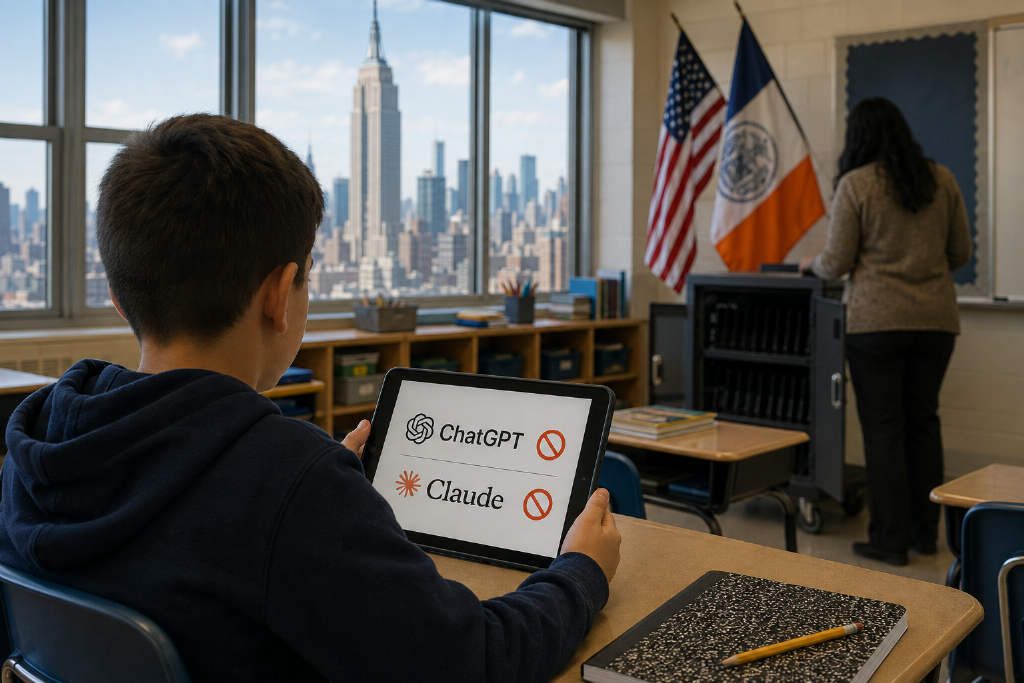
New York City says it will bar generative AI for nearly 600,000 public school students, from 2-K through eighth grade, for one year starting with the 2026-2027 school year, according to a Sept. 2 release from the mayor’s office. Companion-style chatbots are banned in every grade. And big-name services like ChatGPT and Claude will be blocked on school devices.
City officials called it the widest student-facing AI restriction anywhere in the United States. New York City runs the nation’s biggest school district, and this rule hits nearly 600,000 students, roughly two-thirds of the public school system. The school year starts Sept. 10. So the policy is arriving with barely any runway.
Screen time rules and teacher limits arrive with the ban
Mayor Mamdani and Schools Chancellor Kamar Samuels rolled out new screen-time limits too. Students in second grade and younger cannot use personal devices. Students in grades three through five will be capped at 30 minutes a day. Students in grades six through eight get 45 minutes a day. High school students are not under any citywide screen-time cap in this policy.
Teachers are getting boxed in as well. They cannot use AI to grade student work. But they can still use it for lesson planning and administrative work.
The city did leave some exceptions. Assistive tech for students with disabilities, support tools for English learners, and career-focused classes like computer science can seek waivers. The education department’s own Hello App, eye-tracking tools, and similar aids are outside the ban.
High schools get a narrow opening through five pilots
The policy stops short of a full high school ban, but the opening is tiny. Just five "limited AI pilots" that clear strict review will be allowed. Those pilots can cover as many as 50,000 general education high school students, about 5% of all students. Each high school can offer no more than five classes under the pilot setup.
The city set these usage limits for each approved tool:
- Quill for English writing, up to 15 minutes a week;
- Edia for math, up to 20 minutes a week;
- Brisk Teaching across subjects, 10 to 20 minutes per session, once or twice a week;
- Playlab across subjects, up to two assignments per marking period;
- Intel AI-Ready Schools across subjects, one class period per week.
Officials said the rule behind all of this is pretty direct: students have to stay the main thinkers. Every high school student will also have to complete two AI literacy sessions a year, each 45 minutes long. Those lessons will cover what AI is, bias, risks, and ethics. The stated aim is to teach critical thinking before students become dependent on the technology.
Officials argue younger students need human connection, not AI dependence
Mamdani said in the release: "Children need teachers and person-to-person connection to learn and grow. They need to build skills with their peers, form relationships with educators, and wrestle with hard questions on their own." He also pushed back on the industry’s basic argument, saying: "The tech industry wants us to believe AI-driven early education is not just inevitable, but necessary. We do not believe that."
At a press conference, Mamdani added: "We know what AI companies are trying to do, whether they are building sports betting models or education tools. It is to make money. In New York City public schools, our purpose is students." He also said the city had not seen evidence that AI helps younger students, aside from research backed by companies that could profit from the technology.
Samuels took the same line. He said: "Innovation does not mean more technology. Over the next year, we will follow the evidence and make sure technology serves learning, not the other way around." He also told reporters: "I do not want technology thinking for our students."
Supporters and critics are split
Not everybody is on board. United Federation of Teachers President Michael Mulgrew told Chalkbeat the burden of enforcement would probably land on schools, forcing school communities or individual teachers to sort out afterward whether the products they already use fit the new rules.
The city still has not published a list of products whose AI features will be shut off. Asked how enforcement would work, Mamdani said only that teachers, principals, and district superintendents would be there to make sure the policy is enforced.
Robin Hood Foundation CEO Richard Buery said a blanket ban was the wrong call, arguing that teachers already depend on AI for lesson planning and student feedback. Tech:NYC CEO Julie Samuels said high school students should get more than one hour of AI use a week.
Others argue one year is not long enough. In April 2026, more than 250 education experts signed a joint appeal for a five-year ban. Leonie Haimson of Parent Coalition for Student Privacy said: "It took more than a decade to get phones out of schools. We cannot wait that long again."
City action runs against the federal direction
The report said the federal government is heading the other way. Donald Trump signed an executive order in April 2025 calling for broader K-12 AI training grants. More than 250 corporate executives, including leaders from Microsoft and Adobe, also pushed for AI education to become a required high school subject.
In the last legislative session, more than a dozen states talked through similar measures, and seven states passed them, according to the report.
Review planned after one year
After one year, the city will assemble a "campus technology alliance" to review the results of the policy. Mamdani made clear an extension is still possible, saying: "If, after this year, we find that the policy needs to be extended, then we will extend it."
The report also pointed to national restrictions on school technology already adopted in Norway, Sweden, and the Netherlands. Now New York City is testing whether the biggest public school system in the US can press pause on AI in education without falling behind.