
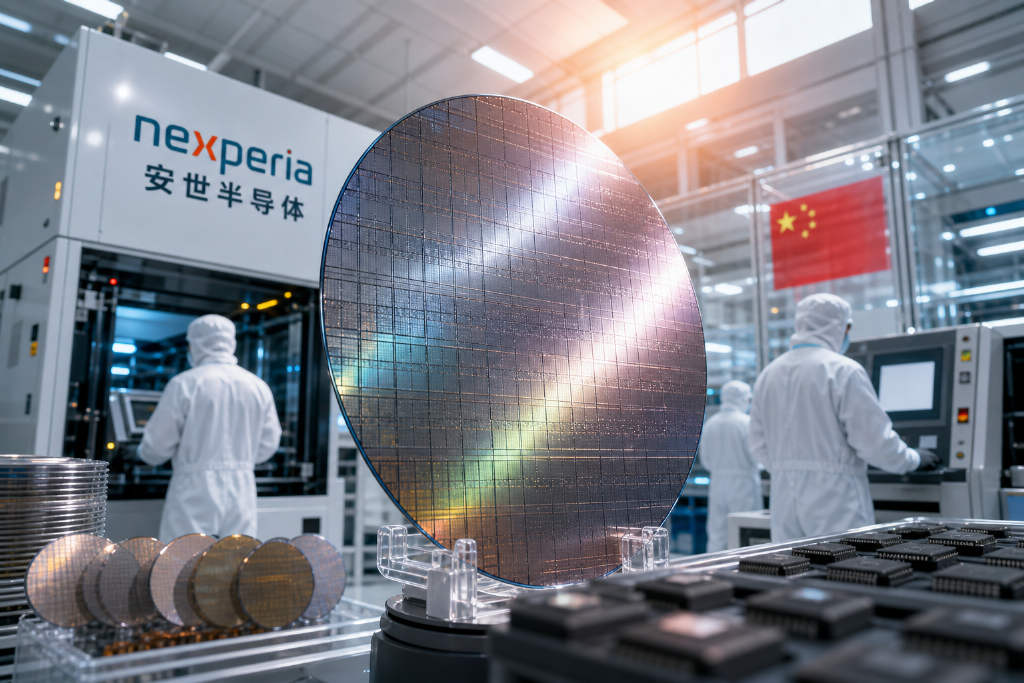
"We are back." That was how Nexperia China CEO Zhang Qiuming described the company’s position on Aug. 22, 2026.
On that day, Nexperia China released multiple power semiconductor products developed on 12-inch wafers and said it had built inventory reserves for supply.
Eleven months earlier, the company was in the middle of a delivery crisis. On Sept. 30 last year, administrative and judicial intervention from the Netherlands left Nexperia China facing a cutoff in overseas 6-inch to 8-inch wafer supply, creating severe uncertainty around deliveries of related chip products.
Li Dongyue, the company’s chief commercial officer, told Economic Observer that outsiders were asking at the time whether the company could survive. Now, he said, three product lines have been put in place on a 12-inch wafer platform. Over the past 11 months, the company completed a broad transition: product lines moved from 8-inch wafers to 12-inch wafers, the supply chain shifted from overseas dependence to domestically controlled operations, and the localization ratio rose from less than 20% to 100%.
Zhang said the shift was not mainly about confrontation. In his words, it was about protecting customers, employees, industry, and the possibility that globalization can continue.
From overseas disruption to a 12-inch wafer platform
Nexperia’s operating model had been a clear example of the global division of labor in semiconductors. Wafers of 6 inches to 8 inches were produced at manufacturing bases in places including Hamburg, Germany, and Manchester, the U.K., then shipped to production sites in China for large-scale packaging and testing. The output included automotive-grade semiconductor chip products such as diodes, transistors, MOSFETs, logic ICs, and ESD devices.
In recent years, Nexperia has delivered more than 110 billion automotive-grade chip products globally each year. Among them, automotive-grade PowerMOS products rank second worldwide, and the company’s global market share in automotive-grade power semiconductors exceeds 30%.
That arrangement stopped after the intervention from the Netherlands. By late October last year, after Nexperia in the Netherlands decided to halt wafer supply to the packaging and testing plant in Dongguan, Nexperia China could no longer obtain steady 6-inch to 8-inch wafers from production bases such as Hamburg and Manchester for packaging and large-scale production of automotive chips.
Zhang called that period the company’s darkest moment. Overseas 6-inch to 8-inch wafer supply was cut off, systems went offline, and overseas data platforms became unreachable. The company still had orders and customers, but no wafers to process and deliver.
Zhang told Economic Observer that the company took stock of all usable inventory, reassigned staff across operations, and did everything it could to keep shipments moving. Li said that in less than a month, Nexperia China delivered more than 11 billion chips to more than 800 customers, which helped steady the customer base. At the most intense point of the supply challenge, the company also introduced a customer-supplied wafer processing model: downstream automotive and industrial equipment makers provided compliant wafers themselves, and Nexperia China completed packaging, production testing, and delivery.
But inventory could only last so long. The management team then had to find a sustainable way to secure production capacity.
Rather than restoring lines based on 6-inch to 8-inch wafers, Nexperia China decided to move technology accumulated over the past 60 years from the 6-inch to 8-inch platform onto a 12-inch platform.
Pang Yibing, general manager of the company’s bipolar business unit, told Economic Observer that this was not a rushed emergency move. He said the company had already been pushing products such as power MOS, insulated-gate bipolar transistors, or IGBTs, and logic ICs toward 12-inch production several years earlier. In his account, the company could have chosen to make 5-inch to 6-inch automotive-grade chips under existing product standards, but room for improvement on those older dimensions was limited as downstream customers demanded more in performance, reliability, and consistency. Domestic partners, he said, already had 12-inch wafer manufacturing platforms and sufficient supply, giving the company a chance to place production directly on a newer platform rather than patching up older 6-inch to 8-inch lines. He also said Nexperia China had the ability to develop and produce power MOS, logic ICs, and discrete devices on 12-inch wafers and could quickly release scale effects in capacity.
Li laid out three practical considerations behind the decision. First, 12-inch wafers cut per-chip production costs by 20% to 30%, while a localized closed-loop supply chain sharply reduced cross-border freight, tariffs, and long-cycle inventory costs, giving products stronger price competitiveness at the same performance level. Second, compared with overseas delivery cycles of 12 to 16 weeks, production and delivery based on a domestic closed-loop supply chain could be reduced to 4 to 6 weeks, more than doubling delivery efficiency. Third, a 12-inch platform combined with a new generation of chip manufacturing processes offered better performance and broader specifications that could meet downstream requirements for safety and reliability.
Inside Nexperia China, Li said, the 12-inch platform came to be seen as the key foundation for fully breaking dependence on overseas wafer supply, regaining production capacity, and bringing the industrial chain under domestic control.
Rebuilding standards, manufacturing, and supply chain systems
In Pang’s view, moving to a 12-inch platform was not a simple matter of taking an old product and placing it on a larger silicon wafer. It required a reconstruction of product standards, manufacturing efficiency, and supply chain capabilities.
He said the 12-inch platform requires more advanced lithography and polishing equipment to improve dimensional precision in automotive-grade chip devices by 30% compared with 8-inch production. If 12-inch production is to achieve yields above those of the 8-inch platform, full automation in material handling and advanced process control have to be built into planning and design from the start, reducing the risks of particle contamination and manual error.
To achieve very high consistency and reliability, AEC-Q standards had to be integrated through every stage of 12-inch wafer production so that quality would meet the IATF16949 automotive quality management system set by the International Automotive Task Force.
Li said the biggest challenge in mass-producing high-performance automotive chips on 12-inch wafers was not a single technological breakthrough. The hard part was that platform, process, and system all had to be in place together. Sustained yield improvement, he said, mainly came from repeated engineering optimization of the platform and process.
He added that the toughest task was ensuring a very high degree of consistency in quality and performance across tens of millions of automotive-grade chips. To deal with that, the company first had to secure stable supply of 12-inch wafers.
Starting this year, Nexperia China worked with multiple domestic wafer manufacturers on technical integration and sample verification, gradually building a "primary supplier plus backup" system for 12-inch wafer sourcing. That effort also ran into setbacks. Several domestic wafer producers initially supplied 12-inch wafers that could not meet the manufacturing requirements for high-performance automotive chips. Nexperia China said technical coordination with those manufacturers later brought the relevant 12-inch wafers into compliance with the IATF16949 system.
At the same time that wafer supply stabilized, the company expanded packaging capacity and optimized process flows for the related automotive products. Economic Observer reported that Nexperia China had previously planned to free up half of one domestic factory for smartwatch chip production. After overseas 6-inch to 8-inch wafer supply was cut off, the company changed that plan and devoted all of that space to expanding packaging capacity for automotive-grade chips based on 12-inch wafers. It also partnered with other leading domestic packaging and testing companies to add more capacity.
A new barrier then appeared: how to help downstream companies complete consistency verification for the new products quickly. Li said whether high-performance automotive chips based on 12-inch wafers could reach mass production also depended on whether downstream companies were willing to be the first users, and whether a leading industry player would move forward alongside the company.
One industry source told Economic Observer that even if some companies were willing to move early, the process from product introduction to verification of consistency and reliability for automotive chips can easily take 6 to 12 months, which would still weigh heavily on the pace of mass production and delivery.
Pang said many automakers were already long-term customers of Nexperia China and had a deep understanding of the company’s automotive chip performance, which helped complete consistency verification for several categories of 12-inch-wafer products in a relatively short time.
Li said the company spent 11 months restoring mass production of automotive chips step by step. At present, its automotive chip product standards have passed AEC-Q101 certification, with failure rates controlled at the parts-per-billion level. Some mature-process automotive chips developed on 12-inch wafers have achieved yields of 99%, which is 5 to 10 percentage points higher than on the 8-inch platform.
According to Li, the recovery in production capacity also delivered 100% localization, and products including MOSFETs and logic ICs have established a domestic closed-loop supply chain. In his account, that means the company is no longer tied to a vulnerable model dependent on overseas wafer supply and has fully switched to a domestically controlled industrial chain system.
Cutting prices while the sector raises them
With stable 12-inch wafer supply and mass-production capability in place, Nexperia China made another move: it cut prices.
Economic Observer reported that while automotive chip prices broadly rose 15% to 20% this year, the company chose to move in the opposite direction. On Aug. 22, it launched eight power MOS products priced about 30% lower than last year, four general logic products with a 20% price cut, and some general bipolar devices priced about 10% below mainstream market products.
Zhang told Economic Observer that the lower prices were not the result of subsidies. He said they reflected the gains from industrial upgrading enabled by the 12-inch platform and a localized closed-loop supply chain. In his words, scale effects from 12-inch mass production, higher chip yields, and large reductions in cross-border transport and warehousing costs through local supply chains meant that benefits once retained inside the production chain could now be passed on to downstream customers through lower prices.
After systems at Nexperia in the Netherlands went offline and overseas data platforms became unreachable, Nexperia China also launched its own e-commerce channel. Downstream companies can now directly check inventory, product selection, and pricing for different automotive chip products, with shipments available as fast as 24 hours after an order is placed.
Yin Jun, the company’s e-commerce director, told Economic Observer that under the traditional distribution model, chipmakers often struggled to see end-customer product selection and pricing feedback directly, leaving both buyers and sellers in a state of weak price transparency. Through the self-operated e-commerce channel, he said, both Nexperia China and downstream companies can quickly grasp each other’s price quotes and chip specification requirements, improving transaction efficiency.
A purchasing executive at a new energy vehicle company told Economic Observer that the price-cut strategy was attractive to downstream automakers. In electric vehicle manufacturing, power semiconductor devices are used in traction inverters, onboard chargers, battery management systems, and body control systems. Lower procurement costs for those core components would create more room for vehicle pricing optimization.
Still, that executive said delivery time mattered even more. This year, as AI data centers expanded rapidly and absorbed a large amount of 8-inch wafer capacity, delivery times for automotive-grade power semiconductor devices generally stretched to 20 to 40 weeks, while some hard-to-find automotive chip models had lead times as long as one year.
Because of shortages, the same executive said, the company had to adopt a strategy of full prepayment and higher-priced inventory reservation, tying up about 5% of operating cash flow and affecting capital turnover for other business lines.
Li said that through stable and sufficient 12-inch wafer supply from domestic strategic partners, Nexperia China has now shortened delivery times for its mainstream automotive chip products to 4 to 6 weeks.
After the system disconnection at Nexperia in the Netherlands, the company also rebuilt its financial system and fully introduced a renminbi-based trade settlement system. That means overseas downstream customers buying automotive chip products from Nexperia China must also pay in renminbi.
A head of procurement for Asia-Pacific at an overseas automotive company told Economic Observer that renminbi settlement was manageable. Their company first converts foreign currency into renminbi in Hong Kong and then continues buying automotive chip products from Nexperia China through cross-border renminbi trade settlement.
Asked why overseas automakers had not switched suppliers, the same executive said automakers usually do not replace chip suppliers casually. If they move to another supplier’s automotive-grade chips, they need at least one to two years to verify chip safety and reliability, which would materially affect new vehicle development schedules.
Li said that with a domestic closed-loop supply chain and a 12-inch platform, Nexperia China is able to keep serving both domestic and overseas markets.
"A strong enough Chinese supply chain does not serve only China. It can also serve the world," he said.
This article was sourced from the WeChat account Economic Observer and written by Chen Zhi.