
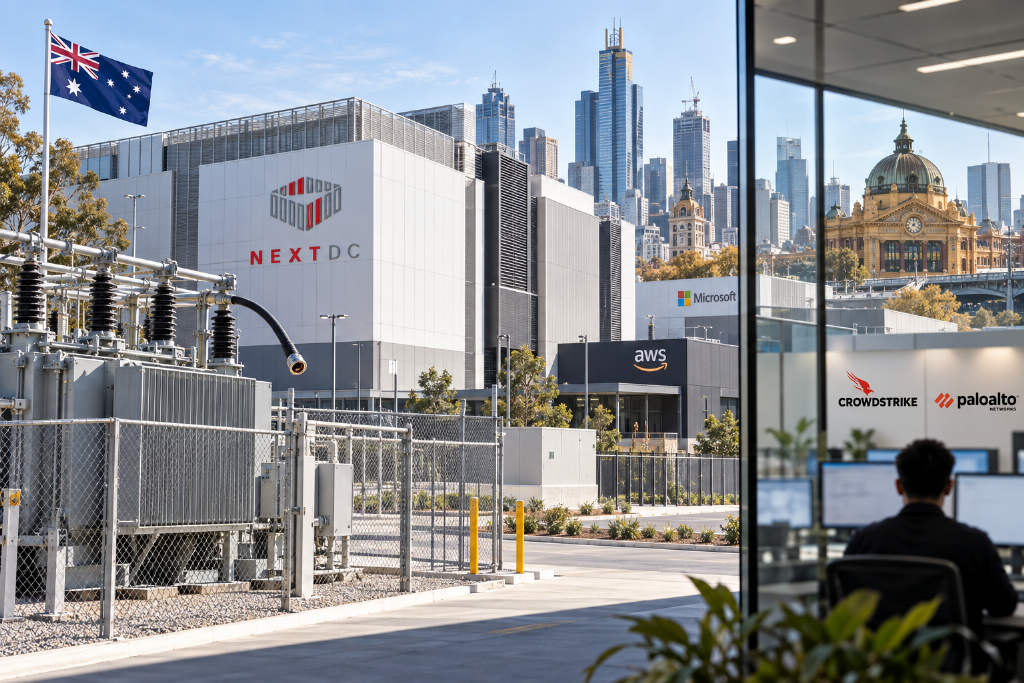
Amazon Chief Executive Officer Andy Jassy said this week that most of Amazon Web Services' large blocks of compute capacity for 2027 have already been reserved, and that a meaningful share of 2028 capacity has also been committed by customers. Strong demand, however, does not mean every data center project will be delivered on schedule. That distinction was on display after NextDC cut guidance and its shares fell about 42% in a day, while Microsoft also pulled out of one U.K. data center project with Nscale. Cybersecurity stocks moved the other way this week, with CrowdStrike and Palo Alto Networks both rising more than 10%.
Delivery terms are becoming central to the value of data center orders
Australian data center operator NextDC said on Oct. 21 that additional power for its Melbourne M3 campus is now expected to be delayed until fiscal 2028 because of a pause tied to grid upgrade works. The company removed about A$140 million, or roughly $98 million, in expected net revenue from affected contracts from its fiscal 2027 guidance.
Using the midpoint of its guidance, expected revenue fell by about 22%, while underlying EBITDA was cut by about 36%. After the revision was announced, NextDC shares dropped about 42% that day.
The issue goes beyond a simple timing shift in revenue. NextDC said the affected scope includes some capacity that had already started billing. Delayed delivery or insufficient power could trigger service credits, and in certain cases customers may also have the right to terminate contracts. If customers accept revised delivery arrangements, some revenue may still be realized later. If credit or termination clauses are triggered, though, the revenue and profit ultimately generated by those contracts could also decline. The company said it is still assessing the relevant terms and any force majeure relief that may be available.
U.K.-based AI cloud provider Nscale has run into a similar delivery problem. With grid connection timing reportedly pushed into the 2030s, Microsoft exited the Loughton campus that had been scheduled to begin operations in early 2027. The project had been planned for 23,040 NVIDIA GB300 GPUs and about 50 MW of compute capacity. Microsoft said the withdrawal applies only to that campus and does not affect other cooperation between the two companies.
Nscale's previously filed GPU services agreement with Anthropic, submitted to the U.S. Securities and Exchange Commission, offers a more detailed look at how payment and delay provisions can work. Billing begins only after acceptance of the relevant batch. Delivery delays can trigger fee discounts, and batches may be terminated if delays run beyond agreed deadlines. The contract also includes termination provisions if qualifying financing is not secured on time.
That agreement cannot be directly mapped onto the Microsoft project, but it shows the structure of the risk. Even when a customer signs a long-term procurement contract, the operator still has to complete financing, deploy equipment and pass acceptance before it can collect payment under the agreed terms.
Even AWS cannot assume every campus will move ahead smoothly. On Oct. 22, Loudoun County, Virginia, said it had reached a preliminary arrangement with Amazon under which the company would withdraw its application for a data center development on the former George Washington University campus and convert part of the land to residential and mixed-use development. The arrangement has not yet been finalized.
AWS does not appear to have a customer shortage, but individual campuses can still be constrained by local approvals and resident opposition. For operators that rely on long-term contracts to raise financing, customer names and headline contract values are only part of the picture. Power connection timing, acceptance conditions, delay-related price cuts and customer exit rights all matter. How much financing a contract can support still depends on how likely those payment commitments are to turn into actual cash flow.
Cheap AI-driven attacks are lifting expectations for security spending
A cyberattack case reported by Reuters this week suggests AI agents can now handle a large share of intrusion work that previously required human operators.
Cybersecurity firm NorForge found that one attacker used AI agents to keep probing more than 1,200 websites, affecting hundreds of companies. Researchers estimated that the campaign consumed about $5,000 in model token costs. The average cost per successful intrusion was about $50, and a successful breach typically required around 23 hours of automated attempts.
Those figures reflect model usage costs for this campaign, not every other expense involved. Even so, attackers can already run multiple agents for extended periods to search for vulnerabilities and test systems without staying involved in each step. Failed attempts do not stop the process; continuous operation can still widen the attack surface over time.
Defenders are not seeing the same reduction in workload. The PHP Foundation said on Oct. 21 that it has published 15 CVEs since July and handled more than 100 invalid, duplicate or non-reproducible security reports. The foundation said AI-assisted research has increased the volume of reports. AI tools can help validate and organize them, but final judgment and patching still require engineers.
Reuters reported on Oct. 23 that T-Mobile's chief technology officer said the company is increasing spending on monitoring and response. AT&T has deployed encryption, multi-factor authentication and human oversight, and is also verifying whether third-party agents requesting access to customer accounts actually represent legitimate customers. As agents gain the ability to call tools, read data and execute actions on their own, companies are being pushed to defend not only against outside attacks but also to limit the access rights of automated systems themselves.
Cybersecurity stocks have rallied, but orders and earnings still need to confirm the thesis
Cybersecurity names outperformed this week. Barron's said CrowdStrike and Palo Alto Networks each rose more than 10%, while a cybersecurity exchange-traded fund gained about 7%. Over the same period, a semiconductor ETF fell about 3% and Lam Research dropped about 13%.
The move cannot be attributed entirely to AI-driven attack concerns. Valuation pressure on semiconductor stocks, software sector performance and shifts in fund flows may also have shaped short-term price action. Still, cybersecurity companies are drawing more attention from the market, and investors are beginning to price in the possibility that enterprises will step up security purchases tied to agent deployments.
Whether that demand turns into real business remains an open question. Companies may increase spending on identity authentication, access control, anomaly detection and operational audit tools, but not all of that budget will necessarily go to standalone security vendors. Cloud platforms and incumbent enterprise software providers may capture part of it as well. Whether CrowdStrike and Palo Alto Networks can convert this wave of expectations into new orders, renewal revenue and profit growth will need to be tested in future earnings reports.
This week's takeaway
The risk in data center orders is not limited to whether customers honor contracts. It also sits in whether projects can be delivered on time. NextDC's service credit terms and the acceptance and termination conditions seen in Nscale's agreement show that once construction slips, the impact may extend beyond billing schedules to contract pricing and customer relationships. For operators that depend on long-term contracts to secure financing, execution on the original terms matters more than simply posting a larger volume of signed deals.
AI agents are lowering the labor threshold for persistent vulnerability hunting and exploitation, and enterprise security spending may rise as a result. But that incremental budget will not automatically flow to independent cybersecurity vendors. Cloud platforms and internal enterprise teams may absorb part of the work. Security stocks have already moved higher. The next question is whether companies actually expand procurement, and which vendors can turn that demand into durable revenue and profit.



