
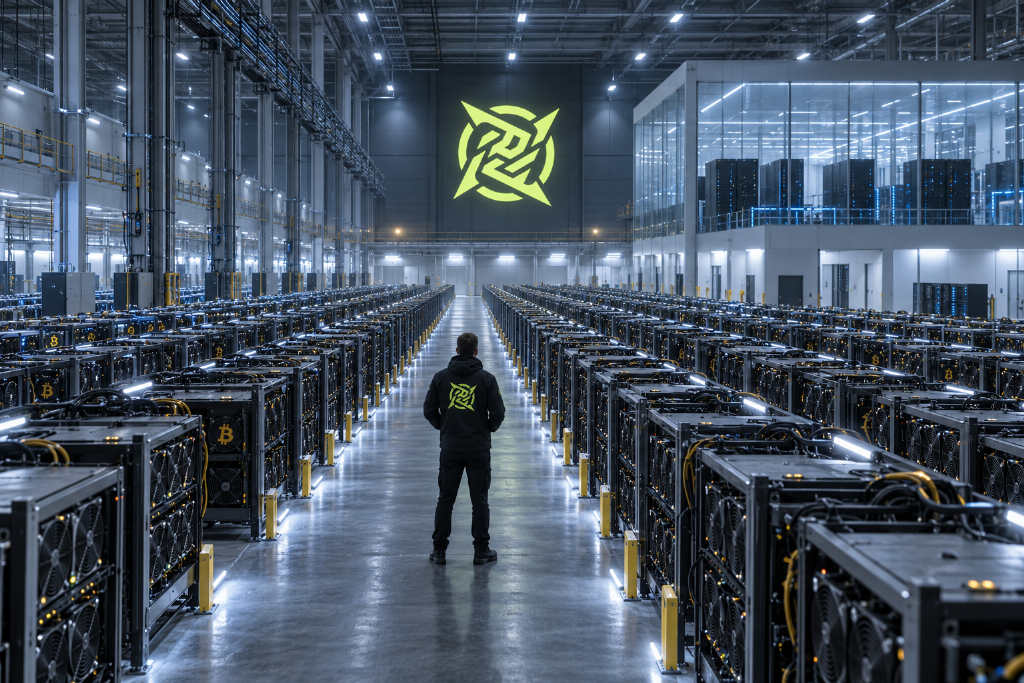
NIP Group, the company behind the well-known esports brand Ninjas in Pyjamas, has acquired a third batch of Bitcoin miners in exchange for more than 247 million Class A ordinary shares.
Hicham Chahine, founder and CEO of NIP Group, told Decrypt that he wants to add Bitcoin mining exposure while the market is "cooling," instead of waiting for hotter conditions and tougher competition. He also said the facilities could be used for artificial intelligence in the future.
Monthly Bitcoin output target rises to 195 BTC
"Now that this tranche is closed, we're at roughly 13.85 EH/s. That puts us among the largest publicly listed miners in the world, roughly 195 Bitcoin a month," Chahine told Decrypt.
He added: "That's real revenue, and it supports everything else we're building. This year we reviewed every single piece of NIP Group, not just mining. We made decisions with one goal: better margins and a clear path to profitability. Mining had to earn its place in that review, and it did."
Decrypt reported that NIP Group expanded its Bitcoin operation last year with a goal of mining 160 Bitcoin per month. The latest acquisition lifts that target by 35 Bitcoin to 195 Bitcoin a month, or about $2.8 million at current prices.
Chahine also told Decrypt that NIP Group is "optimistic about where this is heading," and said the third batch of miners will require "minimal ramp time."
From esports and gaming into mining
NIP Group is a digital entertainment company known for its esports and gaming businesses. It owns Ninjas in Pyjamas, which fields professional teams in Counter-Strike 2, Valorant, League of Legends, and Rocket League.
According to Yahoo Finance data cited in the report, NIP Group shares, trading under NIPG, have fallen 40.7% from $6.74 to $4 since the Bitcoin announcement last week. That move marked an all-time low for the stock. Over the same period, Bitcoin fell 2% to $79,820, according to Decrypt data.
Facilities could shift to AI infrastructure if returns justify it
Chahine said the purchased facilities could later be redirected toward artificial intelligence infrastructure if market demand supports that move.
"We look at what AI and [high-performance computing] customers will actually pay, how long they'll commit and whether that demand is sustained or temporary," he told Decrypt. "When those workloads clearly beat mining on returns, consistently and not just for a week or two, that's when we may move capacity. If the numbers say shift, we shift."
The report noted that any such pivot would require substantial work, since Bitcoin mining sites cannot simply be turned into AI data centers overnight. Even so, Chahine said the infrastructure surrounding the mining facilities provides a solid base for AI and high-performance computing needs.
"When we talk about AI, we mean using that footprint and that know-how for compute-heavy work when the economics make sense," he said. "We're a gaming and entertainment company at heart, and our fans already live on compute, bringing infrastructure and entertainment under one roof makes sense."



