
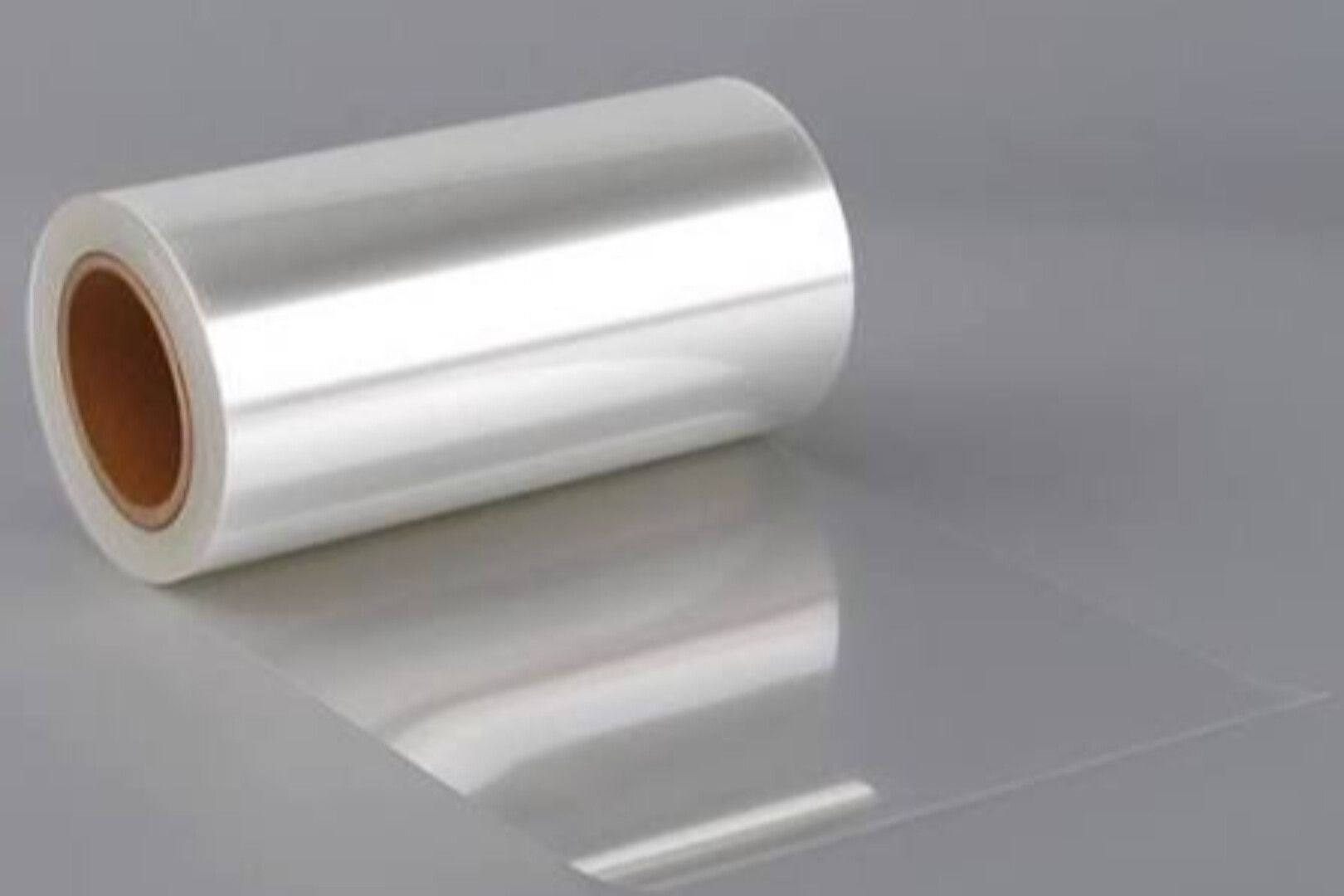
Nomura traces AI server demand further upstream to MLCC release films
In a research note dated July 2, Nomura Securities pushed the AI server investment theme further up the electronics materials chain and highlighted Japan’s MLCC release film segment as a likely beneficiary. The firm forecasts demand for MLCC release films to grow at a compound annual rate of about 10% from 2025 to 2028, and assigned Lintec a Buy rating with a target price of JPY 7,850. The central argument is that rising compute intensity and power consumption in AI servers are driving both higher volumes and higher specifications for multilayer ceramic capacitors, which then raises demand for high-grade release films used in production.
MLCCs are widely used in servers, power systems, motherboards, and other electronic assemblies. As capacitor designs move toward higher layer counts and tighter reliability standards, the manufacturing process requires release films with stronger surface smoothness, cleanliness, and stability. Nomura’s thesis is therefore not simply about one niche material, but about how AI infrastructure spending is propagating into a specialized upstream consumables market.
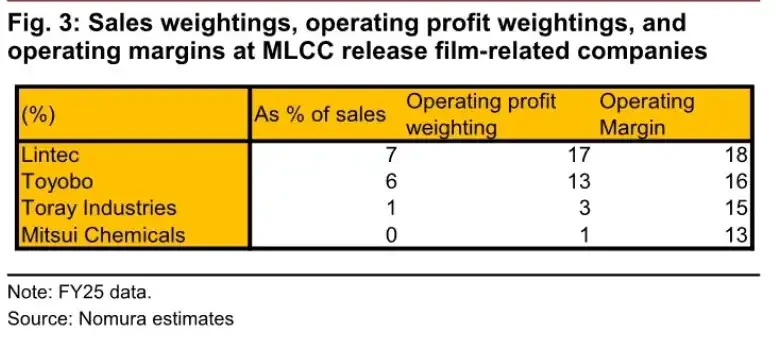
Market structure is a major part of the call. According to Nomura, Japanese companies account for more than 80% of the global MLCC release film market. Within that group, Lintec holds roughly 37%, Toyobo about 32%, while Toray is positioned more heavily in the upstream base film segment. That concentration means any sustained increase in high-end MLCC demand is likely to be captured primarily by Japanese materials suppliers.
Release film sits at a critical point in MLCC manufacturing
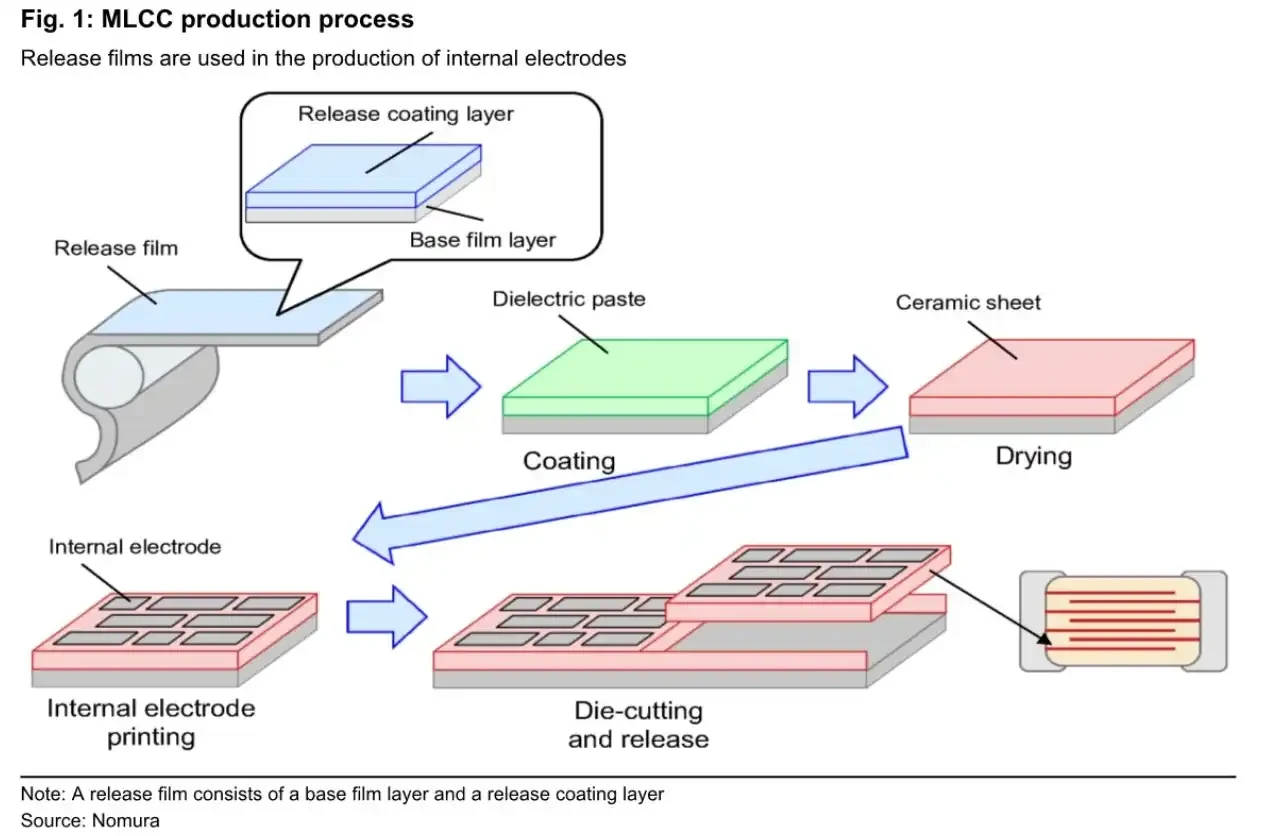
Release film is not part of the finished MLCC, but it appears in several key production steps. Manufacturers first cast dielectric slurry onto the release film, then proceed to drying, inner electrode printing, and lamination. Toray’s investor materials also show process labels such as “Slurry Casting,” “Inner electrode printing,” “Release film,” and “Base PET film,” underscoring the role release film plays across these stages.
For premium multilayer MLCCs, the condition of the release film surface matters because it can affect electrode printing precision and interlayer stability. In practical terms, AI servers are not only increasing the number of MLCCs required, they are also shifting the product mix toward more demanding specifications. Higher layer counts and tighter reliability standards translate into stricter quality requirements for release films, which is why Nomura sees structural support for this niche material segment.
TrendForce, in a note published on June 17, similarly said AI ASIC and accelerator platforms are concentrating demand in premium MLCC categories, with usage of certain specifications rising noticeably. It also flagged a growing risk of supply tightness in the second half of 2026. While that external commentary does not directly validate Nomura’s estimated 10% CAGR for release film demand, it does support the broader directional view that AI servers are lifting demand for high-end MLCCs.
Lintec and Toyobo together control nearly 70% of the market
On Nomura’s end-product coated film basis, MLCC release film market share is split roughly as follows: Lintec at 37%, Toyobo at 32%, Mitsui Chemicals at 12%, and other suppliers at 19%. That puts Lintec and Toyobo together at close to 70%, highlighting a relatively concentrated industry structure.
Lintec’s main advantage lies in high-end coating capabilities. The company procures base film externally, applies release coating, and supplies the finished material to MLCC customers. Because AI server growth is skewing demand toward premium, multilayer MLCCs, Lintec is viewed as one of the most direct beneficiaries of the higher-specification order flow. That helps explain why Nomura took the most constructive stance on Lintec among the names discussed.
Toyobo’s distinction is that it combines both base film and coating capabilities. Public company materials indicate that its new Utsunomiya release film equipment had already been completed and started operations. Investor documents point to commercial production beginning in spring 2025 and full utilization by the end of FY3/26, while Nomura’s report frames the third quarter of 2026 as the full-scale production milestone. If the ramp proceeds as planned, Toyobo could be better positioned after 2027 to absorb more premium demand and potentially gain share.
Toray sits further upstream. Nomura said the company commands more than 50% share in the external sales market for MLCC release film base films. Public IR material shows Toray’s new Gifu line is scheduled to start up in February 2026; under Nomura’s assumptions, related capacity would rise to about 1.6 times the previous level, leaving room for further sales growth. Compared with Lintec and Toyobo, Toray’s benefit is tied more to easing an upstream supply bottleneck than to directly capturing high-end coating orders.
Growth in demand does not automatically mean full earnings leverage
Nomura also stressed that MLCC release film is a high-margin business, but not large enough by itself to dictate the overall earnings trajectory of major materials groups. By the broker’s estimates, the business accounts for about 7% of Lintec’s sales and 17% of operating profit. For Toyobo, the respective figures are about 6% of sales and 13% of operating profit. For Toray, they are about 1% of sales and 3% of operating profit.
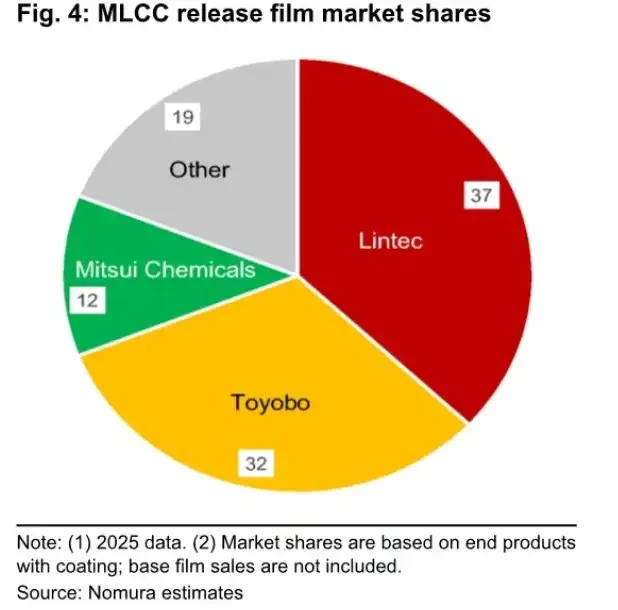
The associated operating margins were cited at around 18% for Lintec, 16% for Toyobo, and 15% for Toray. Those numbers suggest the segment is meaningfully profitable, but they also show why demand growth in release films does not necessarily translate into outsized group-wide earnings upgrades. Capacity timing, pricing, and the durability of incremental order flow all remain critical.
This also means the AI server-related upside is unlikely to be distributed evenly across the value chain. Lintec appears positioned as the most direct beneficiary of premium demand growth; Toyobo looks more like a share challenger tied to fresh capacity; and Toray is likely to benefit primarily through external base film sales. All three are exposed to the same theme, but through different earnings pathways.
Nomura favors Lintec, but capacity remains the key constraint
Among individual names, Nomura’s stance on Lintec was the clearest. It rated the company Buy with a target price of JPY 7,850. The valuation framework used a July 1 share price of JPY 7,110 and implied a 2026 forward P/E of 17.8x. In the same valuation table, Toyobo was rated Neutral with a target price of JPY 1,800, Toray was rated Neutral with a target price of JPY 1,170, and Murata Manufacturing, one of the major downstream MLCC leaders, also received a Buy rating with a target price of JPY 6,000.
Even so, Nomura flagged Lintec’s capacity as a limiting factor. If the company does not move quickly enough on expansion, it could approach full utilization by 2027. If AI server-related demand keeps accelerating at that point, insufficient supply could prevent Lintec from fully capturing incremental orders and may leave room for competitors such as Toyobo to gain share.
For Toyobo, the opportunity and the risk stem from the same source: new capacity. If industry demand does sustain roughly 10% annualized growth, fresh supply could support market share gains. If demand undershoots expectations, however, additional capacity could intensify pricing pressure and weigh on utilization. Toray’s setup appears somewhat steadier, as its expansion is more about relieving an upstream supply constraint, but because the business contributes only a modest portion of group revenue and profit, it may be harder for that segment alone to drive a broad rerating.
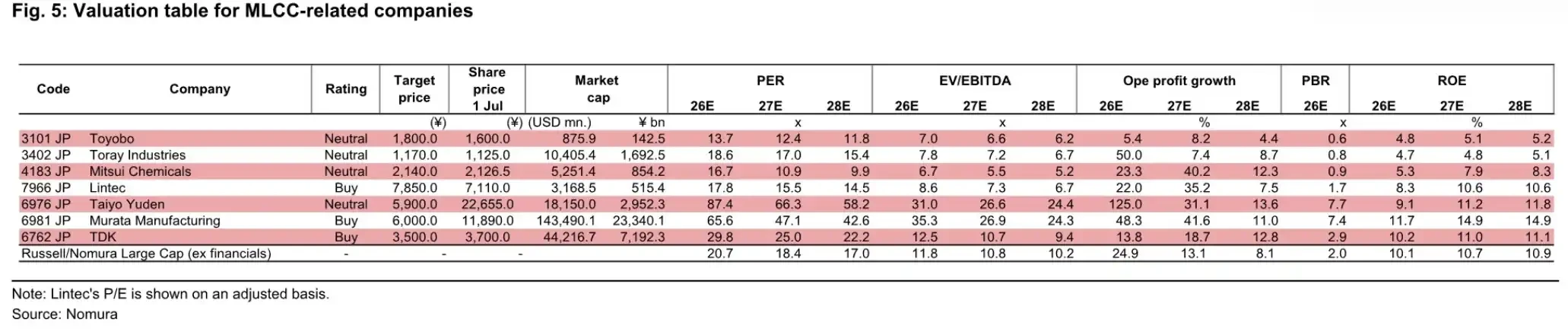
Price pressure in 2026 is the main variable to watch
Nomura did not frame the story as a straightforward sequence of “higher demand, higher prices, higher stocks.” The report explicitly said MLCC release film selling prices could face downside risk in 2026. As Toyobo brings on new capacity and Toray increases base film output, industry supply is set to rise, and pricing may not move in lockstep with demand.
At the same time, the broker argued that capacity additions remain relatively measured overall, and utilization rates are not expected to collapse. On that basis, the probability of a sharp price drop appears limited. In other words, materials suppliers may benefit more from shipment growth than from aggressive price increases over the next phase of the cycle.
That view depends on two conditions holding. First, demand for premium multilayer MLCCs tied to AI servers must continue to materialize. Second, new capacity must not overshoot the rate of high-end demand growth. If end-market capital spending slows or MLCC makers move into an inventory adjustment phase, actual release film demand growth could come in below Nomura’s roughly 10% model assumption.
Overall, AI servers have clearly pushed MLCC release films, once a relatively overlooked materials niche, into clearer market focus. But the earnings outcome still hinges on whether premium MLCC orders continue to expand and whether Japanese producers add capacity at the right pace, rather than too early and at the cost of creating a new supply overhang.