


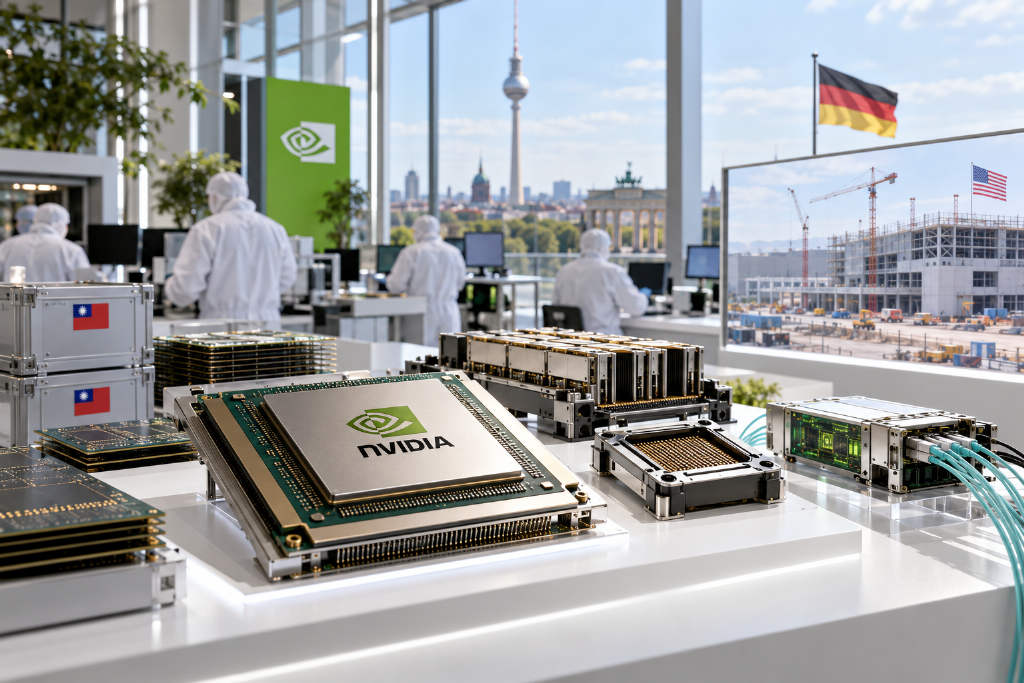
NVIDIA said at its GTC Berlin event on Oct. 21 that it will expand global capacity with six supply chain partners across four areas: substrates, advanced packaging, testing and optical engines. The company said the move is meant to meet continued demand growth from accelerated computing and AI factory platforms.
Three of the six named partners are Taiwan-based companies: Unimicron, King Yuan Electronics and Siliconware Precision Industries, which operates under ASE Technology Holding.
NVIDIA targets 2.5x substrate capacity in three years
NVIDIA CEO Jensen Huang said, 「We are in the largest infrastructure expansion in human history. Demand is incredible, and capacity is the biggest constraint.」
The company plans to increase substrate capacity to 2.5 times current levels within three years. The partners disclosed so far are Japan’s Ibiden, South Korea’s Samsung Electro-Mechanics and Unimicron. NVIDIA said more agreements are still in progress.
NVIDIA has signed a capacity reservation agreement with Unimicron to support the company’s substrate expansion plan in Taiwan. The new capacity is expected to start coming online in the second quarter of 2027 and reach full utilization by mid-2028.
The report said NVIDIA and Unimicron have worked together for years. It added that industry participants expect demand for high-end substrates to rise as AI chips become larger and more integrated.
ABMedia also cited a June Chain News summary of a JPMorgan research report, which said Unimicron had secured about 35% to 40% of global T-glass allocation. JPMorgan at the time projected Unimicron’s net profit would rise 244% year over year in 2026 and another 78% in 2027.
KYEC receives $1.1 billion prepayment for U.S. testing plant
NVIDIA will provide King Yuan Electronics with a $1.1 billion capacity prepayment to support construction of a new testing plant in the United States. The target is to begin mass production in April 2027.
The report described the arrangement as a new cooperation model in which a customer directly funds capacity reservations.
Chain News reported on Oct. 12, citing industry sources, that AI chip testing cycles are getting longer and packaging and testing capacity remains tight. Recent price increases across the sector were said to range from 10% to 30%, while new capacity is only expected to come online gradually in 2027.
Siliconware’s CPO optical engine expansion is the largest
NVIDIA said the biggest expansion in this round will be in co-packaged optics, or CPO, optical engines handled by Siliconware. CPO packages optical components together with switch chips and is intended to replace traditional pluggable optical modules. The report described it as a key technology for improving transmission efficiency in large-scale AI computing infrastructure.
NVIDIA said it will expand optical engine capacity in Taiwan with Siliconware, with a goal of reaching 15 times current capacity by mid-2027 and about 30 times current capacity by the end of 2028.
The report cited institutional investors as saying Siliconware’s core business is high-end packaging and testing, and that this cooperation extends its role into CPO optical engines. That, they said, highlights the value of packaging manufacturing in next-generation AI transmission architecture and could add growth room for parent company ASE Technology Holding.
Ibiden, Samsung Electro-Mechanics and Amkor are also expanding
The report said NVIDIA had already signed with Ibiden earlier this year and provided a multibillion-dollar capacity prepayment to support expansion at Ibiden’s Ono plant in Japan to three times its current level. The new capacity is expected to come online in the first quarter of 2028.
Samsung Electro-Mechanics has also joined NVIDIA’s substrate supply chain. In addition to existing South Korean capacity, the company will upgrade older plants and build new facilities in Sejong and Busan.
Advanced packaging company Amkor Technology (AMKR) will expand in South Korea as well, with a target of increasing interposer wafer capacity by more than 300% by the end of 2028.