
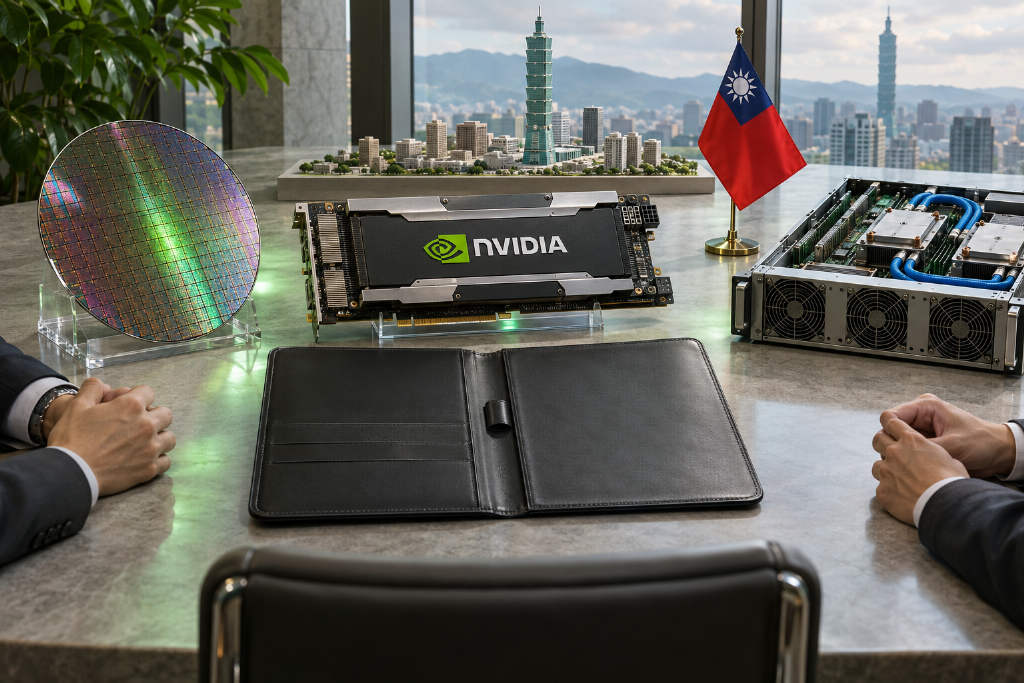
Taiwan stocks opened higher on Nov. 13 after Jensen Huang resigned as Nvidia’s chief executive on Nov. 12, ABMedia reported. Taiwan Stock Exchange data showed the benchmark index at 44,263.25 as of 9:14 a.m. local time, up 2.72% from the previous close. Taiwan Semiconductor Manufacturing Co. (TSMC) rose 1.50% to 2,375 Taiwanese dollars.
In the preceding U.S. session, Nvidia closed down 4.34% at $166.19 after falling as much as 14% during trading. TSMC’s American depositary receipts fell 1.90% to $405.49.
Chief Financial Officer Colette Kress is serving as interim CEO. Nvidia’s board has begun searching for a permanent successor and is considering both internal and external candidates.
Taiwanese server partners mostly gain
At the same time, most of Nvidia’s major Taiwanese server partners posted modest gains. Wiwynn rose 6.37% to 1,670 Taiwanese dollars, Wistron climbed 1.18% to 172, Quanta Computer gained 0.72% to 280.5, and Hon Hai Precision Industry rose 0.21% to 240.5.
Nvidia’s board had not yet made its decision when Taiwan’s market closed on Nov. 12. Reuters reported that day that TSMC fell 2% during trading, South Korea’s SK Hynix lost 1.6%, and Samsung Electronics gained 0.8%.
Suppliers assess capacity plans and investment
Reuters interviewed members of the Asian supply chain before Nvidia’s board meeting. One Taiwanese supplier executive said: 「We will support whatever capacity Nvidia needs, but the new CEO may not be as aggressive as Jensen Huang.」 The executive worried that expansion could slow if the successor did not secure capacity as quickly as Huang.
TF International Securities analyst Ming-Chi Kuo told Reuters that Huang could turn technology engineers considered feasible into products requiring company-wide resources, risk-taking and delivery. 「That is why the supply chain has such high order visibility and is willing to keep up with aggressive specification upgrades,」 Kuo said. He added that this also pushed competitors to follow, driving technology upgrades and supply-chain investment across the artificial intelligence (AI) industry.
Reuters said Huang frequently visited manufacturing partners in Taiwan, including TSMC, Hon Hai and Wistron. In May, he said Nvidia planned to invest about $150 billion a year in Taiwan. Neil Shah, vice president of research at Counterpoint, said Nvidia’s large ecosystem-level investments and bilateral AI infrastructure cooperation 「could slow」 without Huang at the helm.
Investor says near-term chips are already in production
Some investors see limited short-term effects. Armina Rosenberg, co-founder of Nvidia shareholder Minotaur Capital, told Reuters: 「The chips Nvidia will ship over the next one or two years have already been designed and are in production, and customers’ 2027 spending plans do not depend on who runs the company.」
Omdia chief analyst Lian Jye Su said competitors would have more room to catch up if execution slowed or the product roadmap became unclear.
In the leadership announcement, Nvidia Chair Harvey Jones said the board expected the company’s operations, customer commitments and product roadmap to 「continue without interruption.」 ABMedia also compiled information on Kress’s background and potential permanent successors.
Nvidia is scheduled to report fiscal 2027 third-quarter results at 1:20 p.m. U.S. time on Nov. 17, or 5:20 a.m. Taiwan time on Nov. 18. Its earnings call is set for 2 p.m. U.S. time, or 6 a.m. in Taiwan, and will be its first since Huang’s departure.



