
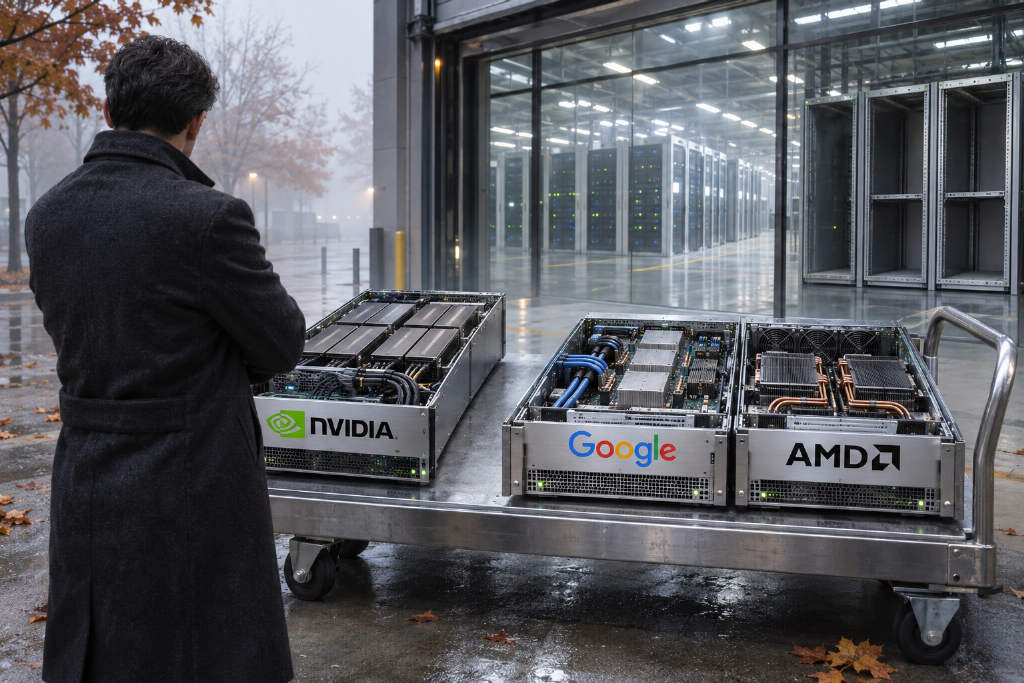
A cloud services provider that has long purchased Nvidia chips is reconsidering its supply strategy after Jensen Huang’s departure, with Google Tensor Processing Units (TPUs) and Advanced Micro Devices (AMD) chips among the options, The Information reported on November 12.
The company had previously considered reducing its dependence on Nvidia but worried that doing so could offend Huang and affect its future access to Nvidia chips. With Huang gone, the provider believes it needs to reconsider other suppliers. One executive interviewed for the report put it bluntly: “We would be an idiot not to.”
The purchasing pressures behind “Jensen Jail”
ABMedia previously used the term “Jensen Jail” to describe a dilemma facing emerging cloud providers, known as NeoCloud companies. Even those interested in Google TPUs or other rival chips could be reluctant to switch suppliers for fear of losing their allocation of Nvidia graphics processing units (GPUs).
In a related report nearly half a year ago, The Wall Street Journal said some NeoCloud providers worried that failing to keep buying Nvidia’s full hardware stack could affect their priority for future GPU supplies. Adam Fisher, a partner at Bessemer Venture Partners, has also discussed that supply-chain pressure.
Demand for artificial intelligence (AI) computing power has long exceeded supply. Nvidia controls not only chips but also GPUs, networking and interconnect equipment, and the CUDA software ecosystem. For NeoCloud providers whose business depends on renting out GPUs, continued access to new-generation chips has a direct bearing on future revenue and competitiveness.
Google TPUs may have cost advantages for certain workloads, and AMD may offer more competitive alternatives, but providers still have to weigh the opportunity cost of changing suppliers, ABMedia said. In its account, “Jensen Jail” describes customers’ heavy dependence on Nvidia during a supply shortage.
At least one cloud provider is now reassessing that constraint. ABMedia said the personal relationship that previously gave customers pause may no longer carry the same force after Huang’s departure.
Kress questioned concentrated financial exposure
Colette Kress, Nvidia’s interim chief executive, joined the company in 2013 and served as chief financial officer for many years. The Information described her as an important contributor to Nvidia’s growth, though not previously the leading voice on major strategic decisions. People familiar with the matter told the publication that Huang held considerable authority inside the company and often overrode Kress when they disagreed.
One example involved a proposed credit arrangement for OpenAI. Nvidia had considered providing up to $250 billion in credit support to help OpenAI secure the company’s new-generation chips for 8 gigawatts of data centers. Kress raised concerns, arguing that Nvidia should not take on excessively concentrated financial risk. Nvidia ultimately split the arrangement into two parts and has so far committed only about $100 billion in first-stage credit support.
As AI data-center construction faced delays and some cloud computing deals were canceled, Kress had already begun prioritizing a review of Nvidia’s financial exposure to a small group of large customers. The aim was to avoid concentrating investment, credit guarantees and other resources in particular companies.
After Huang’s departure, AI investors and startup founders also began questioning whether Nvidia would continue to provide financial support to customers and infrastructure suppliers as aggressively as before.
Google and AMD expand alternatives
ABMedia said the change could create opportunities for Google and AMD. Google is turning its TPUs from internal computing infrastructure into a commercial product for outside customers. Alongside computing capacity offered through Google Cloud, it plans to sell chips directly to customers and expand through financial guarantees and data-center partnerships.
AMD is using its Instinct accelerators to challenge Nvidia, offering an alternative for large-scale AI training and inference while seeking wider adoption among cloud providers and corporate customers.
Google’s position is distinctive, according to ABMedia. It has its own chip designs, Google Cloud, Gemini models and substantial capacity for data-center capital spending, allowing it to offer integrated packages to large AI customers.
Google has partnered with Blackstone, provided financial guarantees for data centers and supplied TPU computing power to companies including Anthropic. ABMedia said those steps gradually replicate Nvidia’s model of combining chips, capital and customers.
That does not mean Nvidia’s market position will immediately weaken, ABMedia said. Several Nvidia customers still expect GPU demand to exceed supply in the short term and do not think the management change will alter the market’s view of Nvidia’s lead in chips.



