
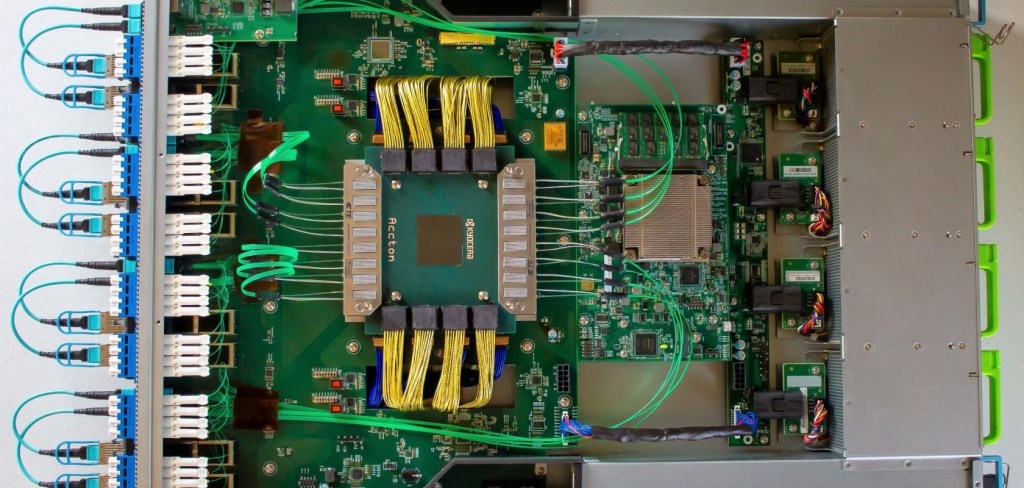
NVIDIA Senior Vice President Gilad Shainer said at a recent technical forum that co-packaged optics, or CPO, has formally entered mass production. He also said the biggest growth engine for the optical communications market will come from scale-up architectures, where bandwidth demand is more than 10 times that of scale-out systems.

The comments lit up Taiwan’s optical communications shares. Lianya (3081), Accton (2345), and other key names in the segment moved sharply higher, with many of them locked at the daily limit.
Shainer outlines where CPO stands
According to an Economic Daily News report cited by ABMedia, Shainer said switches jointly developed by NVIDIA and its supply-chain partners have already been delivered to close partners and deployed inside NVIDIA’s own facilities. He said a large number of switches equipped with CPO technology are expected to begin rolling into AI factories worldwide this year.
Shainer added that NVIDIA prepares its supply chain ahead of any technology ramp. This round of investment spans the broader ecosystem, including optical engines, packaging, fiber arrays, and custom laser light sources. He said he welcomed the industry’s move toward standardization.
Spectrum-X first, with Vera Rubin in view
On the technical side, the report said CPO is currently being introduced on the Spectrum-X platform as NVIDIA prepares for large-scale deployment of its next-generation Vera Rubin systems. Since that platform is said to deliver computing speeds at least three times those of GB300, the matching network switch bandwidth also has to move higher. That, Shainer said, is why scale-up architectures require more than 10 times the bandwidth of scale-out designs.
ABMedia described Shainer as the lead figure behind NVIDIA’s InfiniBand and Ethernet high-speed transmission R&D efforts, as well as the executive in charge of AI platform networking and communications. The report also said he is working with Taiwan Semiconductor Manufacturing Co. on the COUPE silicon photonics packaging platform.
Taiwan optical names move in unison
After the comments circulated, Taiwan optical communications stocks rallied across the board. ABMedia listed Lianya (3081), Browave (3163), GCS (6442), LuxNet (4979), Alpha Networks-linked laser and light-source play Lextar-related name Lianjun (3450), and switch and networking equipment maker Accton (2345) among the stocks that hit limit-up.
The report added that names with weaker linkage to the theme, including APAT (4908) and Sercomm (5388), also rose by about 6%.
TrendForce sees a $39 billion market by 2030
Research firm TrendForce estimates the CPO/NPO market will exceed $39 billion by 2030. Even so, the demand inflection is not expected to show up until late 2027, with faster growth in 2028 and 2029.
Its report said suppliers that can combine silicon photonics design, optical engine manufacturing, and advanced packaging capabilities will be in the strongest position to lead the CPO switch market. At this stage, the sector is still in the early phase of supply-chain positioning.
Not entirely a new disclosure
ABMedia also said Shainer’s latest remarks were a public response to a bearish SemiAnalysis report published several months ago, not a brand-new disclosure. In other words, the latest market reaction was driven in part by the recirculation and amplification of older information rather than a sudden fresh breakthrough.
The earlier SemiAnalysis report argued that CPO yields were poor and that mass production would be delayed again, a view that had weighed on optical communications shares at the time.
Mass production is not the same as volume shipments
The article drew a clear line between an announcement of mass production and shipment volumes large enough to make a meaningful contribution to revenue. Multiple research firms, according to the report, point to roughly the same window for scaled deployment of CPO in scale-up architecture: no earlier than late 2028 or early 2029.
That leaves 2026 to 2027 as a period when total CPO-related shipments are still expected to remain relatively low. The direction of travel may be increasingly clear, but large-volume shipments, based on the report, are still likely to come only after 2028.