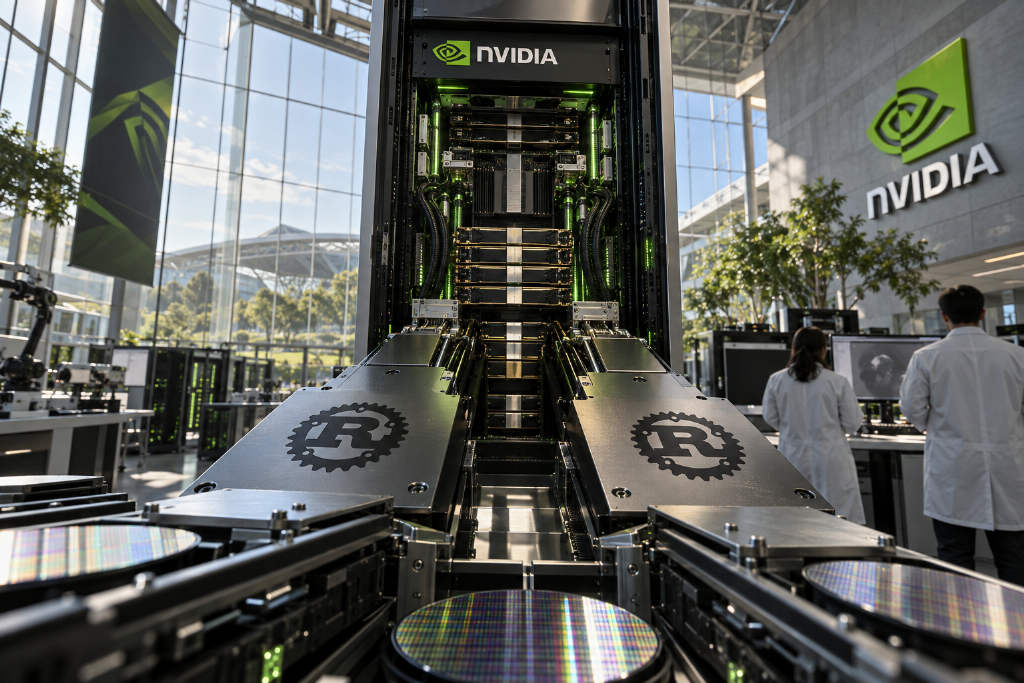
NVIDIA has introduced CUDA Rust, a new effort aimed at making Rust a first-class language for writing GPU kernels. The initiative includes two open-source projects: cuda-oxide for the SIMT model and cutile-rs for the newer Tile model. Both can compile Rust kernels natively and use Rust’s ownership rules to reject aliasing errors at compile time.
Of the two, cutile-rs is already available on crates.io, runs on stable Rust 1.89 and later, and has been used in Hugging Face’s Grout inference engine and mistral.rs. cuda-oxide is still at an early alpha stage. NVIDIA said both projects remain in alpha, and production readiness has not been confirmed.
The company said the move responds to a broader shift toward Rust across the AI systems stack, from inference engines to drivers and agent runtimes. NVIDIA also said developers are encouraged to prioritize the newer Tile model, while SIMT remains available for cases that require explicit control over threads and memory. Planned cross-language interoperability means using Rust is not expected to cut developers off from C++ or Python ecosystems.
NVIDIA has launched CUDA Rust, an initiative designed to make Rust a first-class language for writing GPU kernels.
The effort includes two open-source projects: cuda-oxide for the SIMT model and cutile-rs for the newer Tile model. Both projects can compile Rust kernels natively and use Rust’s ownership rules to reject aliasing errors at compile time.
Project status
cutile-rs is now available on crates.io and runs on stable Rust 1.89 and later. It has already been used in Hugging Face’s Grout inference engine and mistral.rs. cuda-oxide, by contrast, is still in an early alpha stage.
NVIDIA said both projects are currently in alpha, and it has not confirmed whether they are ready for production use.
Why NVIDIA is doing this
According to NVIDIA, the release is a response to the growing use of Rust across the AI systems layer, covering everything from inference engines to drivers and agent runtimes.
On programming models, NVIDIA described Tile as the newer model and said developers are encouraged to prioritize it. The SIMT model remains suited to workloads that require explicit control over threads and memory. The company also said planned cross-language interoperability means choosing Rust will not exclude developers from working with C++ or Python.
The item was cited by Techub from MarkTechPost.
This article was originally published by Bit.Fan. For more cryptocurrency news and market insights, visit www.bit.fan. Disclaimer:
The market information, project data, and third-party content displayed on this platform are for industry information sharing only and do not constitute any form of investment advice or return commitment.
Cryptocurrency trading carries high risks. Users should fully assess their risk tolerance and make independent decisions. All profits, losses, and legal responsibilities are borne by the users themselves.