

Culper Research shorted Nvidia on May 13, arguing that the $5 trillion AI chip company still had a major China problem despite public guidance from CEO Jensen Huang that sales to China should be assumed to be zero under US export controls.
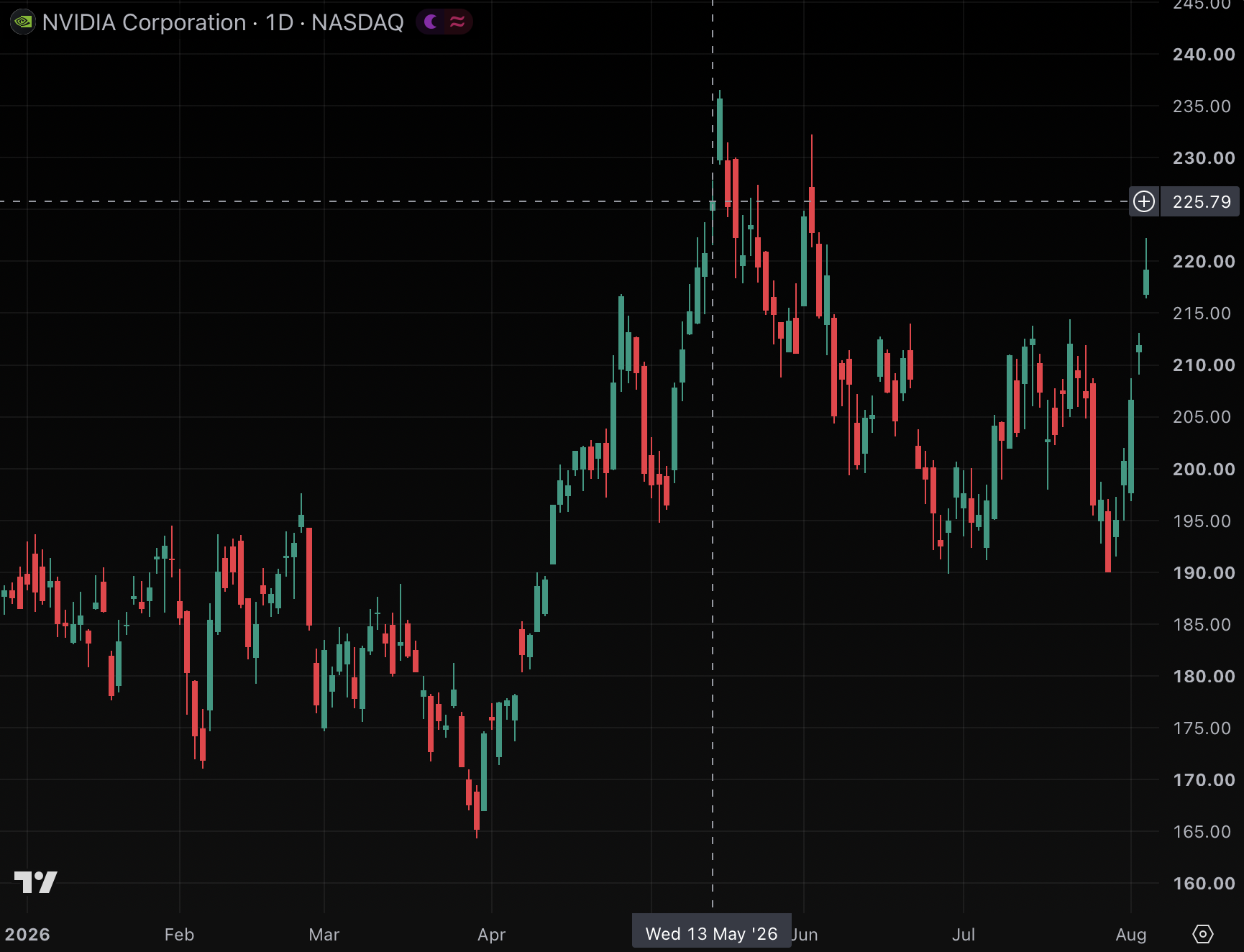
According to Protos, that call looked far outside consensus at the time. But in hindsight, it marked the top with unusual precision. The report says that, aside from one trading day immediately after Culper published its thesis, Nvidia shares have never closed above their May 13 close.
Huang said China sales would be treated as zero
After US export restrictions halted Nvidia’s chip sales to China, Huang said in November 2025 that the company was effectively modeling no China revenue at all. “I’m forecasting China’s sales to be zero,” he said. “It’s zero for the next quarter, zero for the quarter after that. We’re assuming it’s going to be zero.”
Culper challenged that claim on May 13 and put on a short position. Its view was that Nvidia may have been re-routing Chinese demand for AI chips through Taiwan and places such as Malaysia and Singapore. It also said that if regulators uncovered those diversions, legal trouble could follow.
The short came during a strong rally
The timing made the call stand out. Protos wrote that Nvidia had rallied 13% in the week before the report and that the stock was up 20% year to date. Even in that setup, Culper stated: “We are short Nvidia for one reason: The company has a significant China problem.”
Protos said the next three months brought those issues into mainstream coverage. The article argues that Nvidia did, in fact, have large unpublished problems tied to China and neighboring Taiwan.
Taiwan probe moved into public view
On July 24, Taiwanese prosecutors searched the home and workplace of an Nvidia employee suspected of smuggling restricted chips to China. Investigators also searched his desk at Nvidia’s Taipei office. Protos described it as the first known legal action against an alleged Nvidia employee in Taiwan’s widening AI chip-smuggling investigation.
Prosecutors said the man was “strongly suspected of having committed the offences,” and cited risks of flight and destruction of evidence. That story surfaced on July 28. On the same day, Huang quietly met US Commerce Secretary Howard Lutnick in Washington, DC.
Culper named the intermediaries it believed were involved
Protos noted that both developments came 11 weeks after the short seller told investors where to look. In its May 13 report, Culper estimated that more than 20% of Nvidia’s fiscal 2026 compute revenue would still be driven by Chinese demand, though that demand would likely move through Southeast Asian intermediaries and Taiwanese diversion channels.
The report named Singapore’s Megaspeed, Malaysia’s Speedmatrix, and Giga Computing, a subsidiary of Taiwan’s Gigabyte. Culper also warned that the Taiwan corridor was “just one of many in what is a complex and far-flung operation.”

Its position was that multiple Nvidia OEMs, partners, and intermediaries would continue serving Chinese demand through nearby countries. A former high-level Nvidia employee told the firm that “Megaspeed is just the tip of the iceberg.”
Nvidia denied skirting export controls
Huang maintained that Nvidia was not bypassing export restrictions. Protos quoted him as saying the company had “repeatedly tested and sampled data centers around the world and found no diversion.”
The article’s central point is that Culper’s short thesis focused on China exposure at a time when Nvidia remained in a strong rally, and later public investigations made that skepticism look unusually well timed.