
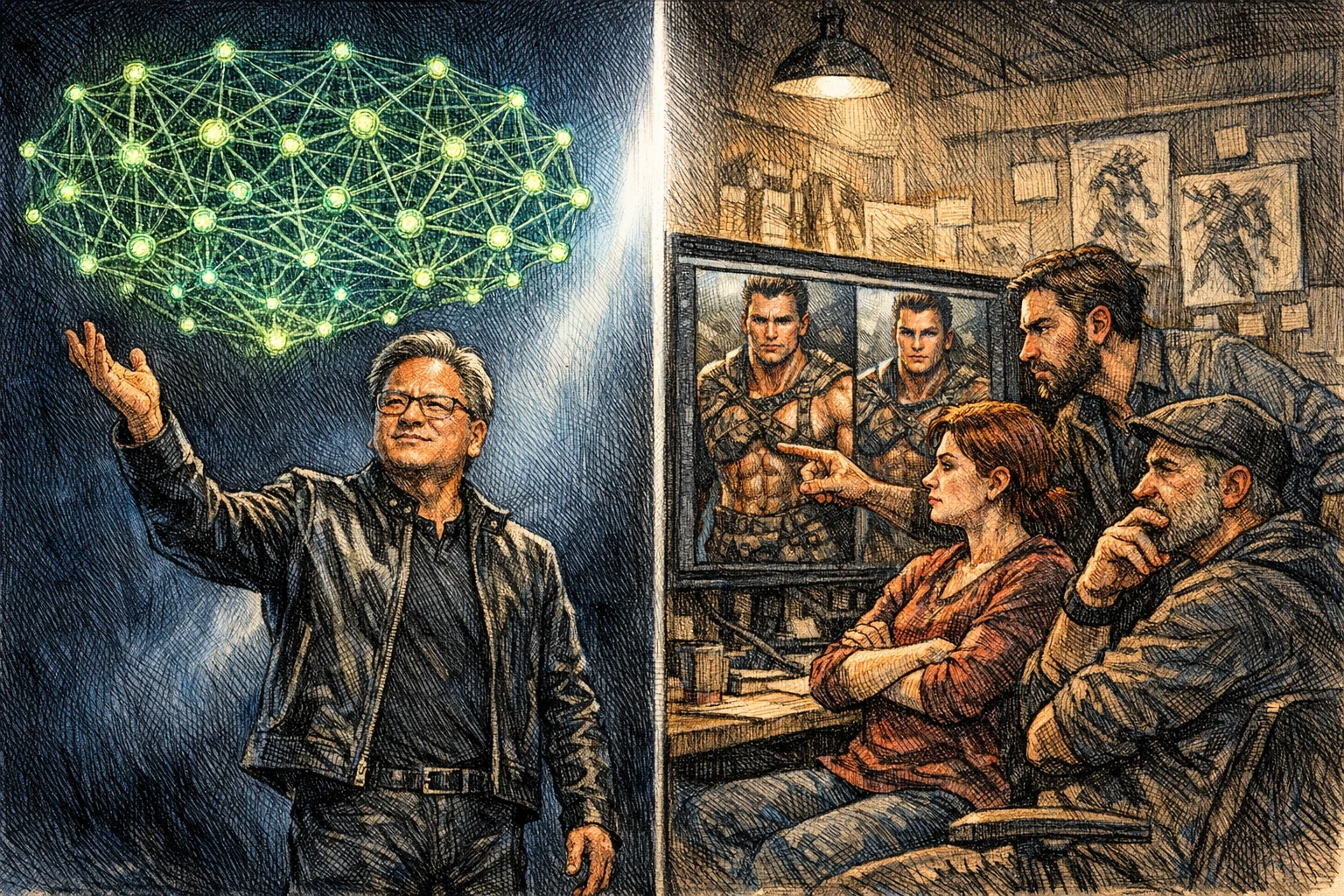
NVIDIA unveiled DLSS 5 at GTC 2026, with Jensen Huang calling it the most significant graphics breakthrough since real-time ray tracing in 2018. But the technical announcement quickly ignited backlash from rendering engineers and concept artists who called the effect a trashy AI filter.
Respawn rendering engineer Steve Karolewics said DLSS 5 looks like an excessive contrast, sharpening, and skin-smoothing filter. Concept artist Jeff Talbot was blunt: 'It's a garbage AI filter,' adding that each enhanced image 'loses more character than the original.' Game producer Danny O'Dwyer chimed in, saying the technology 'can't help but sexualize everything it touches.'
AI Filter or Graphics Revolution? Gap Between Promise and Perception
DLSS 5 combines a structured data system for visual accuracy with a generative AI module for aesthetic enhancement. NVIDIA says developers have full control over the final look, with adjustable intensity, color grading, and masking. Bethesda added that its art team would further tweak lighting and final effects, insisting the output remains 'under our artists' control.' But early demos already tell a different story.
PC Gamer noted the main demo character Grace Ashcroft's face had been visibly altered by AI, calling DLSS 5 an AI aesthetic standard overwriting the original character design. Digital Foundry's founder offered a rare positive take, saying he hadn't seen such an impressive demo in years. But most side-by-side comparisons circulating online show smoother, over-sharpened faces with exaggerated contrast, stripping away original texture and detail.
Generative AI's Homogenizing Tendency Hits the Core
Training data shapes the aesthetic bias of generative AI models — toward clarity, smoothness, high saturation, and mainstream appeal. When that logic is applied automatically to every game character, carefully crafted art styles become objects to be 'optimized.' This homogenizing tendency is a structural issue of model design, not a one-off developer mistake.
DLSS 5 is not the first DLSS iteration to stir aesthetic controversy. DLSS 3 faced ghosting complaints in certain scenes; DLSS 4 improved with a Transformer model but never fully silenced critics. What sets DLSS 5 apart is that it brings AI aesthetic judgment directly into the core character rendering pipeline. NVIDIA's defense — that developers can adjust strength, color, and masks — is technically valid. The real question: under tight dev cycles and cost pressure, how many teams will manually correct the AI's aesthetic bias per character and per scene?
15-Game Support List Points to Live-Service as Primary Target
The partnership list includes Bethesda, Ubisoft, CAPCOM, Tencent, NetEase, and NCsoft, spanning AAA titles like Assassin's Creed Shadows, Hogwarts Legacy, and Starfield, as well as live-service games like Naraka: Bladepoint and Justice Mobile. The roster is extensive, reflecting NVIDIA's heavy push.
Live-service games have different visual priorities than single-player AAA titles. For games where retention and monetization are the metrics, 'better-looking graphics' is a direct business goal, and stylistic consistency matters less. DLSS 5 is likely to gain stronger acceptance in this segment than in art-driven AAA works.
Technology itself is neutral. The real issue is how, where, and with what defaults it is deployed. NVIDIA says developers have control, but the default behavior still embeds the designer's judgment. Bethesda says artists remain in charge — plausible for a remake of The Elder Scrolls IV: Oblivion, but not a universal promise for every game integrating DLSS 5.
DLSS 5 is expected to ship in fall 2026. By then, real game footage — not cherry-picked demo screenshots — will give the industry a clearer answer to the 'revolution or filter' debate.