
Nvidia posted another earnings beat after the U.S. market close, with revenue, adjusted earnings, and forward guidance all coming in above expectations.
The company reported revenue of $96.22 billion, ahead of the $92.17 billion consensus and up 106% from a year earlier. Adjusted EPS was $2.22, above the expected $2.09 and up 120% year over year. Nvidia’s Q3 revenue outlook came in at $108 billion, also above market expectations. On a GAAP basis, the article said quarterly net margin was about 62%, meaning roughly $62 of every $100 in revenue translated into net profit.
Strong report, but the stock first moved lower
Despite those numbers, Nvidia shares fell about 4% at one point in after-hours trading after the release. The article argued that investors had become less impressed by familiar AI-era beats such as better-than-expected quarterly results and higher guidance. What the market wanted was a new trigger.
That shift came during the earnings call. CFO Colette Kress presented a preliminary outlook for roughly 70% revenue growth in FY2028, well above previous Wall Street expectations of around 44% to 45%. Jensen Huang then added that actual demand growth was not merely above 70% but close to 100%, and would be much higher without supply constraints. He also said AI had reached an inflection point and was no longer just an experimental technology, but productive infrastructure capable of generating revenue, adding that computing power now directly translates into money.
Those comments flipped the market reaction. Nvidia shares turned higher and rose more than 5% in after-hours trading, while memory-chip and optical-communications names also advanced, according to the article.
The market focus shifts from delivered numbers to future expectations
The article said the main driver behind Nvidia’s after-hours rally was not the financial statements themselves, but Huang’s remarks on the call. The market’s biggest concern had been the possibility of an AI growth bottleneck. In the article’s framing, Huang effectively pushed the timetable for that concern out by another year.
That changed what investors were pricing. Instead of reacting only to a quarterly beat, the market started trading on the prospect of earnings upgrades over the next one to two years. In the near term, the article said, that works as a powerful boost. Over a longer horizon, though, it also means part of the rally is borrowing from future expectations. Margin pressure has not disappeared, and neither has the risk tied to AI customers financing chip purchases. The article said those issues were temporarily overshadowed by the tone of the earnings call.
Nvidia’s ability to deliver on its $108 billion Q3 outlook, along with next year’s projections, will now become a major test for the stock, the article said. The stronger the promises, the stricter the market’s judgment is likely to be.
Another pool of Wall Street capital is looking beyond U.S. equities
While one part of the market was repricing the AI narrative through Nvidia, the article said another set of investors had already begun shifting attention outside U.S. stocks.
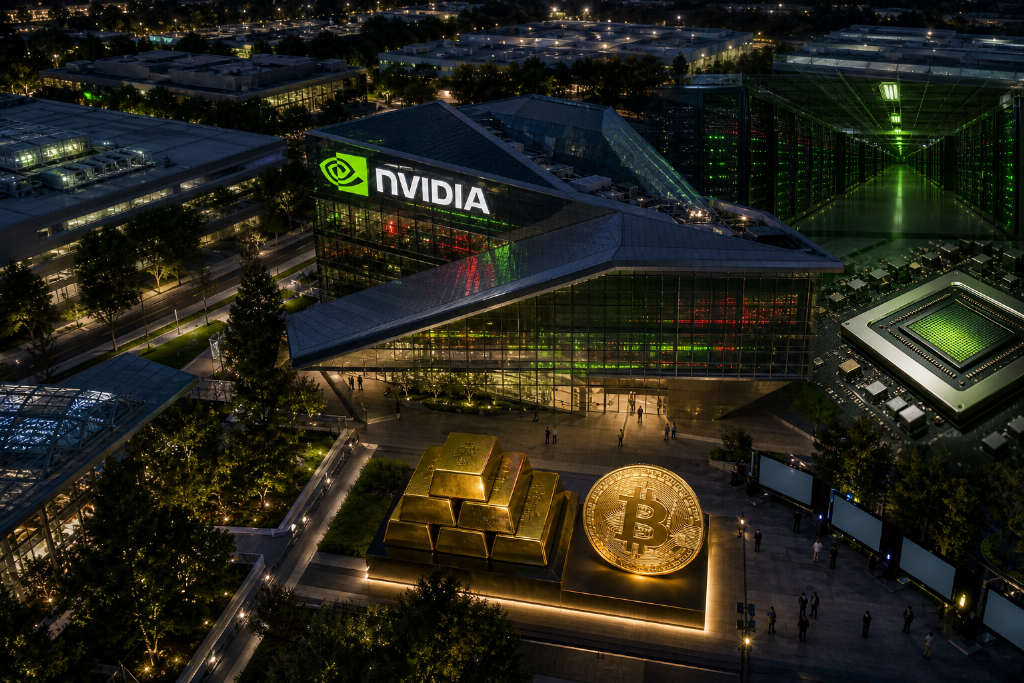
Rather than treating gold and Bitcoin as an either-or choice, those investors were buying both. Over the past five trading days, ETFs tracking the two assets took in a combined roughly $7 billion, a record, according to the article. Several of the largest gold and Bitcoin funds also moved near the top of weekly U.S. ETF inflow rankings.
The article linked that move to recent macro pressure centered on the U.S. Treasury market. With both gold and Bitcoin rising at the same time, some market participants interpreted the flows as a sign that a "currency debasement trade" was gaining traction. Under conditions of worsening fiscal pressure and easier financial conditions, the article said, scarce assets with limited supply were becoming more attractive at a faster pace.
Two market narratives strengthened at the same time
In the article’s closing section, the market move was described as the intersection of two separate lines.
One came from the earnings report itself. Nvidia’s roughly 62% net margin and $108 billion Q3 outlook showed that the AI profit engine was still running at full force. But the reversal in after-hours trading depended heavily on Huang’s comments, suggesting that market pricing had begun to move away from already delivered results and toward promises that have yet to be fulfilled.
The other came from outside the report. Strong buying in both gold and Bitcoin suggested that a meaningful share of capital was already preparing for a different allocation framework.
The article described one line as conviction in AI and the other as caution toward fiat currencies, and said the two rising together could shape the market’s next trading narrative.