
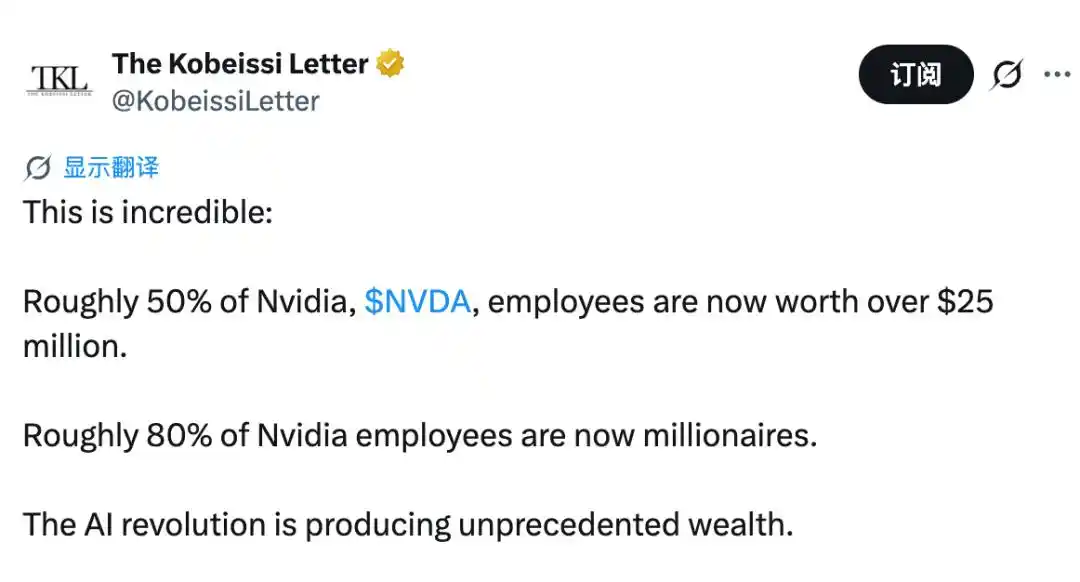
An anonymous employee survey spotlighted by The Kobeissi Letter on X suggests Nvidia has produced an unusually large number of wealthy staff through years of stock-linked compensation. The survey found that about half of respondents had a net worth above $25 million, while 78% were above $1 million.

The poll reportedly covered roughly one-tenth of Nvidia’s employees. It did not break out the full wealth distribution, but it did identify two thresholds: $1 million and $25 million. According to the disclosed results, 78% of respondents were above the first line, and around half cleared the second.
The figures revived attention around comments Jensen Huang made a year earlier on the All-In Podcast, where he said, 「On my management team, I’ve created more billionaires than any CEO in the world.」 The report says a host responded at the time by noting that $300 million contracts used to be associated with NBA players, and now Nvidia engineers were entering the conversation.
Nvidia’s wealth effect reaches across a workforce of 42,000
The scale matters as much as the headline percentages. By the end of fiscal 2026, Nvidia had 42,000 employees worldwide across 38 countries and regions. Five years earlier, that figure was below 19,000, and the company added 12,400 employees over a two-year period.
The report says the wealth accumulation is visible at the executive level as well. Chief Financial Officer Colette Kress and Executive Vice President Jay Puri each saw their personal net worth exceed $1 billion in July of last year, making them the latest additions to the list Huang referred to as the billionaires he had created.
Even with rapid hiring, Nvidia’s attrition rate was cited at just 3.7%. The report compares that with an average turnover rate of about 13% across the U.S. tech industry, putting Nvidia at less than one-third of that benchmark.
It also says more than 40% of new hires came through internal referrals, a sign that existing employees are actively pulling more people into the company.
High payouts, heavy pressure
The story is not presented as purely upside. According to former employees cited in the report, leaving Nvidia’s high-pressure work environment could mean giving up more than RMB 15 million in stock gains in a single year.
That trade-off is straightforward. Leaving means walking away from equity that may still be rising in value. Staying means continuing under Huang’s well-known high-intensity management style. In Silicon Valley, the report says, that tension has a familiar label: “golden handcuffs.”

Huang, for his part, was quoted in an interview as saying that he personally reviews compensation for all 42,000 employees, with one guiding principle: 「As much as we can pay.」
How ESPP and RSUs amplified returns
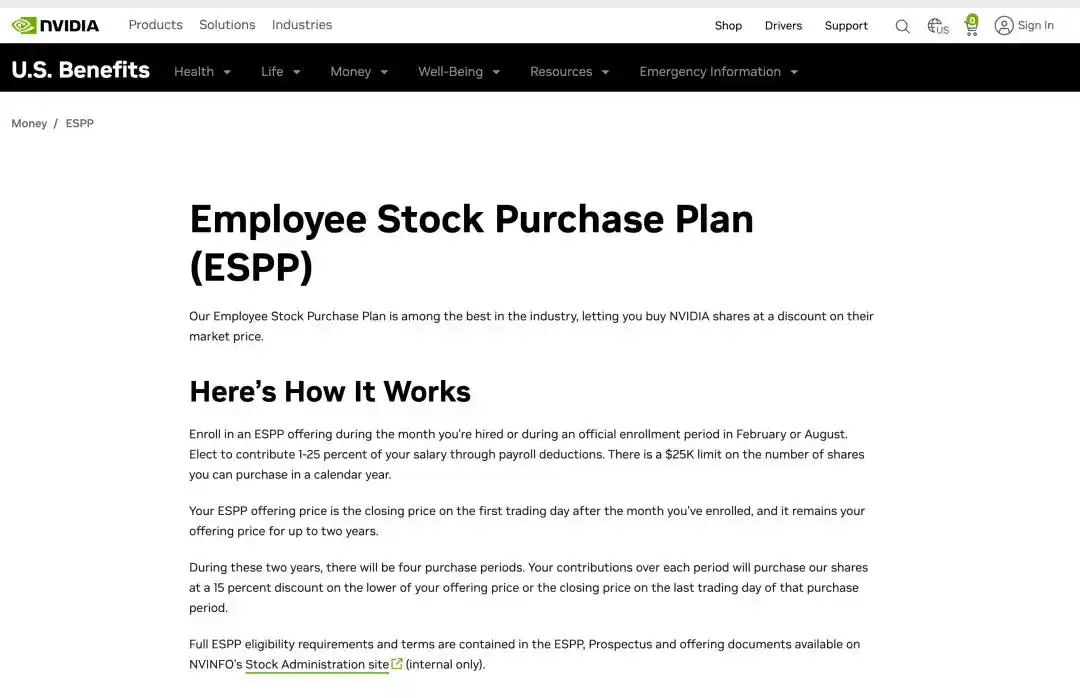
The report traces Nvidia’s employee wealth story back to 2008. During the global financial crisis, the company launched an employee stock purchase plan, or ESPP, allowing staff to buy Nvidia shares at 85% of the lowest stock price seen over the previous two years.
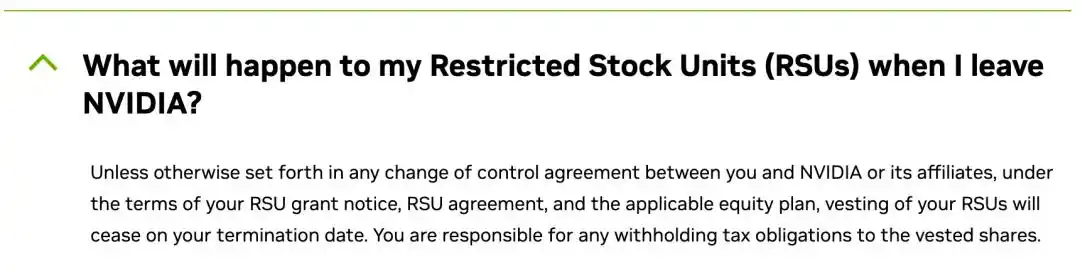
On top of ESPP, restricted stock units, or RSUs, became a core part of compensation. The vesting structure described in the report is standard: a one-year cliff, 25% vesting after the first year, then quarterly vesting, with the full grant delivered over four years.
A typical engineering offer was described as about $180,000 in annual salary plus $300,000 in RSUs paid out over four years. The report notes that a $180,000 base salary is not especially high by Bay Area standards. The real driver was the equity package, because RSU value rose with the stock price.
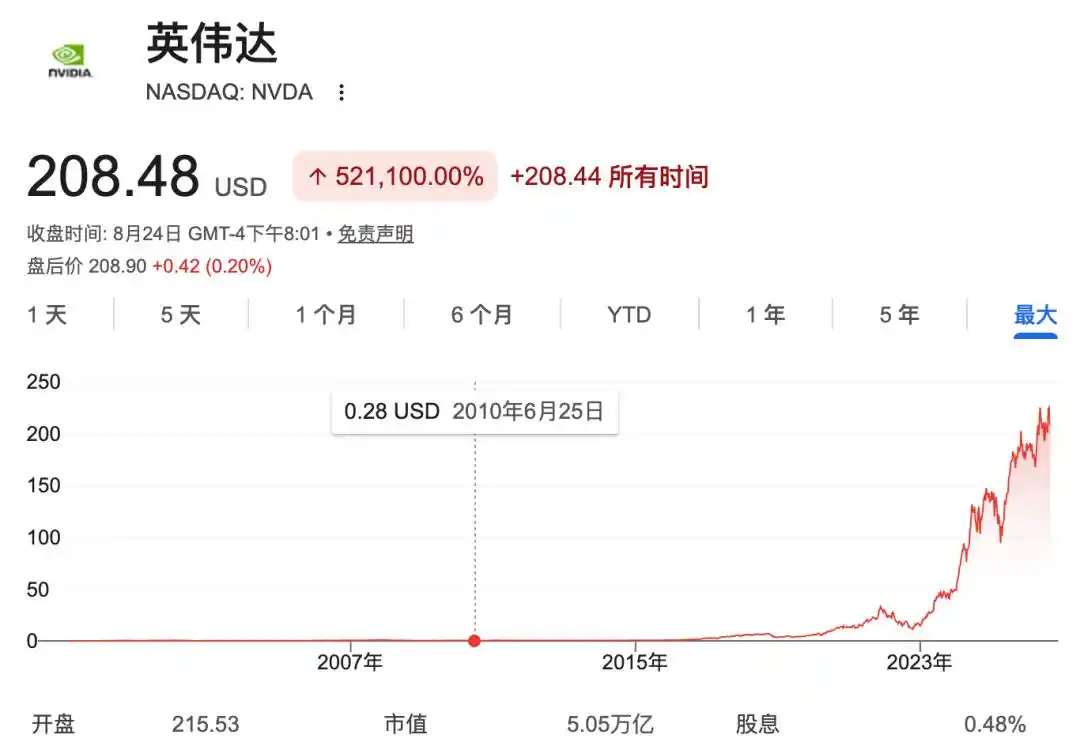
Over the past 10 years, Nvidia’s stock climbed 22,687%, rising from $0.87 to $198, according to the report. By August this year, the share price had moved to about $214, with the company’s market capitalization reaching $5.2 trillion. On that basis, the report says an engineer who received $300,000 in RSUs in 2016 and never sold would now be sitting on stock worth nearly $70 million.
The point made in the piece is simple: this was not an options bet on whether a company might go public. The stock was there from day one, and time was the critical variable. ESPP, RSUs, and a stock that rose more than 200-fold over a decade combined to form what the report described as Nvidia’s wealth-making machine.
Groq 3 LPX entered full production in the same week
In the same week that the employee survey was repeatedly cited by media outlets, Nvidia announced a fresh product update. On August 24, at Hot Chips 2026, the company said its dedicated inference accelerator, Groq 3 LPX, had entered full production.
The chip is built for inference rather than training and is aimed at AI agents. In benchmark testing on the open-source Gemma 4 model, with 31 billion parameters and a 100,000-token context window, Groq 3 LPX delivered output speeds of 3,400 tokens per second. The benchmark was conducted by independent testing group Artificial Analysis.
For latency-sensitive tasks, the report says the chip responded 4x faster than the closest competing platform. Multi-step reasoning tasks that previously took hours were reduced to minutes.
As an extension module for the Vera Rubin data center platform, Groq 3 LPX can integrate 256 LP30 accelerators in a single rack. Its first production-grade customer is cloud service provider Nebius.
The report’s framing is that Nvidia’s employee wealth story and product pipeline are linked through the stock. Equity creates wealth, and product execution supports the equity story. That connection was on display again this week.