
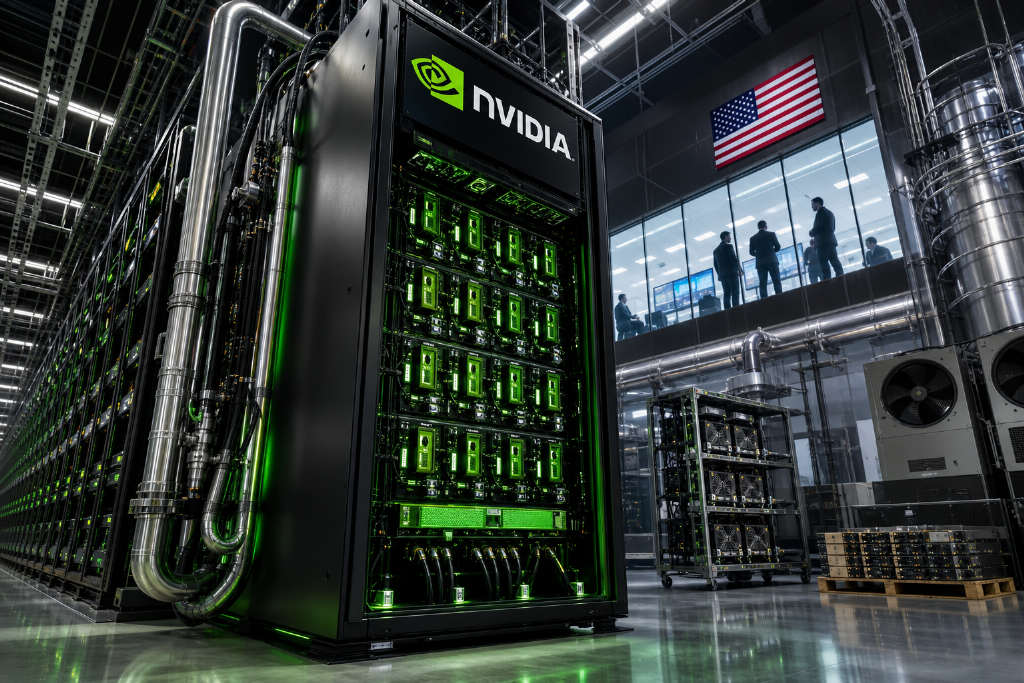
For several quarters, the same story kept getting louder around Nvidia: AI infrastructure money was no longer going just to chips. It was spilling into power, cooling, and custom silicon designed by the cloud giants themselves. In that telling, Nvidia, still the priciest link in the chain, was supposed to watch its data center growth slowly get watered down.
The bears kept coming back with the same case, quarter after quarter: the revenue base was already too big, growth had already topped out, and hyperscalers were pushing ahead on their own ASIC roadmaps. Add the steady doubts about whether the AI capex cycle was nearing its peak, and expectations for Nvidia had started to tighten.
Going into this earnings release, 41 analysts had a consensus estimate just 1.2% above the company’s own guidance. That told you Wall Street was mostly waiting for proof that Nvidia’s data center growth had not cracked. The company had already beaten expectations for five straight quarters, yes, but those beats had been getting smaller. So the market fixated on one thing: was the curve finally approaching an inflection point?
Then the report landed after the U.S. close on Aug. 26. Nvidia posted numbers that cleared those expectations by a wide margin. Data center was still the main growth machine, and both the revenue print and the message inside Q3 guidance came in stronger than the market had priced in. Jensen Huang opened the earnings statement with a line that framed the whole quarter: "AI has reached its tipping point (AI yi jing dao da ta de guai dian). It is doing useful work (Ta zheng zai zuo you yong de gong zuo). Its tokens are productive and profitable (Ta de token shi you sheng chan li, you li run de). Now, compute is revenue (Xian zai, ji suan ji shou ru)." (“AI has reached its tipping point. It is doing useful work. Its tokens are productive and profitable. Now, compute is revenue.”)
Nvidia’s role has expanded well beyond selling chips
Over the past year, Nvidia has started to look less like a plain chip vendor and more like a major capital player in the AI infrastructure buildout. Gaming GPUs have faded into the background. Data center hardware is still the core business. But that is no longer the only way the company gets judged.
On Sept. 18, 2025, Nvidia invested $5 billion in Intel as a strategic move. Rare move. Into a rival, no less. It added another layer of complexity to the relationship between the two long-time chip companies. And the timing mattered. Just one month earlier, the U.S. government had acquired about a 10% stake in Intel for $8.9 billion. Government ownership plus Nvidia’s investment brought back hopes that Intel could matter again, and Intel shares jumped 23% that day, their biggest one-day gain since 1987. On Dec. 29, 2025, the deal formally closed, with Nvidia buying more than 214.7 million Intel shares through a private placement.
Then the investment pace picked up. Fast. On Sept. 22, 2025, only four days after the Intel investment, Nvidia committed up to $100 billion to OpenAI. In January 2026, it invested $10 billion in xAI. In July 2026, it increased its OpenAI commitment, bringing the total to $250 billion.
The most structurally tangled deal in the article came on Aug. 20, when Nvidia made a three-part move involving Poolside. First, it paid $6 billion to license Poolside’s AI model, Model Factory. Second, it invested another $1 billion at a $12 billion pre-money valuation. Third, it sent job offers to more than 100 Poolside employees, who would join Nvidia’s open-source Nemotron model project.
Poolside told investors the arrangement was neither an acquisition nor an acqui-hire, and that the company would keep operating independently with its three co-founders staying in place. The article’s argument is blunt: if Poolside wanted to keep competing on its own in open-source model development, it would have needed more Nvidia hardware than was realistically available. In that reading, compute scarcity pushed the company closer to Nvidia.
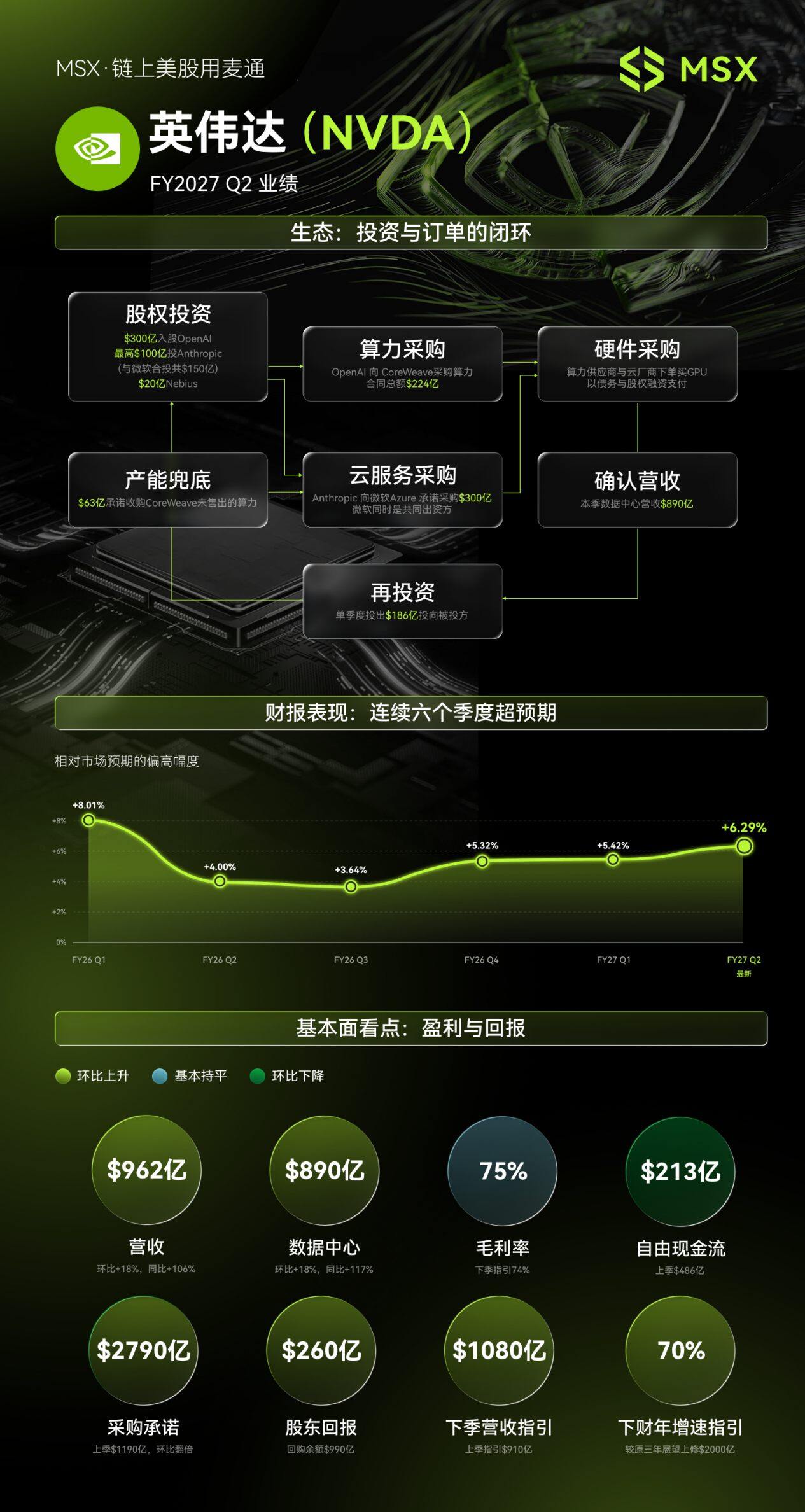
Those repeated capital moves have smeared the old lines across the AI stack. Supplier, shareholder, lender, customer. Roles that used to be separate can now sit around Nvidia at the same time. That is why criticism of “circular financing” has started to feel less abstract. Nvidia invests in customers, customers use capital to buy Nvidia GPUs, the money comes back to Nvidia as revenue, revenue growth props up the stock price, and a higher stock price gives Nvidia more room to fund the next customer. The article boils the debate down to a phrase the market keeps repeating: Nvidia invests $100 billion in OpenAI, and OpenAI sends that money right back by buying from Nvidia.
The same logic goes beyond any one company. Nvidia, Microsoft, and Oracle are all investing in AI developers, and those developers later become big buyers of cloud services. In that setup, the same capital can move through multiple companies and get recognized as revenue more than once along the way.
If the commercial return from AI infrastructure shows up late, the weak spots in that loop become easy to see. The article lays out the basic questions directly: can OpenAI earn enough from its models to cover data center costs, can cloud providers rent out the compute they are building, and can AI startups find a workable business model before their financing runs out? If any link in that chain misses on revenue, orders to Nvidia could fall, the carrying value of equity investments could drop, and earlier funding or guarantees meant to support those customers could turn into potential bad debt.
The defense of Nvidia’s capital strategy is simpler and more mechanical. Supporters say the investments are staged and tied to real deployment milestones. In the OpenAI example cited in the article, each new investment is triggered only when 1 gigawatt of deployment is completed. The first gigawatt would trigger a $1 billion investment, and later tranches would be priced at OpenAI’s then-current valuation. So if the deployment does not happen, the investment does not happen either. That limits the room for revenue to appear without a real buildout underneath it.
This argument has driven market debate for months, and worries about leverage inside the AI infrastructure chain have already spilled into credit markets. The article says hyperscalers and Nvidia-related entities have issued $225 billion in bonds so far in 2026, up 973.7% from a year earlier. Whether those risks show up in full or not, they are still part of the valuation debate around Nvidia.
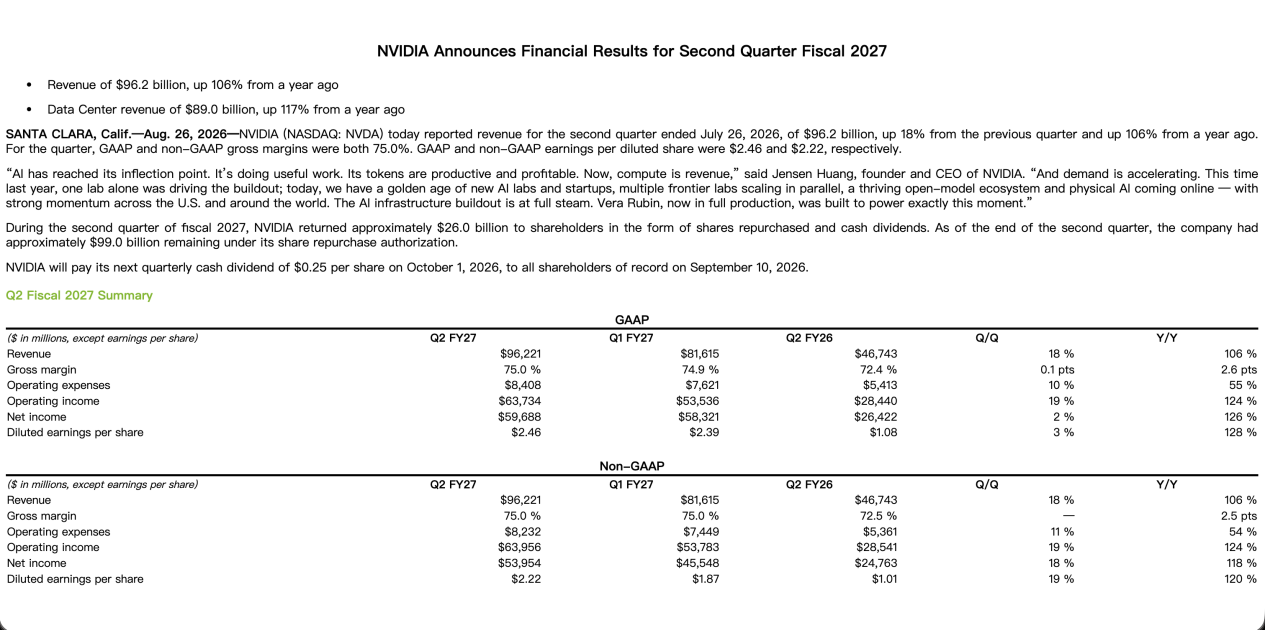
FY2027 Q2 beat across revenue, earnings, and data center demand
By normal financial yardsticks, Nvidia’s FY2027 Q2 was a monster quarter.
- Revenue was $96.221 billion, up 106% year over year and 18% sequentially. The article says that was the fastest annual growth rate since the second quarter of fiscal 2025.
- The result was $5.2 billion above the midpoint of the company’s own guidance and more than 4% above analyst expectations.
- Adjusted EPS was $2.22, up 120% year over year and roughly 6% above consensus.
- Non-GAAP operating profit reached $63.956 billion, up 124%, implying an operating margin of about 66%. That was above analyst expectations of $61.19 billion.
- Operating expenses were $8.232 billion, below the expected $8.32 billion.
Even so, the stock did not react in a clean straight line. Shares rose modestly after the release, then reversed, and at one point fell 4% in after-hours trading.
Data center revenue came in at $89 billion, up 117% year over year and 18% quarter over quarter, ahead of analyst expectations in the $85.8 billion to $85.9 billion range. That segment made up about 92.5% of total company revenue.
And the composition of that number is where things get more interesting:
- Hyperscale cloud customers generated $48.71 billion in revenue, far above the expected $43.55 billion, a beat of close to $5.2 billion.
- AI cloud, industrial, and enterprise applications produced $40.31 billion, below the market expectation of $41.96 billion.
- Edge computing revenue was $7.2 billion, up 27% year over year and 13% quarter over quarter, topping the expected $6.61 billion.
That split makes the source of the upside pretty clear: hyperscalers did the heavy lifting. Growth in enterprise, industrial, and parts of AI cloud demand came in softer than the market expected.
That matters. A lot. One popular pre-quarter view was that Nvidia’s customer mix was diversifying quickly and that enterprise demand was becoming the next growth leg. This quarter did not back that up. The four large cloud providers still look like the main engine. Enterprise demand has not scaled at the pace many investors wanted to see. Compute & Networking revenue, at $88.3 billion versus expectations of $84.69 billion, points the same way: giant cluster buildouts are still the dominant form of demand.
Margins stayed high, but Q3 guidance moved lower
Gross margin was another major focus. Both GAAP and non-GAAP gross margin were 75.0% in Q2, unchanged from the prior quarter and roughly 2.5 to 2.6 percentage points above the year-earlier level. Holding a 75% gross margin with revenue near $100 billion, while the data center supply chain is still tight, suggests Nvidia’s pricing power in AI accelerated computing remains very strong.
But Q3 guidance introduced a shift. Nvidia guided to a 74.0% gross margin, down about 1 percentage point from Q2 and below the 75% expected by analysts. The article points to a few reasons for that move: the usual yield and cost swings that can come with the early stage of ramping a new platform, and rising supply chain costs in key components such as HBM, advanced packaging, and substrates.
Product mix changes may make this more than a one-quarter issue to watch. As rack-scale system deliveries become a larger share of shipments, the cost structure changes compared with selling standalone GPUs. The clearest product signal from the quarter was that Vera Rubin is accelerating into full-scale production.
Nvidia said the current racks are already running with partners including CoreWeave, Google Cloud, Microsoft Azure, Oracle Cloud Infrastructure, and Nebius. That matters because Rubin is no longer just a roadmap promise. It is already operating in actual customer data centers. The system combines the Vera CPU, Rubin GPU, Spectrum-6 networking, BlueField, security, storage, software tools, and the DSX platform. Nvidia keeps using the phrase “AI factory” for this architecture, pushing the idea that it is supplying a full system for building, operating, and expanding AI compute infrastructure, not merely chips.
That difference matters to the market’s valuation framework. One of the biggest pre-quarter questions was whether Nvidia could move smoothly to its next platform after the peak of Blackwell demand. Rubin entering volume production extends visibility into the growth story over the next several quarters. Still, platform transitions bring short-term uncertainty. Supply chain changes, delivery timing, customer qualification, and shifting cost structures can all hit near-term margins. The article treats those factors as one likely reason gross margin guidance moved lower for Q3.
Underlying profit strength is clear, but customer concentration remains
The article argues that the quality of Nvidia’s core growth is real, maybe even better than the headline numbers suggest. Excluding $7.77 billion in gains from equity investments, non-GAAP net income was $53.954 billion, with an operating margin of 66%. Put plainly, the core business was not just being dressed up by investment gains.
Expense control also came in better than expected. At the same time, the miss in AI cloud, industrial, and enterprise applications, which was $1.6 billion below market expectations, suggests customer diversification is happening more slowly than many investors had assumed. Reliance on the four largest cloud companies has not eased in the short term.
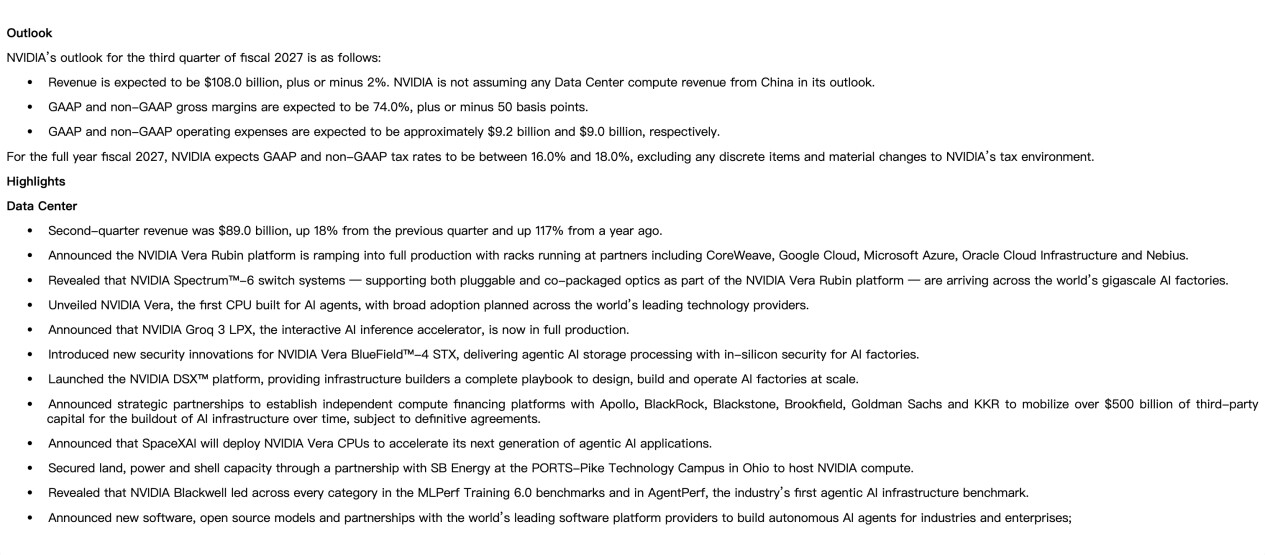
The article also points to a broader financial profile taking shape around the company: lower gross margin guidance, a sharp drop in free cash flow, a jump in accounts receivable, and a swelling investment portfolio. Put together, those features describe a business leaning on a heavier balance sheet and a longer cash conversion cycle to support faster growth.
Three parallel lines now define the Nvidia debate
The article groups the current investment case around Nvidia into three parallel lines: the AI narrative itself, competition, and the supply chain.
The first line is the AI narrative. Wall Street has moved past simple compute expansion and is now focused on proof of economic return. Jensen Huang’s long-term view is that spending on AI infrastructure could reach $3 trillion to $4 trillion per year by the end of the century, driven by the broad use of agentic AI, systems that can make decisions over time, use tools, and carry out multi-step tasks rather than act only as question-and-answer bots.
The article says the disagreement is not really about direction. It is about timing and the path to returns. The market is no longer arguing over whether AI is a future theme worth funding. It is asking when cash flow arrives and how fast returns become visible. That is why the pressure building in credit markets matters. The real conversion of spending into economic output has become the central issue for the whole AI chain.
The second line is competition from custom ASICs. The article says custom silicon is expected to rise from 20.9% of the AI chip market in 2025 to 27.8% in 2026, making it the fastest-growing competitive threat in the market. Google TPU, Amazon Trainium, and Meta MTIA are all part of that push. Broadcom, one of the biggest winners in the segment, has already reached about $10.8 billion in quarterly AI-related revenue.
What makes this threat different is that the driver is not only performance. It is bargaining power. Cloud providers know their in-house chips cannot fully match Nvidia on general-purpose capability and software depth. Even so, they are willing to give up some performance in exchange for less dependence on one supplier, more control over their supply chain, and more leverage in procurement talks. The article does not present this as an immediate threat to Nvidia’s position. It presents it as a long-term share question: not whether TPU can beat Blackwell outright, but how much capex hyperscalers are willing to shift away from Nvidia over time.
The third line is supply. The article argues there is still no sign of real relief in the shortage conditions across data center infrastructure and its broader lifecycle. That theme was already visible in Nvidia’s Q1 report. At that time, the company raised total supply to $145 billion, while management said it was not immune to supply challenges but remained confident in supporting customer growth. It also said Nvidia would likely remain supply-constrained throughout the entire lifecycle of Vera Rubin.
That statement can be read in two very different ways, and the investment takeaway changes depending on which side you prefer. Bulls can see real demand strength so intense that production still cannot keep up, implying durable pricing power and unusually strong order visibility. Another reading is that scarcity itself acts like a market narrative, reinforcing urgency and pushing customers to lock in orders early instead of waiting. Either way, the deciding variables are the same: Taiwan Semiconductor Manufacturing Co.’s CoWoS advanced packaging capacity and the supply of HBM memory.
And that also explains why upstream suppliers remain some of the clearest winners in the AI hardware cycle. TSMC controls advanced process and packaging capacity. Micron and SK hynix control HBM capacity. Their allocation decisions set the ceiling on how much Nvidia can ship, and how much Nvidia can ship sets the revenue ceiling for the broader AI infrastructure chain.
What the market is likely to keep watching
Look at it all together and the article’s framework is pretty simple: demand, capacity, and capital are the three variables holding up the current growth system.
Nvidia still looks fundamentally strong after this FY2027 Q2 report. Core operations grew fast, data center outperformed again, and the Rubin ramp extended visibility into the next phase of the cycle. But the other side has not disappeared. Customer concentration is still high. Capital deployment and balance sheet expansion are happening at the same time. Bond issuance has surged. Gross margin guidance moved lower. Supply constraints are still a hard ceiling, not a solved issue.
The article’s point is not that Nvidia’s growth story is broken. It is that the company has already crossed the line from chip supplier to builder of the compute economy’s physical foundation. So what the market has to judge over the next several quarters is not just how long growth can stay elevated, but whether the structure holding it up, built on demand, capital, and capacity, can keep working without strain.