
This article was originally published by Bit.Fan. For more cryptocurrency news and market insights, visit www.bit.fan.
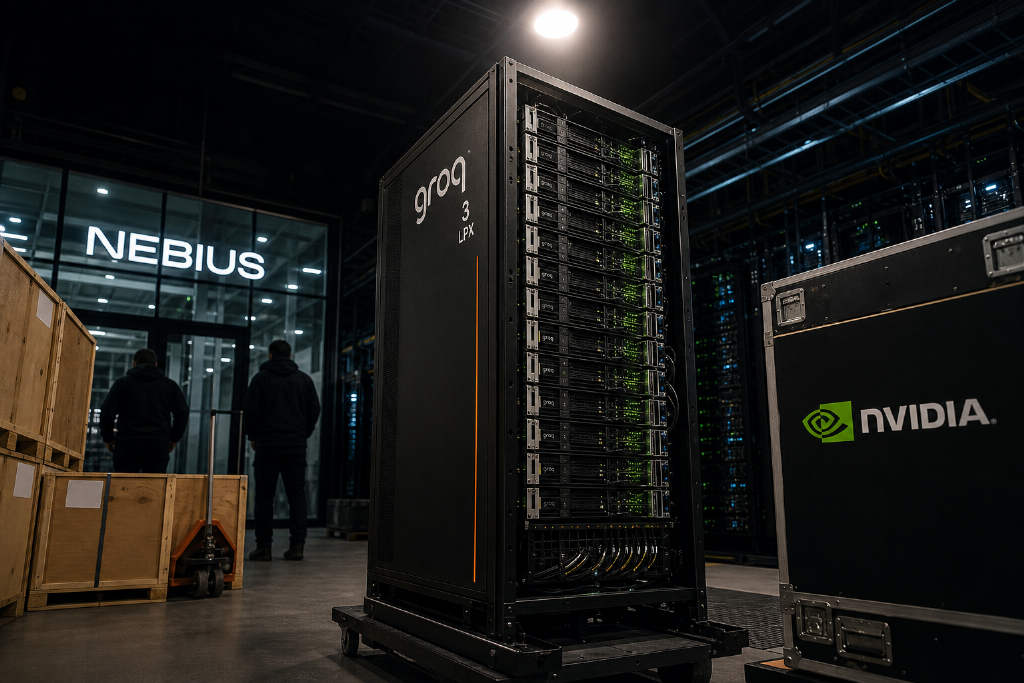
Nvidia Says Groq 3 LPX Racks Enter Full Production, First Deployment Planned for Nebius
N
News EditorNvidia senior director Dion Harris said on Monday local time that Groq 3 LPX racks have entered full production and will be deployed at the data center of Nebius, a new cloud provider, with the rollout expected later this year. The move follows Nvidia’s roughly $20 billion technology licensing deal with Groq in December and marks a step toward commercialization of the technology involved. The report also says several core Groq employees have joined Nvidia, while founder Jonathan Ross now serves as Nvidia’s chief software architect. Groq 3 LPX, launched in March, is described as a Vera Rubin platform inference accelerator that integrates 500 megabytes of high-speed SRAM on the chip die to reduce memory bottlenecks. Nvidia said each LPX rack can combine 256 Groq 3 chips and, based on benchmarks it cited, process 3,400 tokens per second. Harris said low-latency chips are not meant to replace GPUs, but to be used where different workloads call for different processors, and cloud providers may price latency-sensitive tiers higher. Nvidia CEO Jensen Huang plans to allocate about one quarter of data-center space for programming applications to Groq chips, with the rest using Vera Rubin systems. Nvidia also expects combined sales of Blackwell and Vera Rubin to reach $1 trillion by 2027.
Nvidia senior director Dion Harris said Monday local time that Groq 3 LPX racks have entered full production and will be deployed in the data center of Nebius, a new cloud provider, with the system expected to go live later this year.
The report says the rollout follows Nvidia’s roughly $20 billion technology licensing deal with Groq in December, and that the technology obtained in that transaction is now moving into commercial use. It also says several core Groq employees have joined Nvidia, while Groq founder Jonathan Ross is now Nvidia’s chief software architect.
Groq 3 LPX was released in March as an inference accelerator for the Vera Rubin platform. According to the report, the architecture integrates 500 megabytes of high-speed SRAM directly on the chip die to ease memory bottlenecks. Each LPX rack can combine 256 Groq 3 chips, and Nvidia cited benchmarks showing throughput of 3,400 tokens per second. The chip is manufactured by Samsung.
Harris said low-latency chips are not intended to replace GPUs. Instead, they are meant to match different processors to different parts of a workload. Cloud providers, he added, can charge more for users who are sensitive to latency.
Nvidia CEO Jensen Huang plans to devote about one quarter of data-center space for programming applications to Groq chips, with the rest using Vera Rubin systems. Nvidia also expects combined sales of Blackwell and Vera Rubin to reach $1 trillion by 2027.
190
Disclaimer:
The market information, project data, and third-party content displayed on this platform are for industry information sharing only and do not constitute any form of investment advice or return commitment.
Cryptocurrency trading carries high risks. Users should fully assess their risk tolerance and make independent decisions. All profits, losses, and legal responsibilities are borne by the users themselves.