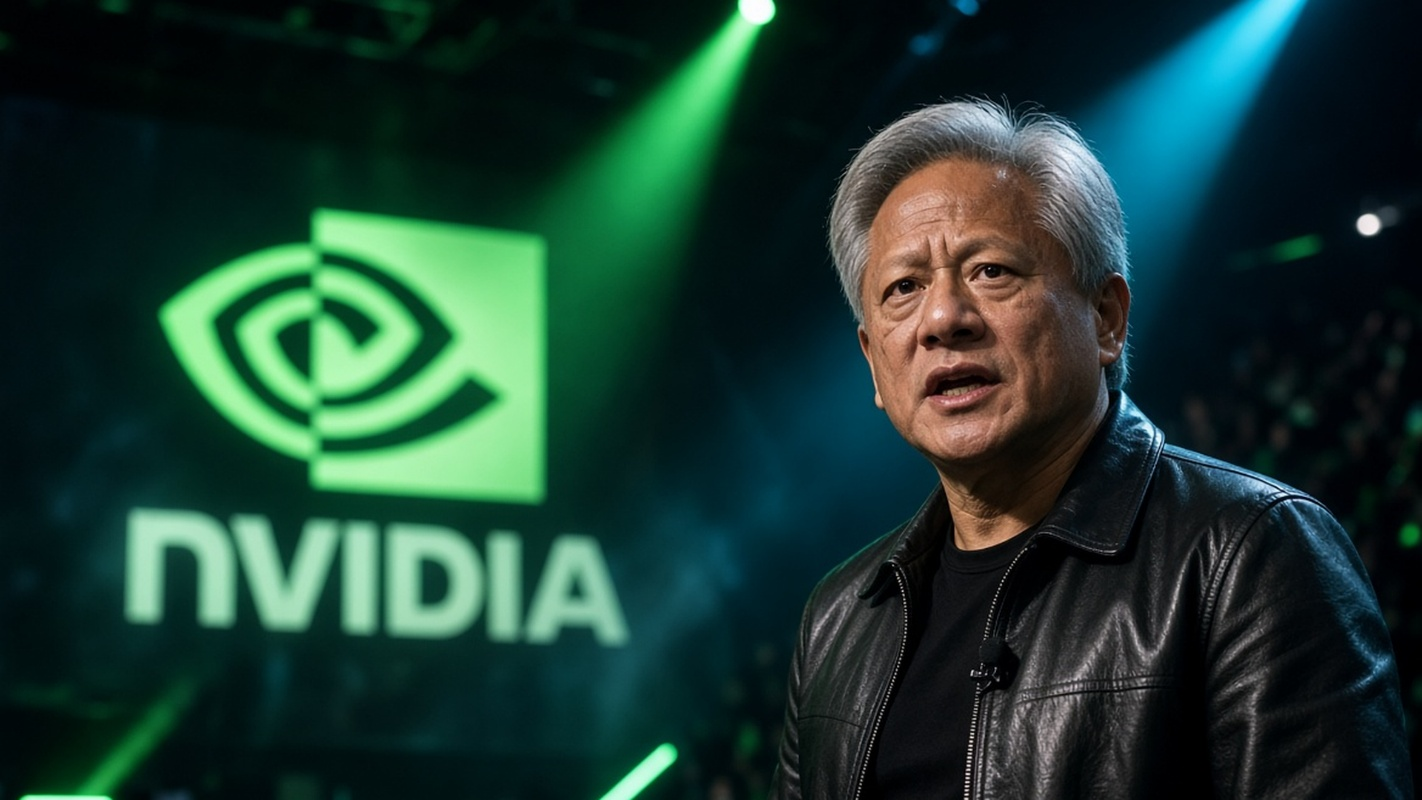
Reports that Nvidia’s board is considering removing Jensen Huang have turned a company leadership story into a stress test for the global AI trade. The Wall Street Journal reported on Wednesday evening, November 11, U.S. Eastern Time, that the board was preparing for Huang to step down. Bloomberg said the board had hired an outside firm to look for a successor and might first name an interim CEO. Nvidia had not formally announced any leadership change as of publication.
Nvidia rose nearly 3% in regular trading that day, then fell 8.6% after hours to $158.78. Investors are weighing more than whether a company with a market capitalization of about $4 trillion can operate steadily without its founder. They are also considering whether U.S. chip policy toward China could tighten and whether the AI investment boom can absorb the shock.
Stock moves and prediction markets track uncertainty
Investors have cut exposure and are waiting for clarity. On Monday, November 9, Nvidia fell about 4% while the Philadelphia Semiconductor Index gained nearly 7%. It was Nvidia’s biggest underperformance on a day of strong gains in the chip sector since 1999. Across Monday and Tuesday, the company lost more than $420 billion in market value. Its shares have fallen close to 20% since the turmoil first surfaced in late October.
Prediction markets showed the shift more starkly. On Polymarket, the implied probability that Huang would announce his resignation or be removed before year-end briefly surged from about 16% to 91%. That is not an official decision, but it indicates traders are preparing for a possible leadership change.
Analysts disagree on the potential consequences. Some believe Nvidia’s valuation could fall 25% to 30% if Huang leaves. Others argue that the sell-off may prove excessive if he remains. The divide in views is itself a source of volatility.
Before the turmoil, Nvidia accounted for about 7% of the S&P 500. A sharp move in its shares can weigh directly on the benchmark and on a large number of passive funds. For Asian investors holding U.S. index products, the episode is a portfolio risk, not just news about one company.
Asian chip shares shift from calm to pressure
Asian markets initially shrugged off the reports before turning lower. On Wednesday, chip stocks across the region were largely unaffected. Taiwan Semiconductor Manufacturing Co. (TSMC) gained 2.2% after its board approved investments in Anthropic and OpenAI. Japanese and South Korean shares also rose at the open on Thursday, led by chipmakers including SK Hynix, Samsung and TSMC. At that point, investors appeared to see the issue as Nvidia-specific.
The mood reversed in the afternoon as the removal reports gained traction. The Nikkei 225 closed down 0.7% at 60,819 points, South Korea’s KOSPI fell 0.6% to 5,343, and the Hang Seng Index lost more than 1%.
South Korea is particularly sensitive to Nvidia-related cooperation. Korean media estimate that partnerships between South Korean companies and Nvidia totaled about 680 trillion won over the past year. In July, SK Group signed a letter of intent with Nvidia covering AI infrastructure and memory cooperation worth more than $500 billion. Much of this cooperation rests on relationships Huang personally advanced, leaving the pace of projects uncertain if the company changes leadership.
The underlying logic of the Asian supply chain, however, has not changed. As long as global data centers continue to demand computing power, foundries, memory suppliers and packaging companies in Taiwan and South Korea remain key parts of the AI cycle. For now, markets are pricing in a premium for uncertainty rather than reassessing AI demand itself.
Three deeper risks for markets
Founder dependence returns to the valuation debate
Huang is Nvidia’s founder and a central figure in its strategy, major customer relationships and government communications. The company has not made a succession plan public. Investors have rarely priced this risk explicitly; now it is becoming part of the valuation discussion. The same scrutiny could reach other technology giants led by their founders.
U.S. chip policy toward China could tighten
Huang has long been one of Washington’s most influential voices against a complete cutoff of chip supplies to China. The current turmoil is also linked to a Singapore company under investigation by the U.S. Department of Justice for export violations. The article says scrutiny of Southeast Asian distributors, data centers and cloud-computing rentals could intensify, narrowing the room for chips to reach China indirectly.
A pause on a U.S. Commerce Department rule expanding export restrictions has been extended only until January 10, while the Chip Security Act is also advancing. For investors, this makes Nvidia’s revenue from China and Southeast Asia harder to forecast and strengthens the case for domestic Chinese chip substitutes.
U.S. AI capital spending faces greater uncertainty
The technology stock pullback is not entirely about Nvidia. In the United States, data centers have shifted from being an economic development selling point to a subject of local political debate. Pressure on electricity and water supplies, higher utility bills for residents and concerns that AI will displace jobs are all weakening public support for AI investment.
Inflation remains elevated and Treasury yields are near 5%, leaving high-valuation, long-duration AI assets under pressure. If computing infrastructure construction slows, the impact could spread across the supply chain, from chips to servers, memory and power equipment.
What investors are watching next
- Nvidia’s November 17 earnings: Data-center guidance and management’s comments on the China business will test whether the turmoil has affected fundamentals.
- The board’s decision: Whether Nvidia appoints an interim CEO, and whether the candidate comes from inside or outside the company, will shape views of the continuity of its long-term strategy.
- A closed-door congressional briefing around November 18: It will offer a window into the direction of U.S. chip policy toward China.
- Financing and valuations at leading AI companies: If companies such as Anthropic and OpenAI continue to raise funds smoothly, capital may still be treating the episode as an isolated event.
- Progress in China’s domestic computing chips: With import channels tightening, the chips’ actual performance in training and inference will influence valuations in the sector over the medium and long term.
Policy and investment pace are the larger variables
So far, markets have confined the fallout mainly to Nvidia and its closest partners rather than the entire AI cycle. Sentiment shocks triggered by an individual leadership story can fade quickly. If the episode ultimately changes U.S. chip policy or the pace of AI investment, its effects would extend well beyond one company’s share price.
Disclaimer: Markets involve risk, and investors should exercise caution. This article does not constitute investment advice. Readers should consider whether any opinions, views or conclusions in the article suit their particular circumstances. Any investment decision is the reader’s responsibility.