
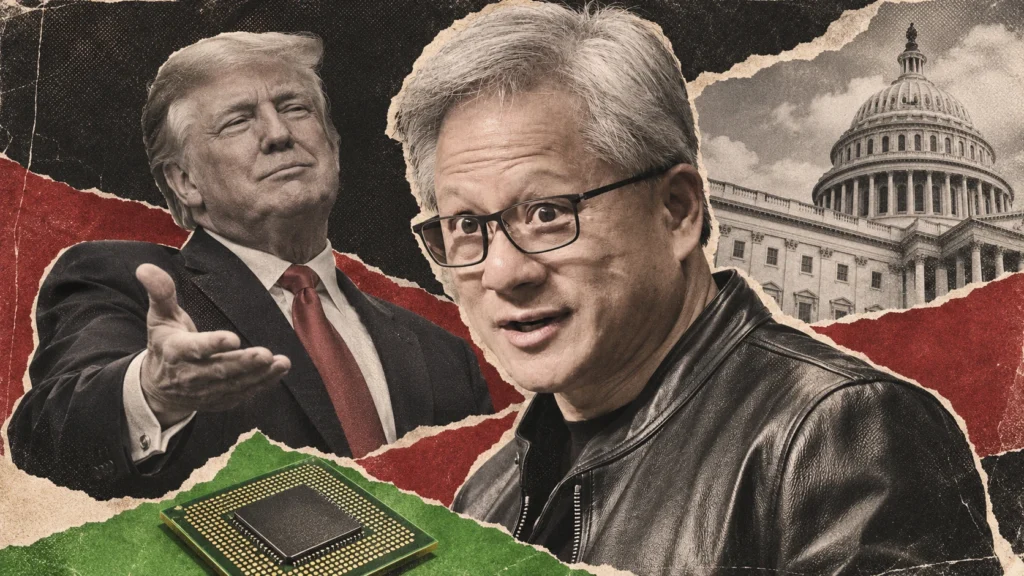
At least 10 Republican lawmakers publicly questioned the national security risks of Jensen Huang’s return to Nvidia’s leadership after the company’s board voted to reinstate him as president, chief executive and a director. Democrats went further, accusing President Donald Trump of placing his financial interests ahead of national security.
Trump told CNBC in a telephone interview: “I made the deal.” Nvidia said in its announcement that the board had consulted senior U.S. government officials and was confident Huang’s reinstatement posed no national security risk. Lawmakers focused on that assertion.
The New York Times previously reported that U.S. intelligence indicated Huang Le had remained in contact with China’s Ministry of State Security while in a relationship with Huang.
Republicans seek the basis for the security assessment
Some Republican lawmakers asked how Nvidia and the government had reached the conclusion that Huang’s return presented no risk. Texas Senator John Cornyn wrote on X: “No national security risk? Based on what?” He later asked whether the Federal Bureau of Investigation (FBI) had given Huang a defensive briefing and, if so, whether Huang had ignored it.
Utah Senator John Curtis asked who in the government had expressed a view, what was said to the board and what evidence the board relied on. He noted that the board had said only last week that it did not intend to reinstate Huang and that an independent investigation had not concluded. “I want to know what changed,” he said.
John Moolenaar, chair of the House Select Committee on China; Rick Crawford, chair of the House Intelligence Committee; and Brian Mast, chair of the House Foreign Affairs Committee, issued a joint statement. They said the board’s “brief internal investigation” and Huang’s reinstatement could not erase national security threats and questions that still needed to be addressed.
Florida Senator Rick Scott, a close Trump ally, told CNBC in a written response that the board was free to vote as it wished, but the government owed Americans an explanation. The situation, he said, “looks bad on its face.”
Others oppose Huang’s return outright
North Dakota Senator Kevin Cramer argued that the board would bear the legal and reputational risks of hiring a chief executive who was “likely to be convicted,” while the national security risks would fall on the U.S. military and the public.
Representative Bacon, a China hawk who is set to retire, wrote on X that Nvidia should have moved forward without Huang rather than heed the government’s “inexplicable desire to save Huang.” In a telephone interview with CNBC, he said he could not understand why Huang was being brought back and called it a “failure of character.” Selling advanced chips to China while saying the United States must win the artificial intelligence (AI) war was a contradiction and a failure of White House leadership, he said.
Democrats cite Trump’s Nvidia holdings
Most of the Republican criticism was directed at the board and at the unidentified government officials who advised it, with few lawmakers naming Trump directly. Democrats took a different approach.
Senate Democratic leader Chuck Schumer wrote that Trump was putting his own financial interests and the needs of his billionaire friends ahead of national security. Senator Ron Wyden told CNBC in a written response that, under the Trump administration, national security had become a commodity available to the highest bidder.
Trump owns Nvidia shares. Reuters relayed a Washington Post estimate based on financial disclosures that put his holdings at $13 million to $62 million at the end of August, compared with $615,000 to $1.3 million at the end of 2024. Reuters said it could not independently verify the estimate.
Office of Government Ethics filings also showed that Trump purchased up to $265,000 in Nvidia shares in September. White House spokesperson Davis Ingle said an independent third-party financial institution manages the president’s portfolio according to an index-based allocation, and that neither Trump nor his family can direct or influence the investments.
Interviews, hearing and proposed legislation
Huang is scheduled for a closed-door, recorded interview with the House Foreign Affairs, Intelligence and China select committees on December 1. Nvidia’s legal chief, Tim Teter, is scheduled to be interviewed on December 2. The Senate Banking Committee will hold a public hearing on December 3 at the request of its Republican chair, Tim Scott.
Democrats are set to take control of Congress in January. Schumer and House Democratic leader Hakeem Jeffries have both said they intend to investigate.
Republicans are also considering legislation. Senator Tom Cotton said he had warned the administration from the start that Huang’s retaining his position did not resolve the controversy. He said he would push export-control bills including the Chip Security Act.



