
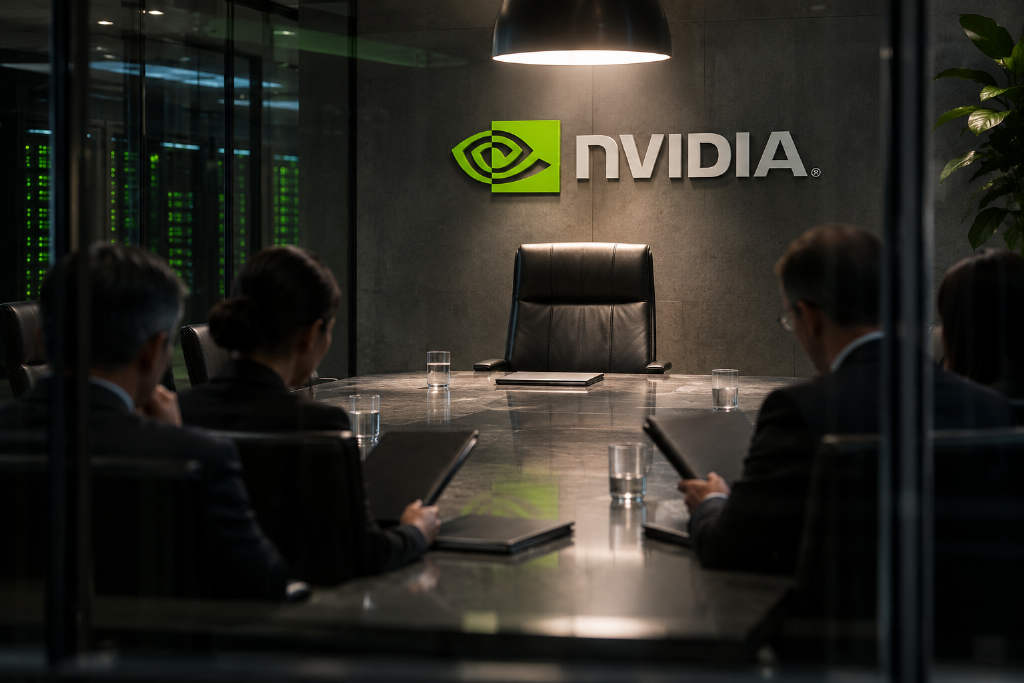
Nvidia’s board is reportedly reviewing Jensen Huang’s future as chief executive and working with outside firms to identify potential successors, including a possible interim CEO. Bloomberg, The Wall Street Journal and Reuters are cited in reports about the board’s discussions and the company’s internal review.
The reports connect the review to allegations involving Huang’s personal relationships. The New York Times previously reported that Huang had an improper relationship with a direct subordinate. That disclosure added to earlier allegations involving a Chinese woman. The reported relationships and allegations remain the subject of review.
According to the reports, Nvidia’s board held an internal meeting on Wednesday to discuss whether Huang should remain CEO. Reuters reported that the board opened an internal investigation on Sunday in response to national-security concerns mentioned in news reports. The review comes shortly before Nvidia is scheduled to release its quarterly results next week.
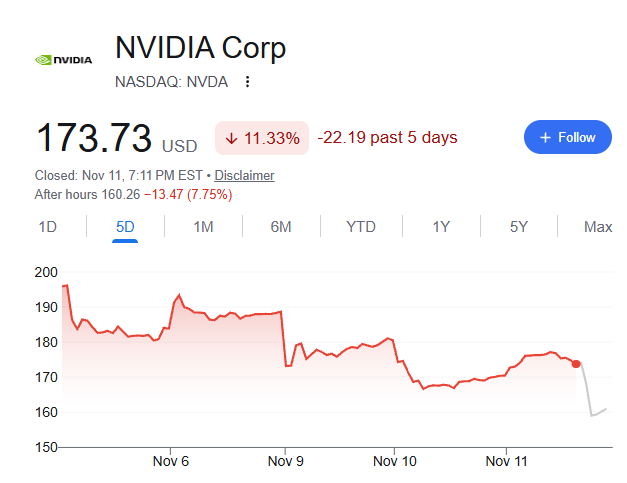
Investors reacted sharply. Nvidia shares fell as much as 9% in Wednesday’s after-hours trading, while Intel and Dell Technologies also declined. The reports described the market reaction as a reassessment of uncertainty around Nvidia’s leadership.
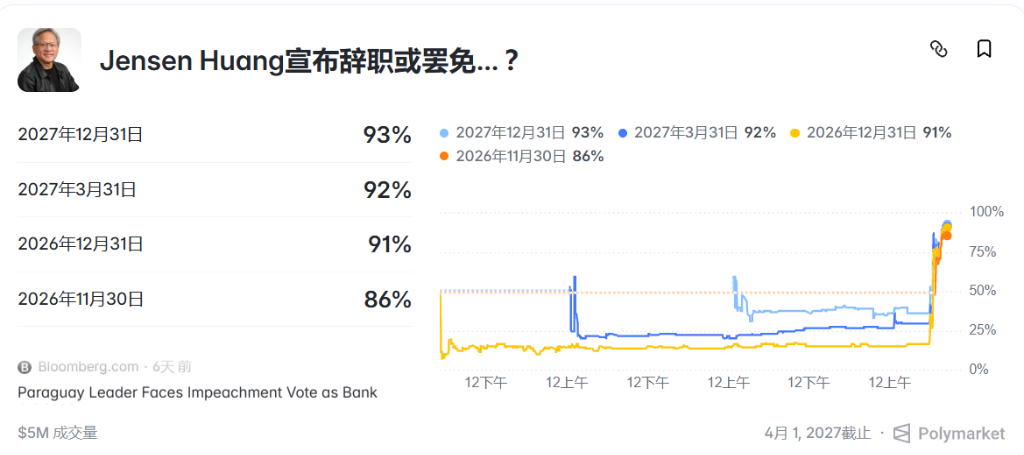
Polymarket data showed a sharp increase in bets on Huang leaving or being removed. The probability of Huang leaving by Nov. 30, 2026, rose to 86%. The figure reached 91% by Dec. 31, 2026, 92% by March 31, 2027, and 93% by Dec. 31, 2027.
Board structure and independent review face scrutiny
Nvidia’s governance structure has also drawn attention. The company has 11 directors but no board chair, according to the reports. Several independent directors, including Mark Stevens, have served since the 1990s, leaving the board with a long-standing membership structure.
Marc Goldstein, head of U.S. research at Institutional Shareholder Services, said Wall Street often gives charismatic Silicon Valley founders a degree of latitude. But with questions now being raised about Huang’s judgment, Goldstein said Nvidia’s board should hire independent legal counsel to strengthen the credibility of the investigation.
Goldstein also suggested that long-serving directors consider recusing themselves from the review to reduce the risk of future legal challenges from shareholders. Gil Soffer, a former U.S. Justice Department official and chair of Katten, said removing Huang could be an appropriate response if an investigation confirms that he concealed a relationship and engaged in misconduct.
Did Huang disclose the relationship?
One central question is whether Huang disclosed the relationship to Nvidia. The company’s code of conduct lists personal relationships as a situation that can create a potential conflict of interest. It also requires employees facing a potential or actual conflict to contact the legal department for guidance.
Soffer said in an email that a full and truthful disclosure by Huang would help his position because it would mean the relationship had not been concealed. It would also have given the board an opportunity to assess the situation and establish controls.
Soffer added that, before more facts become public, it is not possible to determine whether the relationship created an actual conflict of interest, whether the board handled the matter properly, or what level of discipline would be appropriate. He repeated that removal could be an appropriate measure if Huang concealed the relationship and engaged in misconduct.
Nvidia’s latest proxy statement says Huang received $120 million in total compensation over the past three years, mainly through stock awards. The company’s bylaws allow the board to remove him with or without cause through a majority vote.
Investors reassess key-person risk
Several market participants expressed concern about possible leadership disruption at Nvidia. Haris Khurshid, chief investment officer at Karobaar Capital, said the matter had moved beyond an individual scandal and become a governance and key-person risk. He said investors were beginning to reprice sentiment across the broader AI sector.
Joe Gilbert, a portfolio manager at Integrity Asset Management, called the situation “without question a negative” for Nvidia and the wider AI ecosystem, saying a successor would be unlikely to replicate Huang’s strategic vision.
Michael O’Rourke, chief market strategist at Jonestrading, noted that Nvidia had previously forecast 70% sales growth this year. Under an aggressive sales strategy and supplier-financing model, he said a successor could spend an entire year “putting out fires and cleaning up the mess.”
Matt Maley, chief market strategist at Miller Tabak + Co, warned that Nvidia is an important source of financing for the AI industry and that turbulence at the top could lead the sector to reduce spending. The report also names Brian Mulbe of Zacks Investment Management, but the available text does not include a specific comment from him.



