
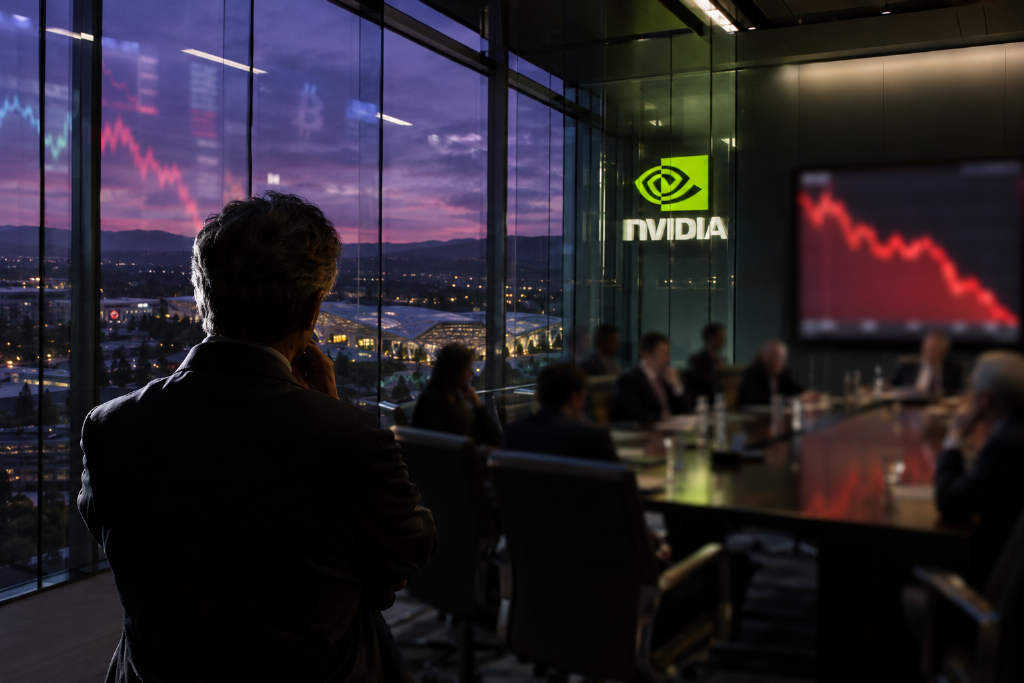
The world is buzzing about NVIDIA founder Jensen Huang. This CEO, who has led the company for 33 years, shifted from AI star to governance crisis figurehead in just one week.
Huang first admitted disloyalty to his wife. NVIDIA's board launched an investigation into whether he became a target for foreign intelligence operations. The New York Times then reported an extramarital affair with medical business VP Kimberly Powell, who reports directly to him.
The Wall Street Journal states the board is preparing to oust Huang. On Polymarket, odds of Huang resigning or being fired by year-end spiked to 90%.
Some Wall Street firms downgraded NVIDIA. Reuters tallies show, including after-hours drops, NVIDIA's market cap has lost about $600 billion since the board probe announcement.
Board Holds Removal Power, No Successor Locked In
Early focus fell on Huang's ties to Alice Huang, ex-executive at Megaspeed, a Singapore data center operator and NVIDIA customer. The U.S. government probes if it illegally shipped NVIDIA chips to China.
Since Alice Huang isn't an NVIDIA employee, the board has time to await probe results. From Nov. 9 to 11, Polymarket odds for Huang's year-end exit hovered around 15%.
The shift hit on Nov. 11. The New York Times, citing five current or former employees, detailed Huang's affair with direct subordinate Powell. In U.S. firms, CEO-direct report relationships cross governance lines. Intel ex-CEO Brian Krzanich and McDonald's ex-CEO Steve Easterbrook both exited over employee relations policy breaches.
Huang lacks leverage against the board. NVIDIA uses one-share-one-vote, no dual-class structure. Per the company's May 2026 proxy, Huang holds ~3.58% stake. Of 11 board members, he's the sole non-independent director. Bylaws let the board remove executives by majority vote anytime.
Bloomberg reports the board hired external headhunters for candidates and eyes an interim CEO first. Semafor sources say some directors favor CFO Colette Kress.
Kress joined NVIDIA in 2013 after stints at Microsoft, Cisco, and Texas Instruments. She often joins Huang on earnings calls, making her a Wall Street familiar face.
Prediction markets favor Ian Buck. Post-ouster reports, Polymarket and Kalshi show Buck leading odds for next CEO. As of Dec. 12 afternoon 6 p.m., Polymarket has Buck at 25%, Kress at 22%.
Buck joined in 2004, key CUDA software architect, now heads exascale and high-performance computing.
Analysts float Kress stabilizing ops and finance, Buck on products and tech, as co-CEOs for transition.
Outsiders: Arm CEO Rene Haas worked at NVIDIA seven years but also SoftBank International CEO, high poach cost. Semafor notes Apple hardware chief Johny Srouji in mix. AMD CEO Lisa Su mentioned, but AMD competes directly and she's related to Huang—low odds.
In a Bloomberg doc, Huang said he wants the next CEO internal, not his kids. Like him, they earn it on merit, as he could be fired anytime.
Not everyone backs a change. Seaport's Jay Goldberg, with a sell rating, calls forcing Huang out a mistake for all—no easy replacement.
The Kobeissi Letter urges a special shareholder meeting for advisory vote; Musk backs shareholder voice. But advisory votes bind nothing; board decides.
Orders and Ecosystem Steady, Huang's Judgment Hard to Hand Off
NVIDIA ops won't halt on leadership swap. Devs worldwide rely on CUDA; cloud buyers have schedules locked. Bernstein's Stacy Rasgon sees it as NVIDIA's issue—clients won't cut buys.
Bernstein cuts to market-perform, price target $400 to $200, keeps earnings forecast but halves multiple to ~12.7x FY2028 EPS. Rasgon blames leadership uncertainty, prefers sidelines.
Baird to neutral, $500 to $200 target, citing probes and export curbs. Morgan Stanley drops from top picks per stop-loss but holds overweight, $300 target. Yorkville Ives' Dan Ives sees 25-30% initial stock drop if Huang goes.
Huang's call-making is tough to pass. Tianfeng's Guo Mingqi says Huang turns engineer feasible tech into firm-wide resource commitments and must-deliver products, giving supply chain visibility and forcing rivals to chase. Guo figures Huang won't escape unscathed; NVIDIA should ease personal decision reliance and prep succession.
Another tough asset: D.C. pull. Last two years, Huang lobbied Trump admin for looser China chip exports. Dec. 2025, Trump ok'd H200 sales to China, U.S. taking 25% fee.
Pressure now from Congress: three GOP House committee chairs summon Huang to closed briefing Nov. 18. Foreign Affairs Chair Brian Mast threatens subpoena if no-show.
New York Times: Commerce probe on Megaspeed handed to Justice, now criminal. Successor faces these sans Huang's clout.
NVIDIA Shakeup Ripples Across Markets
NVIDIA price swings hit far beyond holders. As of Oct. 28, 7.81% weight in SPDR S&P 500 ETF. Benzinga: 10% NVIDIA move drags S&P 500 ~0.78 points.
Monday: down 4.27%, 463M shares—four times average. Mon-Tue: -9.5% total. WSJ ouster story tanks Nasdaq futures 0.8%, S&P 0.3%. Pressure on AI chain: Super Micro, Oracle, CoreWeave drop; AMD bucks up 3.8%. Taiwan, Korea, Japan suppliers—high NVIDIA weight—trade spot first.
Cap-weighted indexes auto-shrink NVIDIA weight on drops, no forced sales. Real pressure: active funds risk tweaks, founder-bet funds. Axios: Founder ETFs to dump if Huang out.
Reuters: Lawmakers leverage for tighter China chip curbs. Escalation—like Justice probe hitting NVIDIA or export clamps—spreads pain to full AI hardware stack.
Crypto side, NVDA tops Hyperliquid open interest for HIP-3, platform's #4 after BTC, ETH, HYPE.
Pre-U.S. open last weekend, Hyperliquid/Binance NVDA perps and tokenized shares fell 3-4%. BTC briefly under $74K; some call it leveraged safe-haven reflex.
Many BTC miners pivot to AI compute. IREN signed $3.4B five-year AI cloud deal with NVIDIA in May; NVIDIA gets warrants for up to 30M IREN shares at $70/share if GPU milestones hit. Post-swap, deal pace in question for miners.



