
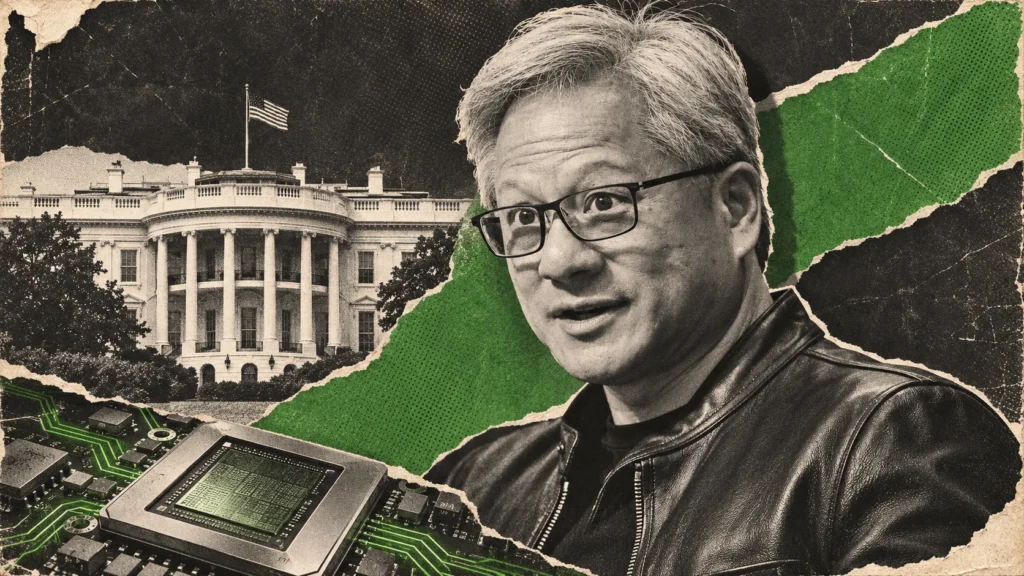
Nvidia’s board unanimously reinstated Jensen Huang as the company’s president, chief executive and director, 11 days after he left those roles. BlockTempo presents the decision as the outcome of a political arrangement involving President Donald Trump, Treasury Secretary Scott Bessent and Secretary of State Marco Rubio: Bessent gained greater control over chip export policy, Rubio publicly supported Trump’s diplomatic approach, and Trump pushed for Huang’s return. Nvidia shares climbed 35.64% on Nov. 23, taking the company’s market value back to $4.1 trillion.
The reinstatement followed weeks of political tension and a sharp selloff in Nvidia stock. The report says the board had looked for a successor while disagreements inside the White House grew over export restrictions and artificial intelligence policy. Traders on prediction markets had assigned only a small chance to Huang’s return before the board announced its decision.
Arm’s contract announcement narrowed the succession field
At 4:38 a.m. Eastern time on Monday, Nov. 23, 2026, chip-design company Arm announced that CEO Rene Haas had extended his contract through 2033. Haas would also become vice chairman of SoftBank Group. According to the report, Nvidia’s board had approached Haas first when it began searching for a successor about 10 days earlier.
More than four hours after Arm’s announcement, and before the U.S. market opened, Nvidia posted a statement of fewer than 600 words. It said the board had unanimously restored Huang as president, CEO and director, effective immediately. Nvidia shares rose in premarket trading and gained more than 30% after the opening bell.
Huang had been out of those three positions for just 11 days. Bloomberg had previously reported that, on the night before his resignation, his replies to company emails became slower. He repeatedly typed “whatever” and “I don’t care,” and reportedly described himself to people around him as “a piece of shit.” The account says personal-conduct controversy and questions from Washington combined to push him out of office in a short period.
The political dispute was already visible. The report describes Rubio as a traditional Republican hawk on Russia and says he gave the media a memo he had drafted in the spring. Bessent, meanwhile, was angry with Commerce Secretary Howard Lutnick over delays to chip controls and turned his criticism toward Nvidia. In its Nov. 23 reinstatement statement, Nvidia said the board had received input from senior U.S. government officials and, based on that input, concluded Huang’s return would not create a national security risk.
BlockTempo identifies Nov. 16 through Nov. 22 as the week in which the three sides reached a new understanding. Its interpretation is that Bessent and Rubio had both backed pressure on Huang, but changed course after making progress on their respective priorities. Huang then had a path back to the company’s headquarters in Santa Clara.
New export rules gave Bessent more authority
On Sunday, Nov. 15, Bessent appeared on Fox News’ morning program and issued Nvidia’s board an ultimatum. He demanded that the company explain its export-compliance issues within 10 days, undertake a thorough cleanup and find a new CEO. The board, he said, “needs to look outside the company.” At the time, prediction-market bets that Lutnick would leave his post had risen to 63%.
The report recounts two earlier policy clashes involving Bessent and the White House. In May, Bessent and White House Chief of Staff Susie Wiles spent months drafting an executive order to review AI models. The proposal stalled after David Sacks, who had just left his position as the White House’s AI czar, called Trump, according to the account. In November, the Treasury Department, State Department and Office of the U.S. Trade Representative supported placing Megaspeed, which was suspected of chip transshipment, on the Entity List. Commerce Secretary Lutnick, who controlled export licenses, did not act.
In a Nov. 13 CNBC interview, Bessent criticized the delay, saying that officials had supported sanctions for months but that the pen was in the Commerce Department’s hands. Congress subsequently released data on chip approvals. On Nov. 19, the House Foreign Affairs Committee published a report stating that, as of May 11, 2026, Nvidia and AMD had applied to sell more than 3.4 million H200 and MI325X chips to China-linked companies. The Bureau of Industry and Security (BIS), part of the Commerce Department, approved 879,868. The applications named well-known Chinese companies.
BlockTempo describes the revised export rules as a key part of the political arrangement. On Nov. 16, BIS issued an “interim final rule.” The document said the Treasury Department and National Security Council had drafted the rule and directed its release. It took effect on Nov. 19 and requires licenses for covered chips shipped to Singapore, Malaysia, Thailand, Indonesia and Brazil.
Under the previous rules, companies could send chips to those countries, build data centers there and provide computing capacity through remote connections—a setup the earlier framework did not cover. The new rule also gives overseas data centers providing remote computing services 90 days to complete the required paperwork.
Bessent’s public position softened after the rule took effect. On Nov. 20, after returning from a trip to Asia, he told CNBC that appropriate chip restrictions were in place, remote access had been curtailed and there was no need to add restrictions on older chips.
On Sunday, Nov. 22, CBS host Margaret Brennan challenged him over the shift. She noted that Trump had said Huang should get his job back, while Bessent had called for the board to hire from outside. Bessent replied: “I did say they should look outside, but Jensen Huang is now outside.” BlockTempo reads the remark as a sign that the export-policy changes had addressed Bessent’s concerns.
Rubio backed Trump as the president pressed for Huang’s return
The report treats Rubio’s public comments on Russia as another sign of a political rapprochement. Rubio had previously opposed Trump’s direct engagement with Russian President Vladimir Putin. In early November, he also distanced himself from the White House on AI through a classified memo. At the time, observers expected him to continue separating himself from the president.
The turn came on Nov. 20 in the White House briefing room. Trump stood at the lectern, with Vice President JD Vance and Rubio on either side. As critics condemned Trump’s direct meetings with Putin and other major-power leaders, Rubio stepped up to defend the president. He said it was “not only absurd, but dangerous” to argue that leaders of countries holding most of the world’s nuclear weapons should not meet regularly. Direct communication between leaders, he added, helps trade negotiators and diplomats do their work, and such meetings are “invaluable.”
BlockTempo places the remarks alongside Rubio’s earlier policy differences and says he chose to remain part of Trump’s team. It also cites a domestic poll conducted after the midterm elections, according to which 70% of respondents opposed data centers being built near their homes and objected to rising electricity bills. Rubio’s earlier memo had already allowed him to present himself to Republican hawks as a check on the president and Silicon Valley. The report concludes that, once the White House divisions were settled, Rubio had less reason to keep targeting Nvidia.
Trump made his support for Huang’s return explicit several times. On Nov. 16, he told reporters he would not mind Huang going back. On Nov. 20, he called the United States a country of “second chances” and said he hoped Huang would apologize and return. Late on Nov. 22, Trump named Nvidia’s board in a Truth Social post, saying rehiring Huang would be “best for the company and best for the United States.” The same week, the White House was said to be considering Nvidia, Microsoft and other companies for designation as “national champions” in the U.S. AI sector.
The report also cites The Washington Post’s review of Trump’s financial disclosures, published Nov. 16. At the end of 2024, Trump personally held between $615,000 and $1.3 million in Nvidia stock. By the end of August that year, the position had grown to between $13 million and $62 million. His accounts had made at least 103 Nvidia trades, and he was still buying in September; the largest single purchase was $265,000.
Beyond Trump’s personal holdings, the report points to revenue for the U.S. government. When the White House authorized H200 sales in December 2025, it set a condition requiring the government to take 25% of sales revenue.
Boardroom divisions and a falling share price raised pressure
Nvidia reported results for the third quarter of fiscal 2027 after the market closed on Nov. 17. Revenue was $115.8 billion, up 103% year over year, and GAAP net income was $65.3 billion. Despite the strong figures, the stock kept falling. From its record high of $239.24 on Oct. 6 through Nov. 20, Nvidia had lost about $2.7 trillion in market value after seven consecutive declining sessions—roughly the market value of Amazon, the report said.
BlockTempo says investors were worried about more than the financial results. Nvidia’s chip architecture, major customer orders, access to Taiwan Semiconductor Manufacturing Company’s capacity and relationship with Washington were all closely tied to Huang. The sudden prospect of a temporary CFO-led company added to market unease. The report argues that the destruction of $2.7 trillion in value would hurt the Trump family and Silicon Valley investors, while Rubio and Bessent, looking toward the 2028 election, had little interest in inheriting a market crash and a destabilized AI leader.
Nvidia’s board was also divided. On the morning of Nov. 17, after five days of silence, Huang wrote on X that he would be “honored to return as CEO” if the board believed it was in everyone’s best interest. Hours later, new board chair Harvey Jones told analysts on the company’s third-quarter earnings call that the board did “not intend to reinstate Jensen.” Semafor reported later that day that three directors had privately been pushing for Huang’s return.
At an all-hands meeting the next day, interim CEO Colette Kress said next year’s salary adjustments and additional equity awards would be brought forward to December. The report says employees remained unsettled. Rumors circulated in Silicon Valley that Huang might join Intel. A “Stand with Jensen” petition gathered more than 178,000 signatures in four days, including about 8,800 people who identified themselves as Nvidia employees.
Prediction-market odds reversed after the announcement
Prediction markets had nearly written off a return. On Nov. 18, Kalshi put the probability of Huang’s reinstatement at 6% to 11%. Even a few hours before the official announcement on Nov. 23, the odds had only reached 19%. After senior White House officials weighed in with the board—and after Arm announced Haas’s contract extension through 2033—the market shifted rapidly, taking the probability to 100%.
Within the first hour of trading on Nov. 23, Nvidia shares had climbed 35.64% to $170.28, returning the company’s market value to $4.1 trillion. AI and chip stocks also rose broadly. SK Hynix gained more than 21%, Cerebras rose nearly 20% and SpaceX advanced more than 9%.
The New York Times and Anthropic stood apart from the rally
BlockTempo says The New York Times had published several exclusive reports about Huang during the 11 days before his return, keeping attention on the controversy around his departure. The newspaper also wrote about his signature black leather jacket, saying he had “betrayed the leather-jacket world.” A columnist mocked whether an expensive leather jacket on a middle-aged man had become a new kind of symbol. Huang was back in his Santa Clara office after the reinstatement.
Another company moving against the market was Anthropic, which had recently listed on Nasdaq. After a strong first day on Nov. 19, its shares fell 8.5% in the second session. An hour into trading on Nov. 23, tech stocks were broadly higher, but Anthropic reversed an early gain and fell 3.42% to $85.87. It touched $84.79 during the session, less than $2 above its $83 offering price.
The report describes Anthropic and Nvidia under Huang as taking opposing positions in Washington. Anthropic donated $40 million to the political action committee Public First Action in 2026, while its federal lobbying spending reached $5.6 million in the first three quarters. It advocated stricter AI regulation and chip-export controls. Nvidia, by contrast, had consistently opposed tighter export restrictions and spent heavily to support open-source models and its competitors.
During the controversy, some in Silicon Valley accused Anthropic of supplying material to The New York Times as the company prepared for its listing. BlockTempo says the allegation has not been substantiated. The board ultimately restored Huang to his position, and investors returned to Nvidia. At the end of the Nov. 23 reinstatement announcement, Huang wrote: “I can’t wait to get back to work.”



