
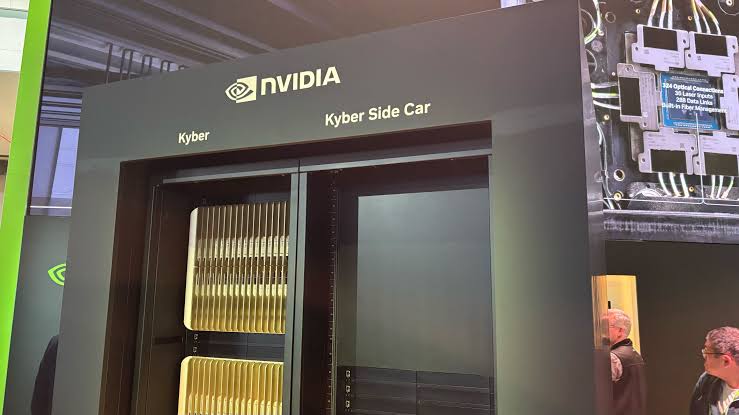
On July 6, semiconductor research firm SemiAnalysis said Nvidia’s Kyber NVL144 rack, personally showcased by CEO Jensen Huang at GTC 2026, has run into a major setback just three months after its debut. According to the report, commercial deployment has been pushed back by more than 12 months to 2028. SemiAnalysis also said the companion NVL72x2 back-to-back rack architecture has been canceled, effectively reducing Rubin Ultra’s NVLink expansion domain. Because the report targets a core piece of Nvidia’s AI infrastructure roadmap, the market treated it as one of the day’s most significant negative catalysts for the broader tech complex.
Viewed in isolation, the update is a product delay. Viewed over the last 30 days, however, it looks more like part of a broader retreat across Nvidia’s next-generation infrastructure stack. On June 10, SemiAnalysis told institutional clients that Nvidia’s native 800VDC power architecture would not ship at scale until after 2028, and that mass production of co-packaged optics, or CPO, could slip to 2028 or even 2029. That report hit U.S. optical names immediately, with AAOI dropping as much as 17% intraday, Lumentum down around 8%, and Himax, Navitas, and Wolfspeed also under pressure. On June 30, the firm followed with another report claiming that the four-die version of Rubin Ultra unveiled at GTC 2026 had been scrapped due to manufacturing execution risk and replaced by a two-die design with roughly half the original compute performance and memory bandwidth.

Why Kyber has become a bottleneck for the supply chain
Kyber is Nvidia’s next-generation rack architecture intended for Rubin Ultra and the later Feynman generation. The key change is structural: compute trays are rotated 90 degrees and inserted vertically into the rack, while an orthogonal backplane PCB replaces the vast amount of copper cabling typically used inside the cabinet. Based on the original GTC 2025 specifications, a single rack could consume as much as 600 kilowatts and would require an entirely new 800VDC power system. That combination sharply increases the difficulty of power delivery, thermal design, materials sourcing, and yield management.
The backplane PCB is considered the hardest part of the system to manufacture. Jefferies previously described the design as requiring a 78-layer stack built on M9-grade materials. Industry observers who examined the GTC 2026 demo unit said a single mid-board carried more than 10,000 connector pins, while the full rack contained over 87,000 NVLink pins. At that density, even one bent pin can render the board unusable. According to the report cited in the article, only two or three suppliers globally are capable of mass-producing this specification, making the supply base extremely narrow.

Jefferies had already warned on June 22 that the Kyber backplane PCB program was likely to be delayed to 2028, with full cancellation as a worst-case scenario. Based on that view, the bank cut its forecasts for the global AI PCB market by 5% for 2027 and 11% for 2028, while reducing its covered copper clad laminate, or CCL, forecasts by 8% and 16%, respectively. On June 23, that warning combined with now-disproven market chatter that Nvidia had asked PCB suppliers for a 10% price cut, sparking panic selling in PCB-related names listed in mainland China and Hong Kong. SemiAnalysis’ latest note is now being interpreted by traders as a stronger confirmation of those earlier concerns.
Nvidia’s roadmap has been repriced in stages over the past month
The reported cancellation of NVL72x2 is as important as the Kyber delay itself. The design had been positioned as a transitional architecture that would connect two racks back-to-back to expand the NVLink domain. If that option is gone, Rubin Ultra in 2027 is now more likely to fall back to the more mature Oberon architecture, essentially the current NVL72 form factor, bringing expansion capability back within the limits of the previous generation. That shift has intensified concerns that Nvidia’s highly public multi-generation roadmap is being reset by manufacturing realities and physical constraints.

Jensen Huang has previously said Nvidia was the first technology company to publish a four-generation product roadmap all at once. The strategy was meant to give the supply chain enough lead time. Data center site selection, power retrofits, and liquid cooling deployments all require long planning cycles measured in years, not months. But the side effect is that the roadmap itself became a tradable asset in public markets. Optical module names were modeled on expected CPO adoption, PCB stocks were valued on the timing of backplane ramp-ups, and power vendors scheduled production around the assumed switch to 800VDC. As those assumptions are pushed out, each revision forces a fresh repricing across entire subsectors.

That is exactly what has happened over the last month. Optical communications, PCB manufacturing, and power infrastructure have each gone through their own selloff and reset in sequence. In that sense, investors are not just reacting to a single delayed product. They are recalculating the pace of Nvidia’s AI infrastructure upgrade cycle and reordering the expected beneficiaries across the supply chain. The timing shift matters not only for shipments, but also for where margin and earnings power could accumulate over the next two years.
Winners and losers are changing as the timeline slips
Based on current market interpretation, copper cable and connector vendors may have received a temporary reprieve. With the lifecycle of the Oberon architecture extended, demand for copper cabling that was supposed to be replaced by backplane PCB solutions is likely to remain in place for longer. Within the framework cited by SemiAnalysis, Amphenol is seen as a relative beneficiary, while Vertiv and Legrand also received more constructive assessments. Compared with more speculative next-generation components, these parts of the chain now look less exposed to timing risk and potentially better positioned for near-term earnings visibility.

The upstream materials story appears more resilient. The article argues that tight supply in fiberglass cloth and CCL is not dependent on Kyber alone, but instead reflects broader industry-wide demand. Copper clad laminate prices have already risen four times in the last six months. In other words, a Kyber delay changes demand mix more than total demand, leaving pricing power largely in the hands of material suppliers. The more direct pain is concentrated in PCB manufacturing, especially among mid-tier players caught between high-end technology leaders with sticky customer relationships and low-end capacity providers with cost advantages. For that middle segment, competitive pressure may intensify further.
Optical communications and the broader CPO ecosystem are also being pushed to the right. Sidecar shipments tied to the Rubin Ultra and Kyber platforms are now expected to move into a 2028 window. SemiAnalysis remains cautious on Lumentum, Himax, Navitas, and Wolfspeed. At the same time, the firm noted that some NPO, or near-packaged optics, projects could accelerate as the industry searches for workable alternatives. That suggests the delay is not simply freezing demand, but redistributing it across different technical routes.

The larger narrative shock falls on Nvidia itself. With Rubin Ultra reportedly cut back and Kyber potentially delayed, some analysts have begun to frame the situation as an early sign that Nvidia’s performance moat may be experiencing marginal erosion. AMD and Google’s TPU ecosystem have been mentioned as possible incremental beneficiaries. For now, that conclusion remains far from proven. Importantly, the reported delays and cancellations cited in the article come from third-party sources including SemiAnalysis and Jefferies, and Nvidia has not officially confirmed them. Supply-chain reports can also change repeatedly. Going forward, the market is likely to focus on two confirmation signals: whether Nvidia directly addresses the Kyber and Rubin Ultra timeline on its next earnings call, and whether Taiwanese ODMs and PCB suppliers begin to show structural changes in order guidance.