
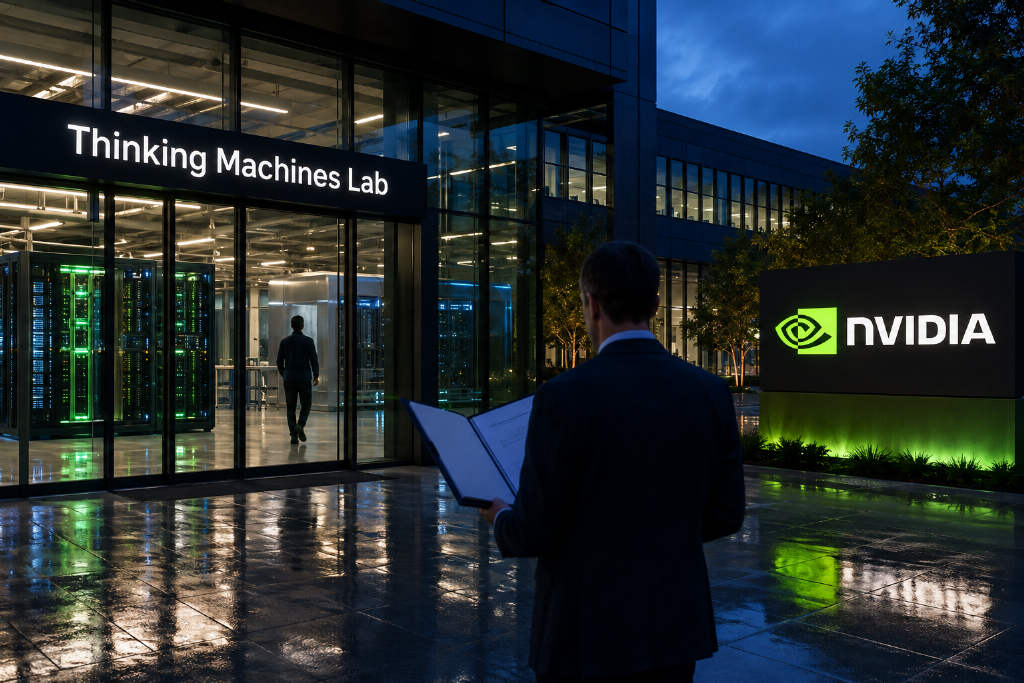
Nvidia is reportedly discussing a fresh investment in Thinking Machines Lab, the startup founded by former OpenAI CTO Mira Murati, with the check said to be worth close to $3 billion.
According to the input material, the company is raising $5 billion to $6 billion at a pre-money valuation of at least $40 billion, and Nvidia could supply roughly half of that total.
Valuation jumps from $12 billion to $40 billion in 14 months
The input says this would not be Nvidia’s first investment in Thinking Machines Lab, but a follow-on commitment.
In July 2025, the startup closed a $2 billion seed round, one of the largest seed financings on record according to the source, at a $12 billion post-money valuation. Andreessen Horowitz led that round, with Accel, Nvidia, AMD and Jane Street participating.
Fourteen months later, the company’s pre-money valuation has climbed to at least $40 billion. If the current $5 billion to $6 billion round is completed, its post-money valuation would reach roughly $45 billion to $46 billion.
The same input says annualized revenue has only just crossed $100 million, putting the company at about 400 times revenue at the $40 billion valuation.
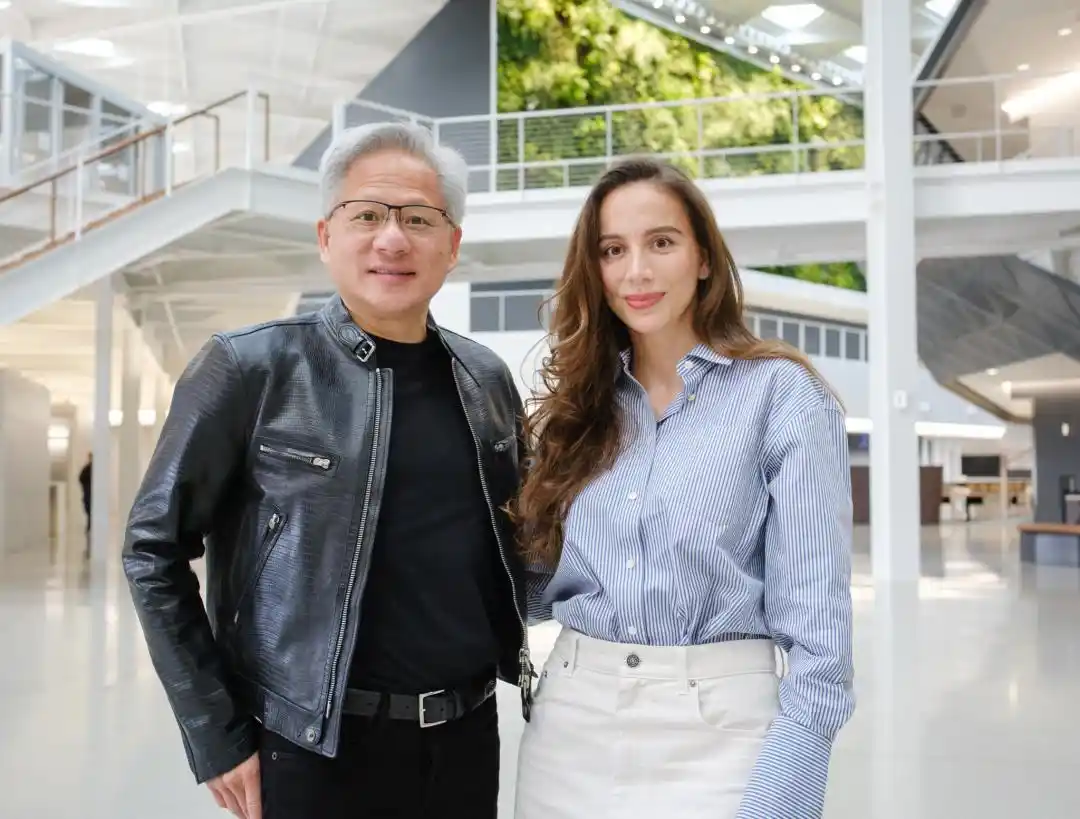
Murati left OpenAI in September 2024
Mira Murati announced her departure from OpenAI in September 2024, according to the input. At the time, she was the company’s CTO and had briefly served as interim CEO during the period when Sam Altman was removed by the board.
About five months later, Thinking Machines Lab emerged. The founding roster cited in the input included Lilian Weng, John Schulman, Barret Zoph and Luke Metz, among other former OpenAI figures.
When the company raised its seed financing in July 2025, the report says it still did not have a mature product in market, and investors were largely backing Murati herself.
Tinker came first, then Inkling
The company later began shipping products.
According to the input, Thinking Machines Lab launched Tinker in October 2025 and opened it fully in December. Tinker is described not as a model, but as a fine-tuning platform. Developers can upload their own data, adapt open-weight models to their needs and pay based on compute usage.
On July 15, 2026, the company released Inkling, its first flagship in-house model. The input lists the following specifications:

- 975 billion total parameters
- 41 billion active parameters
- Up to 1 million tokens of context
- Text, image and audio input support
- Fully open weights
The input also cites the launch blog as saying that 「Inkling is not the strongest model today, whether in open or closed form.」
Nvidia and Thinking Machines announced a 1GW Vera Rubin partnership
On March 10, 2026, Nvidia and Thinking Machines Lab announced a multi-year strategic partnership to deploy at least 1GW of Vera Rubin systems, the input says. Nvidia also made a separate undisclosed investment at that time.
The same source highlights another line from that announcement: the two sides would jointly design training and inference systems built for Nvidia architecture.
The report links the new $5 billion to $6 billion fundraising plan directly to that 1GW buildout. In the input’s description, a 1GW cluster sits at frontier-lab scale, with chips, networking, power and data center infrastructure all needing to be built at that level.
It also says the planned raise was first discussed at around $1 billion before expanding to $5 billion to $6 billion.
Nvidia could become the biggest backer in the new round
In the previous financing, Nvidia was one of several participating investors while Andreessen Horowitz led the deal. This time, the input says Accel is leading and Nvidia may take roughly half of the round, moving from participant to largest capital provider.
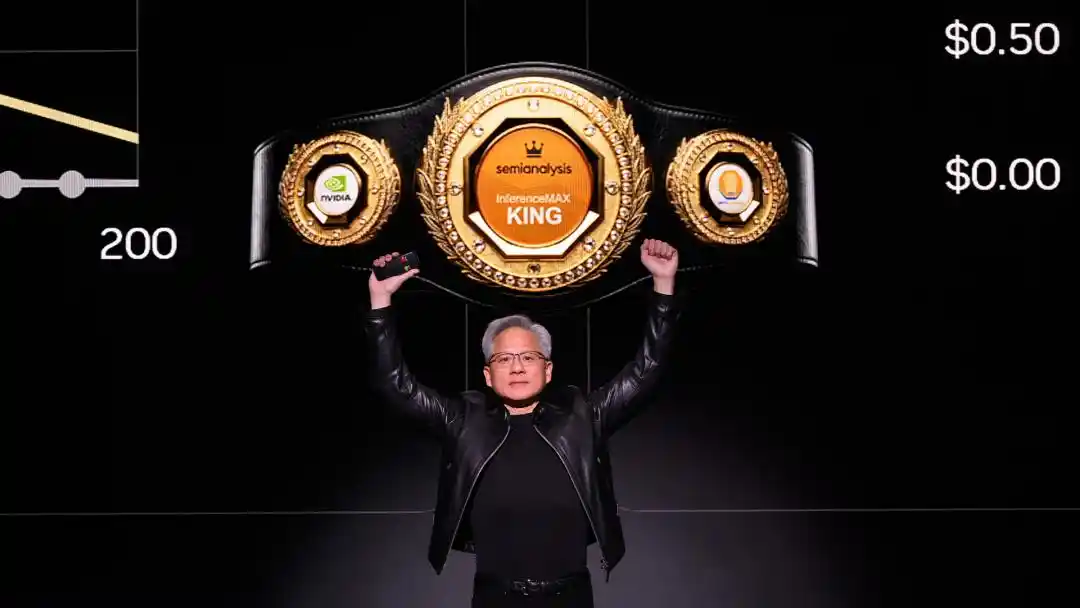
If that structure holds, Nvidia would be both the biggest investor in the financing and the supplier for the 1GW system. The input describes the result as a closed loop: money enters Thinking Machines Lab, and a large portion of it could come back as orders for Nvidia systems.
Nvidia also signed a deal to buy Hugging Face
This is not Nvidia’s only major AI move this month. The input says Nvidia announced on Sept. 3 that it had signed an agreement to acquire Hugging Face for $12.9303 billion.
Placed side by side, the source frames the two assets this way:
- Hugging Face controls an open-model distribution gateway and a developer community
- Thinking Machines Lab brings frontier models, a fine-tuning platform and a research team
The input adds that Inkling’s full weights are hosted on Hugging Face, with an NVFP4 version tailored for Nvidia Blackwell. Developers can download Inkling from Hugging Face, fine-tune it on Tinker, and run it on Vera Rubin systems.
Murati’s strategy centers on customizable AI
The input portrays Murati’s 19-month plan as an effort to avoid a direct race with OpenAI and Anthropic over who has the strongest model.
Under that approach, Thinking Machines Lab’s business model was set when Tinker launched: it sells the ability to make a model your own. Enterprises bring their own data and business workflows to the platform, train, fine-tune and run inference there, and pay based on compute consumption.

The input quotes Murati as saying the company wants to build AI 「that people can shape and make their own.」
That positioning separates Thinking Machines Lab from OpenAI and Anthropic in the source material. Those companies are focused on stronger general-purpose closed models; Thinking Machines is placed one layer below, as infrastructure for customized models.
The input also cites Jensen Huang’s GTC 2026 remarks
According to the input, Jensen Huang said in his March 16, 2026 GTC keynote that demand for compute had risen 「1 million times」 and that revenue from 2025 to 2027 would total at least $1 trillion.
Against that backdrop, the source argues that Nvidia is no longer satisfied with only supplying chips to established AI labs such as OpenAI and Anthropic. It is now using equity stakes to lock in the next generation of frontier players and their future compute demand.
The input lists TechCrunch, The Information, Thinking Machines Lab’s website and Nvidia’s blog as references. It also says the original Chinese article came from the WeChat account Xinzhiyuan, written by ASI Qishilu and edited by Yuanyu.