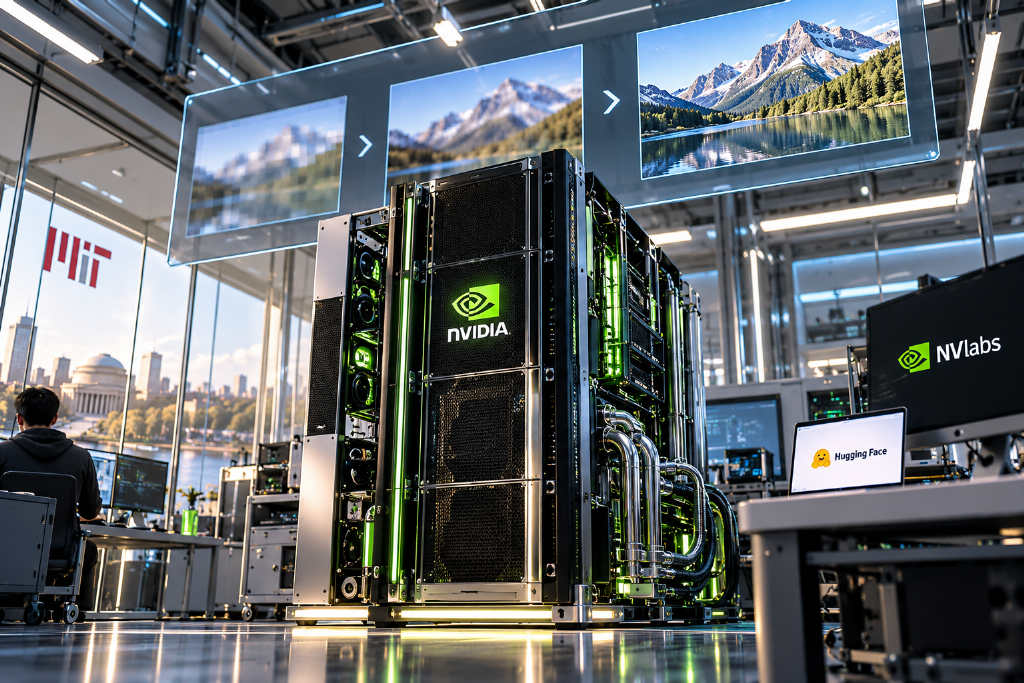
Researchers from NVIDIA and the Massachusetts Institute of Technology, working as the Efficient-Large-Model team, have released the model weights for the video enhancement project Open-H3-Regenerate-2K on Hugging Face, with inference code made available in the NVlabs/Sana repository. Built on MiniMax H3, the system regenerates low-resolution video drafts into higher-resolution output, supporting 2560×1440 2K output and up to native 3840×2160 4K regeneration. According to tests shared by the team, the combined time for latent upscaling, three-step refinement, and 2K decoding for a roughly five-second video on a single NVIDIA B200 GPU fell from 87.26 seconds in an unoptimized implementation to 22.45 seconds, or about 3.9x faster. In image quality testing, Open-H3-Regenerate-2K posted an average UniPercept score of 60.0 on RefinerBench-150, above the official H3-Regenerate-2K API score of 53.4. The update follows MiniMax H3 opening its weights in August this year, after which it recorded more than 24 million downloads in one month and produced more than 300 public derivative models.
The Efficient-Large-Model team, made up of researchers from NVIDIA and the Massachusetts Institute of Technology, has released the model weights for Open-H3-Regenerate-2K on Hugging Face. Its inference code is also available in the NVlabs/Sana repository.
Built on MiniMax H3
The project is based on MiniMax H3 and is designed to regenerate low-resolution video drafts into higher-resolution video. It supports 2560×1440 2K output and can reach native 3840×2160 4K regeneration.
Runtime cut on a single NVIDIA B200 GPU
Tests published by the team show that, on a single NVIDIA B200 GPU, the combined runtime for latent upscaling, three-step refinement, and 2K decoding for a video of about five seconds dropped from 87.26 seconds in an unoptimized implementation to 22.45 seconds. That puts processing speed at about 3.9 times the original level.
Higher UniPercept score than the official API
On image quality, Open-H3-Regenerate-2K recorded an average score of 60.0 on the UniPercept perceptual quality benchmark in RefinerBench-150, above the 53.4 posted by the official H3-Regenerate-2K API.
MiniMax H3 adoption data
MiniMax H3 opened its weights in August this year. Within one month, it logged more than 24 million downloads and generated more than 300 public derivative models, making it one of the most downloaded models globally in 2026.
Alongside this video enhancement release, the team also introduced StreamRender-H3, a streaming video rendering model built on H3 Ref2VA, and Sol-H3-VAE, a fast decoder distilled from the H3 video VAE.
The item was cited from QbitAI and published in summary form by Techub.
This article was originally published by Bit.Fan. For more cryptocurrency news and market insights, visit www.bit.fan. Disclaimer:
The market information, project data, and third-party content displayed on this platform are for industry information sharing only and do not constitute any form of investment advice or return commitment.
Cryptocurrency trading carries high risks. Users should fully assess their risk tolerance and make independent decisions. All profits, losses, and legal responsibilities are borne by the users themselves.