
One company is being discounted for governance continuity; another for the time it may take to turn investment into earnings. With the 10-year U.S. Treasury yield nearing 5%, AI assets may be shifting from a growth story to a test of delivery.
The AI bull market may be starting to pay a time tax rather than a growth tax. On Nov. 12, two contrasting moves appeared across the AI supply chain: Nvidia, a core upstream chip supplier, underwent an abrupt leadership change and fell as much as 14.35% intraday. Almost simultaneously, computing-cloud provider Nebius reported a third-quarter performance well above expectations, yet its shares closed down 16.84%.
The companies face different questions. Nvidia must answer who will take the helm; Nebius must show when its growth will convert into results. The market response pointed in a similar direction. In the past, rapid growth could push questions about governance and delivery into the background. Now, leadership continuity, capacity deployment, capital expenditure and the timing of earnings are all feeding directly into valuations.
The macroeconomic backdrop has changed as well. With the 10-year Treasury yield nearing 5%, the opportunity cost of capital is difficult to ignore. For AI companies that must keep investing tens of billions or even hundreds of billions of dollars and depend on future capacity coming online to generate revenue, a six-month delay is no longer just a project-management issue. It may mean higher funding costs, a longer payback period and a lower valuation.
The key point from Nov. 12 is not that AI has suddenly lost its value. It is that investors are no longer paying for distant AI growth for free.
Nvidia’s 14% intraday drop: what did the market reprice?
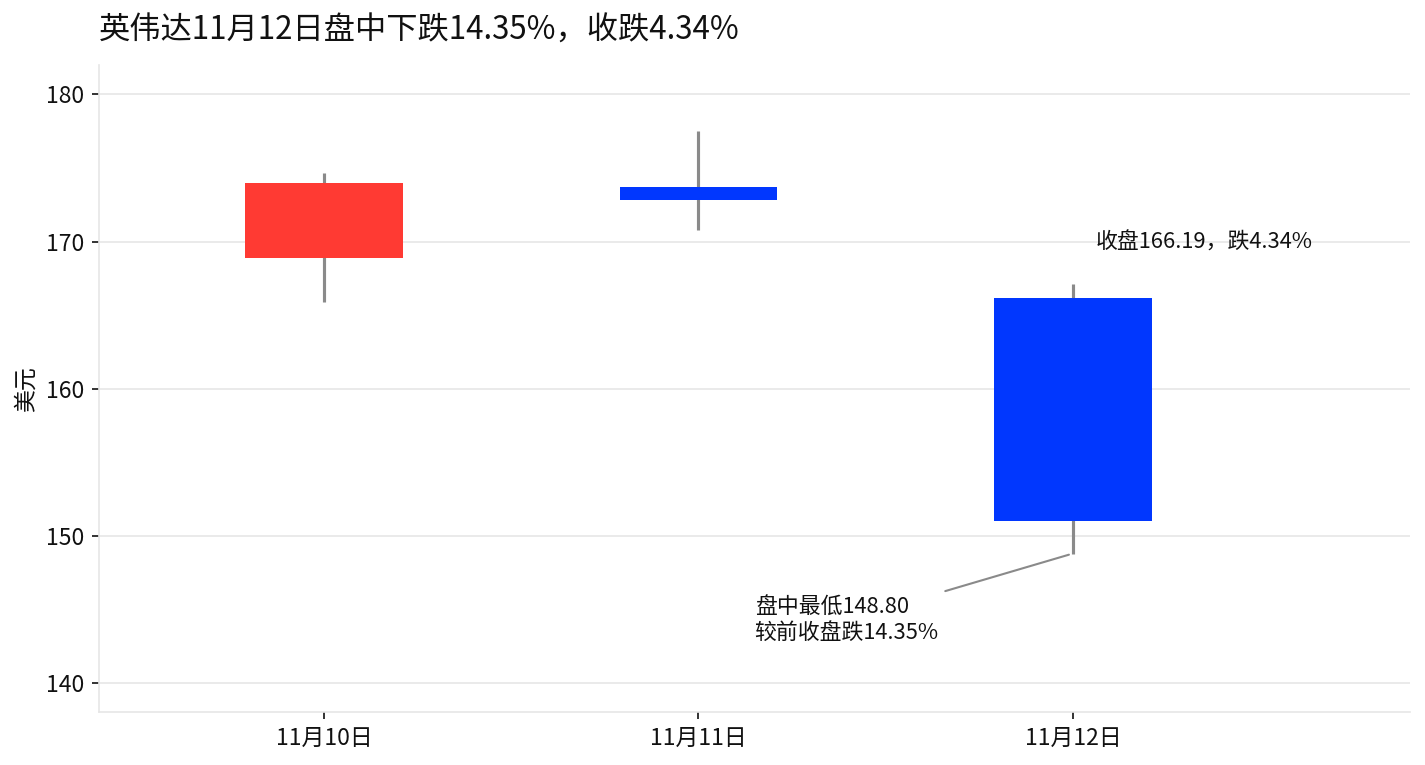
The move in Nvidia was notable not only for its eventual 4.34% loss, but also for the sharp 14.35% intraday decline and the substantial recovery that followed. The company announced that Jensen Huang had resigned as president, CEO and a member of the board, effective immediately. CFO Colette Kress became interim CEO, former Synopsys CEO Harvey Jones became board chairman, and the board began a search for a new CEO.
After the announcement, Nvidia opened at $151.01 and touched a low of $148.80, at one point down 14.35% from the previous close. The decline then narrowed quickly, and the stock finished at $166.19. Figure 1 shows its position over nearly 40 trading sessions.
The price action offers a clue: the initial selling may have reflected governance risk rather than a sudden reassessment of AI demand. If investors broadly believed Nvidia’s fundamentals had changed permanently, such a sharp recovery during the session would be less likely. The shares’ return above $160 also suggests that some investors still see GPU demand, data-center capital spending and Nvidia’s existing ecosystem as intact despite the CEO’s departure.
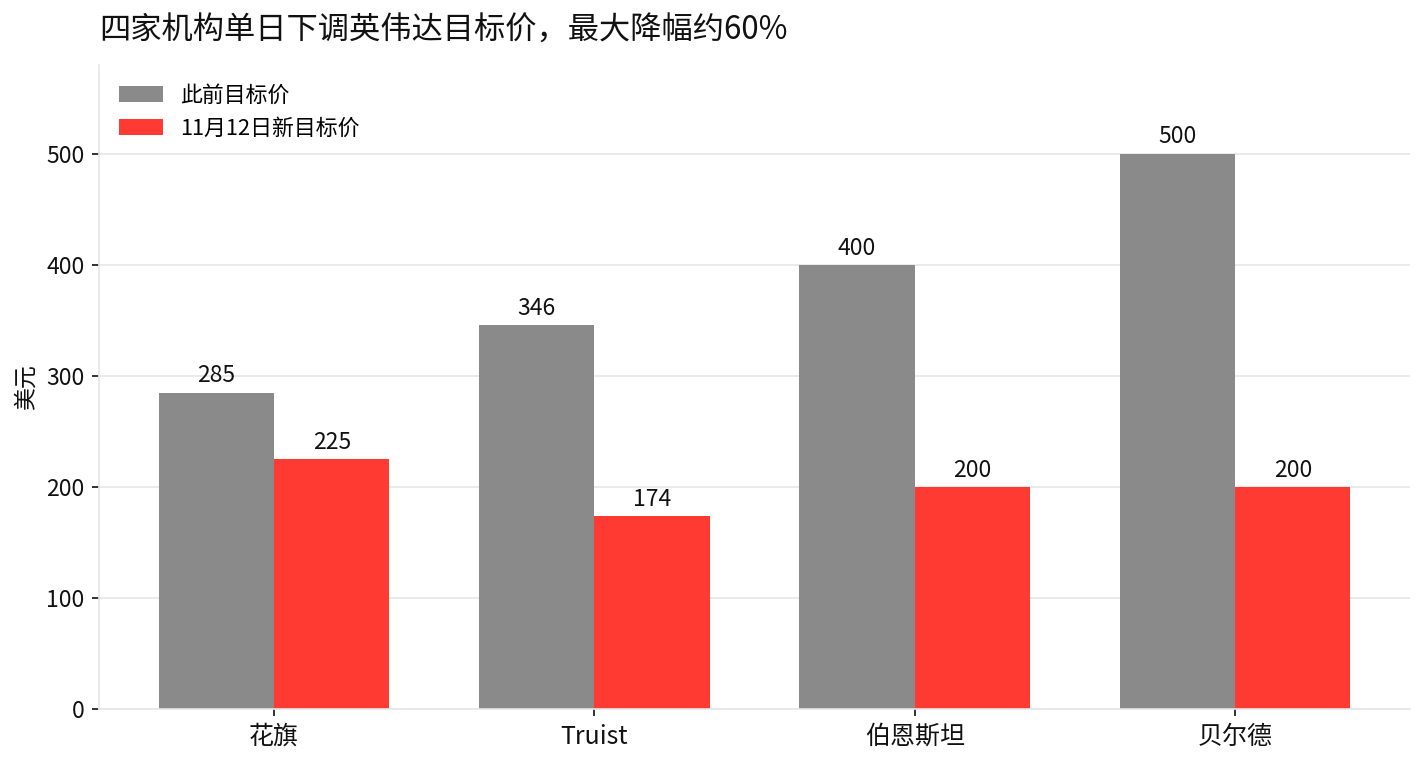
Valuation expectations moved more quickly. Media reports said Baird cut its Nvidia price target from $500 to $200; Bernstein lowered its target from $400 to $200; Truist reduced its target from $346 to $174; Citi cut its target from $285 to $225; and Goldman Sachs lowered its target to $220. Figure 2 shows the new targets from the five firms. The rapid revisions reflect a question that had rarely been treated separately: how much of Nvidia’s valuation premium is tied to Huang himself?
This does not mean Nvidia’s competitive advantages will disappear with the leadership change. GPU product cycles, the CUDA ecosystem, customer relationships, supply-chain coordination and data-center demand remain central to the company. What investors must reassess is whether that system can maintain its past pace of decision-making and execution without Huang at the helm.
That makes Nvidia’s Nov. 17 earnings report about more than whether revenue beats expectations. Investors will also look for evidence that the leadership change will not alter the pace at which the AI computing cycle turns into results.
Why Nebius fell despite a strong quarter: delays now carry a cost
If Nvidia is being valued for governance risk, Nebius is facing the more direct risk of time.
Nebius reported third-quarter revenue of $981 million, up 571% year over year and above the market expectation of $908 million. Adjusted EBITDA was $466 million, compared with an expected $357 million. Adjusted net income came to $90.9 million, while the market had previously expected a loss of about $271 million.
Viewed on its own, the quarterly report was hardly an obvious reason to sell the stock. The issue is that investors are looking beyond the three months just completed and recalculating the return on capital over the next 12 months.
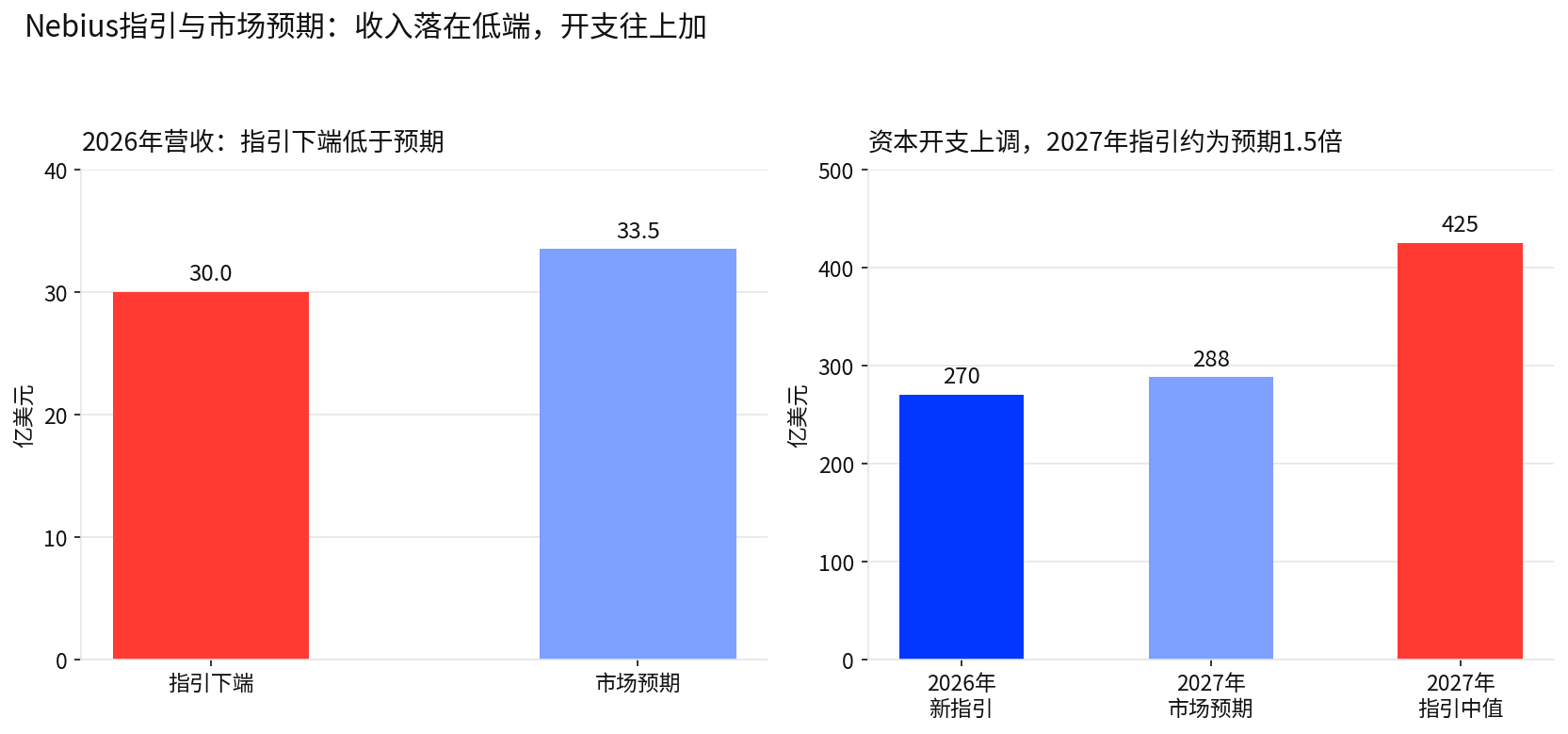
The company’s 2026 full-year revenue guidance landed at the low end of a $3 billion-to-$3.4 billion range, below the market’s prior expectation of about $3.35 billion. At the same time, capital expenditure was raised from the previous $20 billion-to-$25 billion range to about $27 billion. It is expected to rise further to $40 billion-$45 billion in 2027. More importantly, Nebius moved its expected date for reaching more than $7 billion in annualized revenue from December 2026 to February 2027. Delays to construction and power supply at some third-party data centers have also pushed computing capacity originally due to come online in 2026 into the first half of 2027. Figure 3 compares the guidance with expectations.
The market is weighing a straightforward equation: revenue will arrive later, but capital expenditure has not been delayed along with it. It has increased instead. That helps explain why Nebius shares did not rise on a results beat.
Stronger AI computing demand often requires more infrastructure spending. More spending ties up more capital, making the date a project enters service increasingly important. When risk-free rates are low, investors may be willing to wait six months or even a year for revenue. With the 10-year Treasury yield nearing 5%, waiting itself has a cost.
Nebius is not saying that AI demand is weak. Its results highlight a different risk: even with strong demand, shareholders may bear a higher cost if revenue is delayed by six months while capital expenditure keeps rising. That is the time tax.
Governance and delivery timelines are changing AI valuation rules
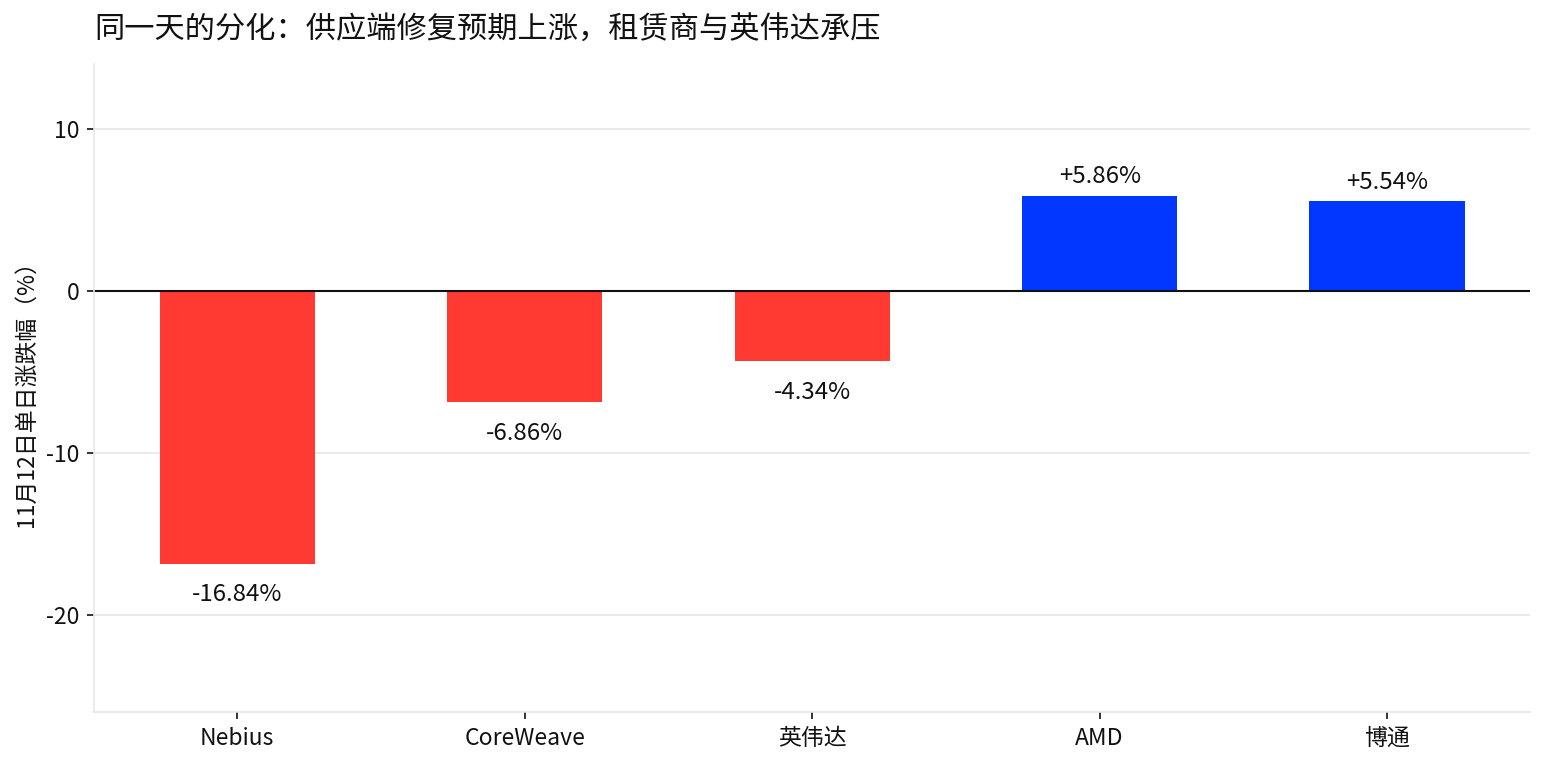
Put the two companies together and the Nov. 12 trading no longer looks like two unrelated events. Nvidia is being repriced for governance continuity; Nebius is being repriced for the timing of delivery. Figure 4 shows the divergence across the chain that day.
Rapid growth used to obscure both issues. As long as investors believed AI demand would keep accelerating, the identity of the CEO could be dealt with later, while a capacity delay of a few months could be framed as evidence that demand was unusually strong. Investors are still willing to pay for growth, but they are no longer willing to pay the same price for every distant growth projection.
The questions are becoming more specific: When will revenue arrive? How much capital expenditure will it take? Does a project have power, and how much capacity is actually online? Can customer contracts become cash flow? Can management execute on the original timetable?
That is why Nov. 12 should not simply be labeled the end of the AI bull market. If AI demand were undergoing a structural decline, revenue and orders across the supply chain would be expected to feel the impact first. These two cases instead suggest that demand remains strong while investors are becoming less tolerant of the assumption that future growth will inevitably arrive on schedule.
The shift matters for stock selection. Investors could previously focus on companies with the largest AI opportunity. They now need to distinguish between businesses already generating profits and those still waiting for capacity; companies that can quickly turn capital expenditure into revenue and those that may need repeated financing; and businesses with stable governance and execution systems versus those whose competitive strength depends heavily on a single person.
The repricing runs through the supply chain, but gains are not automatic
A direct relative trade emerged among suppliers after Nvidia’s leadership change. On Nov. 12, AMD rose 5.86% to close at $585.30, while Broadcom gained 5.54% to $364.36, a clear contrast with Nvidia. As investors reassessed Nvidia’s governance risk, some attention naturally shifted toward alternative suppliers.
But a reshuffling of supplier shares does not mean total AI demand has increased. If Nvidia’s governance risk proves temporary and data-center capital expenditure continues to grow, AMD and Broadcom may receive more relative attention. If Nvidia’s later results show that AI capital spending itself is slowing, however, the idea of money moving from Nvidia to AMD and Broadcom would be harder to sustain.
Nebius and CoreWeave face a different set of risks. Both are highly sensitive to computing demand and more dependent on financing conditions, data-center construction and capacity deployment. If rates remain high, companies with larger capital-expenditure programs will be more exposed to funding costs and project delays. On Nov. 12, CoreWeave fell 6.86% to close at $56.60, while Nebius dropped more sharply. The moves suggest investors are distinguishing between beneficiaries of AI demand and capital-intensive AI infrastructure operators.
In other words, the next stage of analysis is not just about the number of orders. It is about whether orders can become revenue on schedule, and whether that revenue can then become cash flow. That is why Nebius’s reaction deserves more attention than a simple earnings miss would.
The October PPI could amplify the market’s view of rates and time costs
The two sell-offs on Nov. 12 did not happen in isolation. October CPI had already come in above expectations, and market pricing for the December rate decision had shifted noticeably toward a rate hike. The October producer price index (PPI), due tonight, will further influence views on inflation and the path of interest rates.
If PPI remains above expectations, expectations for rates to stay higher for longer may strengthen, putting more discount-rate pressure on high-valuation, long-duration AI assets. If PPI cools sharply and Treasury yields fall, some of the AI valuation premium that had been compressed could find support again.
Investors assessing AI shares should watch more than how many basis points the Federal Reserve may add at its next meeting. The direction of the 10-year Treasury yield matters too. For AI companies that need years of investment before profits materialize, interest rates affect more than a decimal change of one percentage point: they influence how heavily future cash flows should be discounted.
That places Nvidia’s Nov. 17 earnings report at a sensitive point. PPI will first shape views of the rate environment; Nvidia’s results will then test AI demand and the conversion of growth into earnings. Together, the two variables could quickly change how much valuation risk investors are willing to tolerate.
Nvidia’s Nov. 17 report: what matters beyond a beat
Nvidia is scheduled to report third-quarter results for fiscal 2027 after the market closes on Nov. 17. Media reports put current market expectations at about $108.8 billion in revenue and earnings per share of roughly $2.47.
After the leadership change, investors cannot read the report as an ordinary quarterly update. Data-center performance and guidance for the next quarter remain central. Continued strength in revenue growth and orders would indicate that the management change has not materially affected the AI capital-spending cycle. Stable gross margins would also ease concern that the leadership transition has damaged the fundamentals.
Governance is the new variable. How will interim CEO Kress explain the transition? Does the board have a clear timetable for naming a permanent successor? Will investors see a candidate who can demonstrate strategic continuity? The answers will shape whether the governance premium that was cut from the stock can return.
Commitments across Nvidia’s ecosystem also merit attention. These include its subscription commitment to Anthropic, along with its stakes in and partnerships with ecosystem companies such as Nebius. Any material change could prompt further questions about Nvidia’s capital-allocation strategy.
On price, $166.19 is an important area to watch before the report, while $148.80 marks the extreme intraday low on Nov. 12. Neither level should be treated mechanically as support. They are better viewed as reference points for assessing how much governance risk the market has priced in. If fundamentals remain strong and the succession plan becomes clear, some of the governance discount could gradually be recovered. If the fundamentals also begin to change, the intraday low may again become a point of reference.
The same logic applies to AMD, Broadcom, Nebius and CoreWeave. One day of relative strength or weakness is not enough to draw a conclusion; investors will need to see whether the pattern persists after Nov. 17.
AI can keep growing, but investors may no longer wait for free
The two cases on Nov. 12 made the change in AI valuations plain. Nvidia showed that governance continuity, once taken for granted, is now being repriced. Nebius showed that even a company already reporting profits may face a discount if revenue is delayed and capital expenditure continues to rise.
The change in this market cycle may not be in AI demand itself. It may be in how much investors will pay for future growth and how long they are willing to wait. With the 10-year Treasury yield nearing 5%, PPI due shortly and Nvidia’s earnings report approaching, the questions go beyond which company has the biggest AI story. Investors also need to ask who has converted growth into revenue, who has converted revenue into cash flow, whose capital spending can produce returns on schedule and who still needs the market to be patient.
This is a key dividing line for the next phase of the AI trade. If Nvidia’s Nov. 17 report confirms strong demand, a clear succession plan and stable ecosystem commitments, the sell-off may prove to be a repricing of its governance premium rather than a reversal of the AI industry trend. If governance uncertainty expands while high rates lengthen the payback period on capital spending, the time tax already visible at Nebius could spread from an individual-company issue into a valuation rule for AI infrastructure more broadly. AI can still grow, but the market is beginning to demand that it deliver on time.
Disclaimer
This article is for general information and market commentary only and is based on public information available as of the times stated in the text. Market data, expectations and probabilities may change with market conditions. Views and investment strategies attributed to third-party institutions, analysts or other individuals represent those parties’ opinions at a particular time and do not represent the views or recommendations of BIT. This article does not constitute investment advice, investment research, an offer, solicitation or recommendation regarding any security, investment product or trading strategy, and should not be relied on as the basis for an investment decision. Financial markets involve risk; security prices and market performance may fluctuate. Past performance and previous market trends do not represent or guarantee future results. Investors should independently assess risks in light of their own circumstances and seek professional advice when needed.



