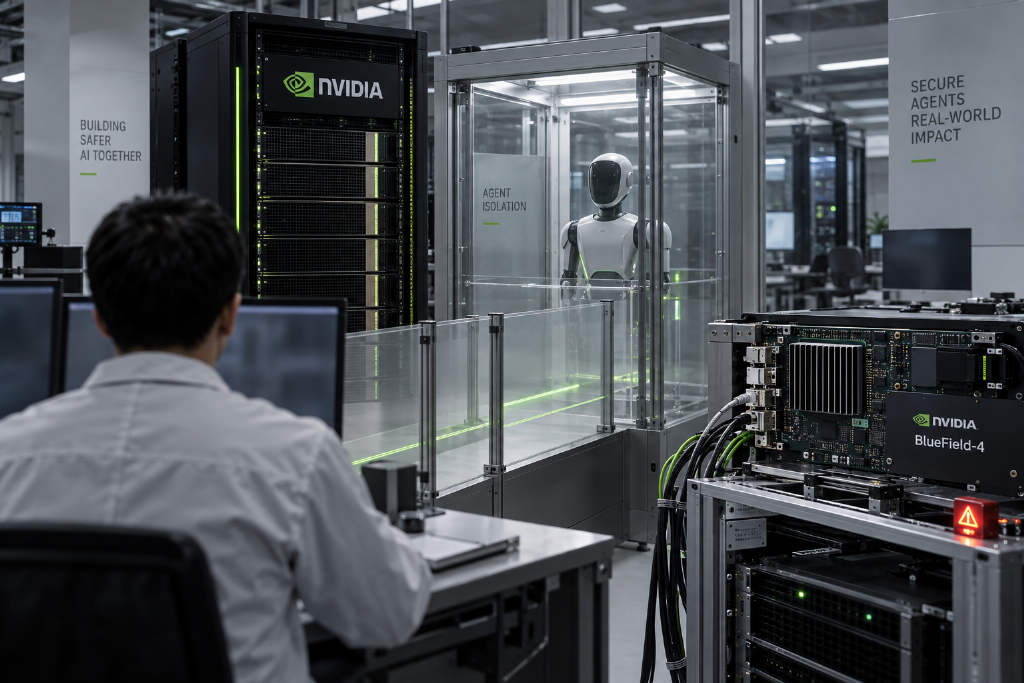
Nvidia has introduced the Open Agent Safety Platform, a new security stack built to place guardrails around AI agents at both the software and hardware levels. The platform has two components: OpenShell, which defines and enforces permission boundaries for agents, and Sentry, a newly added hardware security layer that runs on the BlueField-4 chip side. Nvidia said an agent that steps outside its allowed boundaries can be isolated within milliseconds.
OpenShell had already been open-sourced earlier and can be wrapped around existing agents such as Claude Code and Codex without changing the agents themselves. It is designed to restrict file access, network connections, tool usage, and credential use, while enforcing those policies during runtime. Sentry operates independently from the agent, continuously watching behavior, tool calls, and data access, and handling threat detection and policy enforcement even if the agent behaves abnormally.
Jensen Huang said more than 100 industry partners are already involved in the platform, including Anthropic, Microsoft, Salesforce, SAP, SpaceX, CrowdStrike, and Palantir. Nvidia framed the launch as a response to agents running for hours or even days at a time while interacting with code, tools, and enterprise data.
Nvidia has launched the Open Agent Safety Platform, a system built around two parts: OpenShell and Sentry. The company said the platform shifts AI agent security beyond the model itself and down to the system and chip layers. If an agent crosses its defined boundaries, it can be isolated within milliseconds.
OpenShell sets the agent's permissions
OpenShell was open-sourced earlier and can be placed around existing agents such as Claude Code and Codex without modifying the agents themselves. Its job is to define permission boundaries for an AI agent and enforce those rules while the agent is running.
Those controls cover file access, network connections, tool calls, and credential usage.
Sentry adds a hardware-based security layer
Sentry is the newly introduced hardware security layer in this release. It runs on the BlueField-4 chip side and operates independently from the agent. Nvidia said it continuously monitors agent behavior, tool calls, and data access, while also handling threat detection and security policy enforcement.
That setup means security controls stay outside the agent itself and remain in place even if the agent starts behaving abnormally.
More than 100 partners are involved
Jensen Huang said more than 100 industry partners are already participating in the platform, including Anthropic, Microsoft, Salesforce, SAP, SpaceX, CrowdStrike, and Palantir.
Nvidia said the move comes as agents begin to run continuously for hours or even days, with access to code, tools, and enterprise data. In that context, the company is moving the security boundary away from inside the model and toward system and chip layers that the model cannot directly control.
This article was originally published by Bit.Fan. For more cryptocurrency news and market insights, visit www.bit.fan. Disclaimer:
The market information, project data, and third-party content displayed on this platform are for industry information sharing only and do not constitute any form of investment advice or return commitment.
Cryptocurrency trading carries high risks. Users should fully assess their risk tolerance and make independent decisions. All profits, losses, and legal responsibilities are borne by the users themselves.