
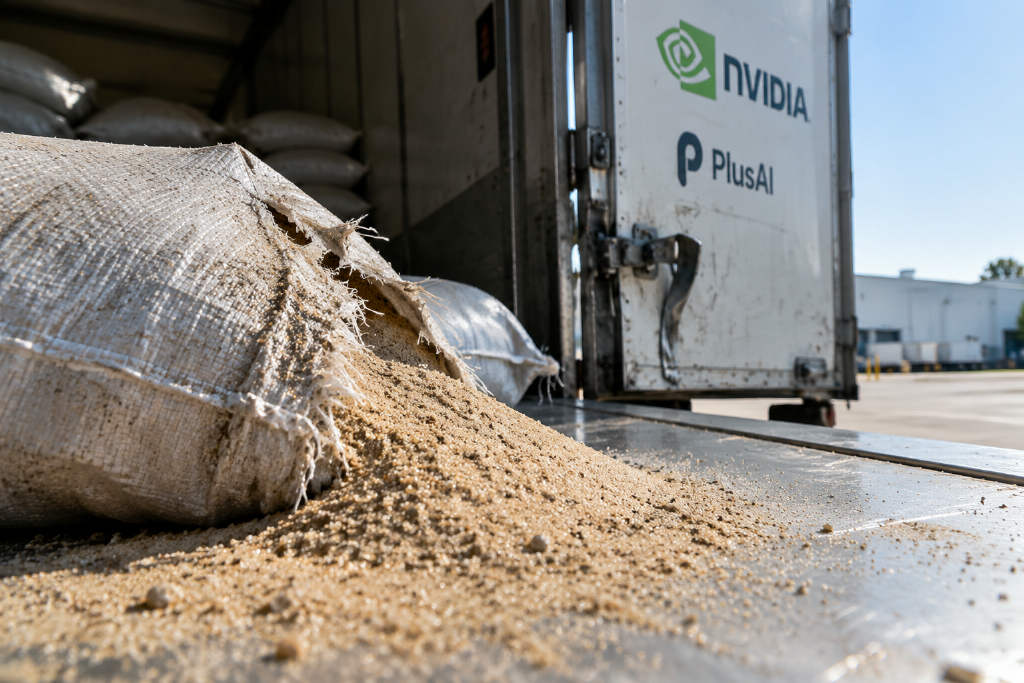
Two trailers bearing Nvidia and PlusAI logos were stolen in California, but the thieves found no high-priced AI hardware when they forced them open. Inside were 40,000 pounds of sand. WIRED recently reported that the theft came to light on the morning of Sept. 24.
According to the report, a PlusAI executive received a text message from an acquaintance saying, “I’ve always been proud of your adventure and success at Plus. I just saw your two trucks near where I work!” The acquaintance’s office was in Newark, California, while the trailers were supposed to be parked about half a mile, or roughly 800 meters, away outside the company’s warehouse.
Police later helped recover the trailers. PlusAI spokesperson Lauren Kwan told WIRED that the company uses simulated payloads in the trailers to support research and testing. When they were recovered, “40,000 pounds of sand were intact,” she said, with about 20,000 pounds in each trailer. The trailers had been secured with hand locks, and the locks had been broken.
Fremont police spokesperson Amy Gee said the case is under investigation and no arrests have been made. The trailers were returned to PlusAI that afternoon. Nvidia did not immediately respond to a request for comment.
Why the trailers were carrying sand
PlusAI said autonomous trucks need to be tested under full-load conditions because payload weight changes braking distance, turning behavior, and how the vehicle responds to road conditions. The sand was there to simulate the weight of real cargo.
Kwan said the tractor units that actually carried the self-driving technology, including the cab, were parked inside the warehouse and were not stolen.
PlusAI’s self-driving stack and Nvidia partnership
PlusAI’s SuperDrive 6.0 autonomous driving system runs on multiple Nvidia system-on-chips, including DRIVE Orin and Thor. In March, the two companies said they were expanding their partnership: Nvidia’s Alpamayo foundation model would handle AI inference and decision-making, DRIVE Hyperion would provide hardware integration, and Halos would cover safety.
PlusAI is also working with truck manufacturer International to build factory-produced Level 4 autonomous trucks equipped with lidar, radar, cameras, and Nvidia DRIVE AGX Thor system-on-chips. In simple terms, Level 4 means the truck can operate without human takeover on specific routes and under defined conditions. The target is to begin driverless commercial operations in 2027 using autonomous trucks built at the factory level.
Fewer thefts, larger losses
The sand theft may have ended in embarrassment for the thieves, but the risk around high-value technology cargo is real. Verisk CargoNet’s Q2 2026 report showed 677 supply-chain thefts across the U.S. and Canada, down 26% from a year earlier. Estimated losses, however, reached $304.6 million, compared with $135.7 million in the same period last year, more than doubling.
The average loss per incident was $564,009. That stands in sharp contrast to the limited value of the 18 metric tons of sand inside these two trailers.
A lower case count paired with much higher losses suggests thieves are choosing targets more precisely. The report identified enterprise computers and networking equipment, components, and cryptocurrency mining machines as technology targets, with individual loads often worth millions of dollars.
WIRED also said thieves this year had targeted Tesla batteries and various Bitcoin mining machines, and many of those cases remain unsolved.
Tactics are changing as well
In a separate August report, WIRED described two California cases in which thieves deliberately rammed security vehicles escorting high-value technology cargo. In one case, a vehicle was rear-ended and the driver fled. In the other, a vehicle was forced off the road using a PIT maneuver, a tactic police use to stop pursuits.
Both shipments were traveling from Silicon Valley to Southern California. As of August, data-center equipment worth millions of dollars had still not been recovered.
The most valuable cargo usually does not advertise itself
The report also said technology shipments worth millions of dollars often move through supply chains as ordinary dry freight. They carry no logos and no obvious markings, blending in with standard containers.
According to Lewis, the groups behind the biggest losses care about selecting the right load. In this case, the thieves appear to have chosen based on branding on the trailers and ended up taking the least valuable shipment available.
The episode shows a simple point: real AI hardware shipments tend to rely on discretion, not visibility.