
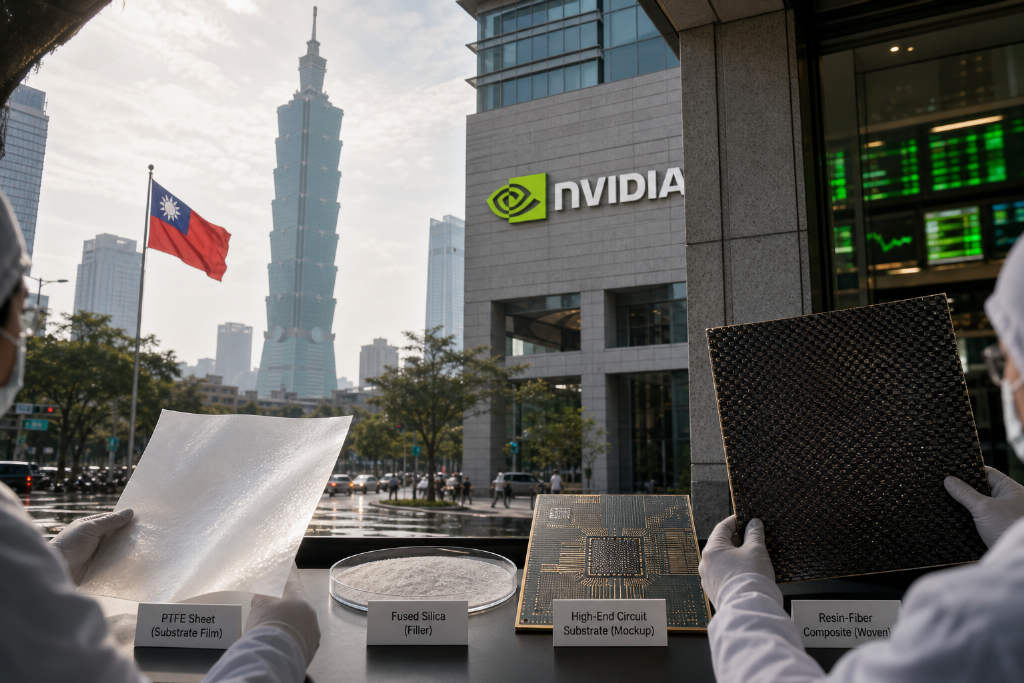
PTFE-related stocks in Taiwan extended their rally as investors zeroed in on a possible materials change linked to NVIDIA’s next-generation AI computing platform, Rubin Ultra. Taimide Tech Co. (8039) and Asia Electronic Material Co. (4939) were locked at the daily limit at the open for a third straight session, hitting record highs of NT$352.5 and NT$86.6. Their gains for the month reached 108% and 76%, respectively. Other names also moved higher, including copper clad laminate, or CCL, makers EMC and ITEQ, as well as printed circuit board, or PCB, companies Fuljo and Gold Circuit Electronics.

The catalyst cited by the report was a single theme: a shift in the material evaluation process for Rubin Ultra’s substrate design.
Why PTFE is back in focus
PTFE, or polytetrafluoroethylene, has long been used in high-frequency cables and aerospace communications. It has returned to the spotlight because two electrical properties have become especially valuable in the AI era: fast signal propagation and low dielectric loss.
For AI server interconnect systems handling signals in the hundreds of Gbps, those properties affect whether overall computing performance can be used efficiently. As AI servers keep pushing signal frequency and transmission speed higher, the traditional M9 resin plus quartz cloth, or Q cloth, approach is increasingly seen as nearing its physical limit. That has moved PTFE from a niche material to one of the main candidates for next-generation high-speed substrates.
Rubin Ultra review drives the trade
According to market information compiled by semiconductor technology researcher @stfbutnou, NVIDIA is evaluating a filmless route for the orthogonal backplane in Rubin Ultra. That route would use PTFE with silica filler instead of the long-standing M9 resin plus Q cloth combination. Final material selection is expected in the fourth quarter of 2026.
@stfbutnou pushed back on the market claim that PTFE will fully replace glass fiber cloth. In that view, the two are not mutually exclusive and can coexist in different applications. Another source cited in the report described the supply chain review as a broader shift toward division of labor across materials and mixed lamination processes.
- Boards built mainly for signal transmission, including backplanes, switch trays, midplanes and LPU-related boards, are considered better suited to PTFE because signal integrity matters more than mechanical strength in those products.
- Boards carrying logic chips such as GPUs and LPUs still need glass fiber-reinforced materials because mechanical strength and control of the coefficient of thermal expansion remain critical.
- High-end HDI layers currently cannot use PTFE.
Leaked technical details cited in the report showed that the Rubin Ultra switch tray uses two rounds of N+N lamination, with copper paste interconnecting the layers. The diffusion layer uses PTFE with second-generation glass fiber cloth and fourth-generation copper foil, while the middle layer uses PTFE with Q cloth and fourth-generation copper foil. Overall signal loss was said to be better than in earlier designs.
On cost, @stfbutnou said PTFE-based PCB pricing is about RMB 90,000 to RMB 100,000 per square meter, while CCL is about RMB 2,200 per sheet. That is above the current Q cloth plus M9 approach, but the premium is described as reflecting measurable low-loss benefits.
PTFE concept names across CCL and PCB
CCL makers
Taimide Tech (8039) was described as a new PTFE materials entrant in Taiwan. Its in-house PTFE material is now under customer qualification. If the process goes smoothly, mass production could begin as early as 2027, and the company could become the world’s second-largest PTFE CCL supplier after China-based Shengyi Technology. The report said foreign investors have recently shifted from a bearish to a bullish stance, while the three major institutional investor groups have posted consecutive net buying.
Asia Electronic Material (4939) has developed M10-grade PTFE material and paired it with its existing M9 prepreg to launch a Hybrid Coreless solution, which was submitted to customers for validation in the second quarter. The company is also extending PI film, filler dispersion and precision coating technologies to develop an anti-warp balance film for advanced packaging. Test results are expected in the second half of 2026, with revenue contribution projected after 2027.
EMC (2383) announced in August 2026 that it had started a three-party strategic cooperation with Taimide and Unimicron to jointly develop PTFE hybrid materials that meet NVIDIA specifications. The report described EMC as one of the earliest Taiwanese CCL makers to enter the technical cooperation stage.
ITEQ (6213), a high-frequency and high-speed CCL maker with accumulated material expertise, also benefited from the PTFE theme. Its shares were locked at the daily limit for two straight sessions before slipping 2.92% on the latest day mentioned in the report.
PCB makers
Unimicron (3037) has joined the PTFE hybrid material cooperation project with EMC and Taimide, making it one of the more strategically placed PCB beneficiaries in the current theme, according to the report.
Fuljo (1815) and Gold Circuit Electronics (2368) were lifted by the broader bullish mood in PCB stocks, with one-month gains of 78% and 19%, respectively.
Qualification race remains at an early stage
The report also drew a clear line between market pricing and operating reality. All Taiwanese suppliers discussed are still in the customer qualification stage, and none has secured confirmed mass-production orders yet.
It said the rally rests on two reinforcing factors.
- U.S. customers want a more diversified supply chain. NVIDIA does not want to rely entirely on Chinese suppliers for PTFE CCL. If Taiwanese companies pass qualification, they could win share from a market now led by Shengyi Technology.
- PTFE comes with a real technical barrier. PTFE lamination requires high-temperature, high-pressure processing and is not compatible with the low-temperature process used for traditional FR-4. Qualified lamination capacity is therefore scarce. High-performance copper foil, defined here as low surface roughness and high hardness foil, could also become a supply bottleneck. The speed of capacity expansion in both areas will shape how much demand Taiwanese suppliers can eventually take on.
Three variables to watch
@stfbutnou highlighted three points that the market still needs to track closely.
- The final material decision for Rubin Ultra’s switch tray. The report expects that in the fourth quarter of 2026. That decision will determine whether the PTFE theme holds and which companies stand to benefit.
- The pace of supplier qualification in Taiwan. Taimide’s qualification outcome was described as a milestone case for Taiwan’s CCL supply chain, with a clearer answer unlikely before 2027.
- The expansion speed of PTFE, copper foil and lamination capacity. Even if the material path is confirmed, output growth will still depend on capacity and yield.
The report’s broader point was that PTFE’s rise does not amount to a simple, one-material replacement story. The direction instead appears to be toward application-specific and mixed-material substrate design. PTFE has the clearest advantage in boards built mainly for signal transmission, while glass fiber-reinforced materials remain necessary where mechanical strength and CTE control matter.
For now, the sharp market response reflects pricing around the possibility of supply-chain reshaping after successful qualification, rather than booked orders or installed production capacity.